
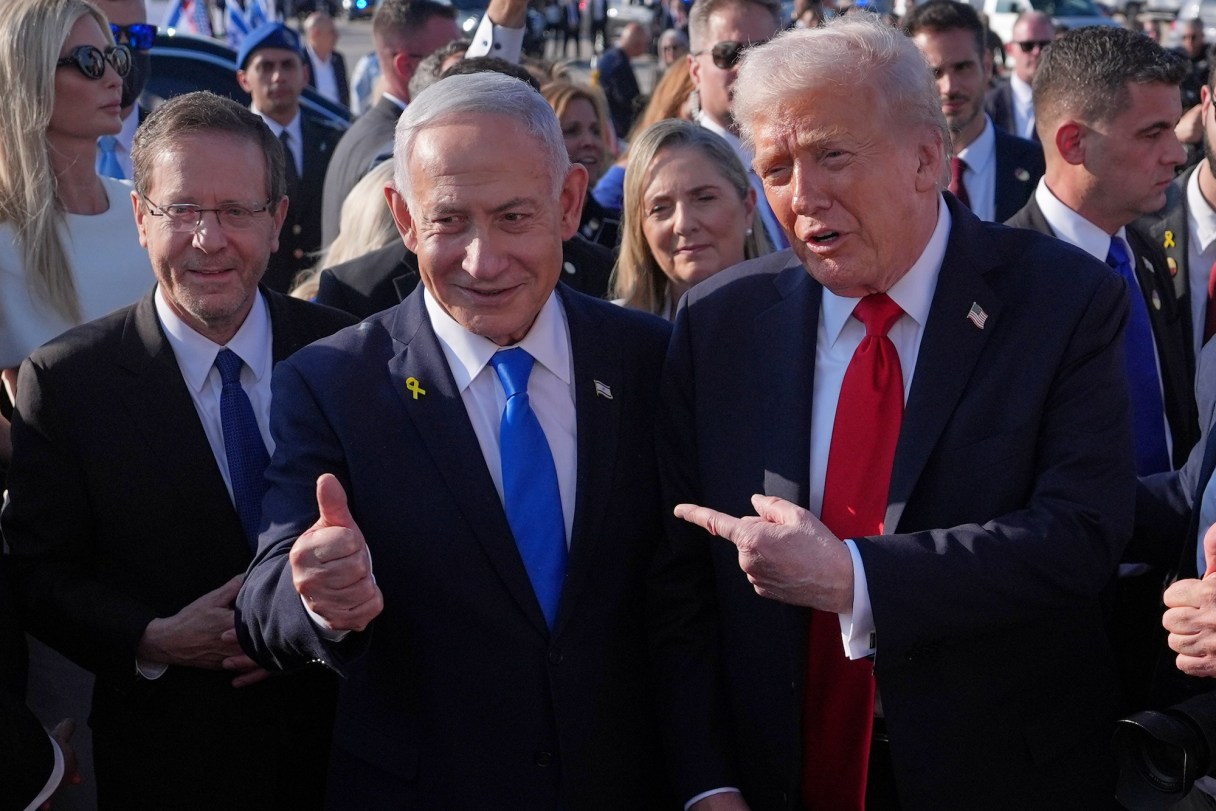
Donald Trump is famous for his hubristic overstatements, but his characterization of last Thursday’s events as a “momentous breakthrough” in the Middle East is supported by the facts. Even if his characterization of the future there as being one of “lasting peace, hopefully an everlasting peace” still remains to be seen, given that history teaches us that “lasting” is a relative term in this region and “everlasting” too often a mirage.
But all of this deserves recognition. Frankly, we’re disinterested in Trumpian verbiage but nonetheless profoundly glad that two years of fighting and killing in Gaza appears set to cease, and the 48 Israeli hostages are coming home to their families, even the 28 whom the Israelis believe are no longer alive.
The chief Hamas negotiator, Khalil Al-Hayya, said Thursday into a camera in no uncertain terms that the war was over and that Hamas has received guarantees from the United States, Arab mediators and Turkey that this would be not be a temporary ceasefire.
Momentous is the word.
We’re happy to give Trump credit for all of this. We even think he was right to bat away questions, for now, about the so-called two-state solution and focus on the specific, nascent agreement made by the two parties, on ensuring the disarmament and the rest of the 20-point process happens per the plan and on immediately creating better conditions in Gaza for the people who live there.
Achievements such as this one are to be admired. Take, for example, the statement by Britain’s prime minister, Keir Starmer, a Labour Party politician and a man utterly opposed to most of Trump’s actions and ideologies. He said during a visit to India last week that this first phase of the Gaza peace plan “would not have happened without President Trump’s leadership.” Remarkably gracious.
“I want to be really clear about that,” Starmer went on, “and I say that from the informed position of the U.K. having played a part behind the scenes in this with the U.S. and with the mediators.”
We are appreciative that the Israelis stepped back from their impossible condition that Hamas be totally “eradicated” in one fell swoop, an impossibility as any rational person has always known. But Israel has not stepped back from its reasonable demand that Hamas no longer be a credible threat to the peaceful existence of its people. If that proves to be the case, as we fervently wish, Israel now has a responsibility to, in the stirring words of its foreign minister, Gideon Sa’ar, “expand the circle of peace” in its region and also to consider and cooperate with the aspirations of the Palestinian people.
We remain haunted by a visit we received, soon after the Oct. 7 attacks, from the families of the Israeli hostages, mostly liberal-minded folks, some who lived in the U.S., who just wanted their loved ones to come home after they were abducted from their kibbutzim or an outdoor musical festival. That did not, of course, happen in every case. And Israel’s military response to those attacks resulted in exponentially larger and similarly catastrophic loss of Palestinian life. But there still will be some this week when those hostages are returned and the Palestinian people can stop fearing for their lives. No wonder Palestinians were cheering in the streets even as Israelis danced in Tel Aviv.
Thank you for your attention to this matter, Mr. President. Well done. You’ve shown a willingness to cooperate and work with multiple nations in the Middle East and seen the success it can bring. Bringing about the conditions for peace must be a great feeling.
We hope you start to employ these same tactics back at home.