
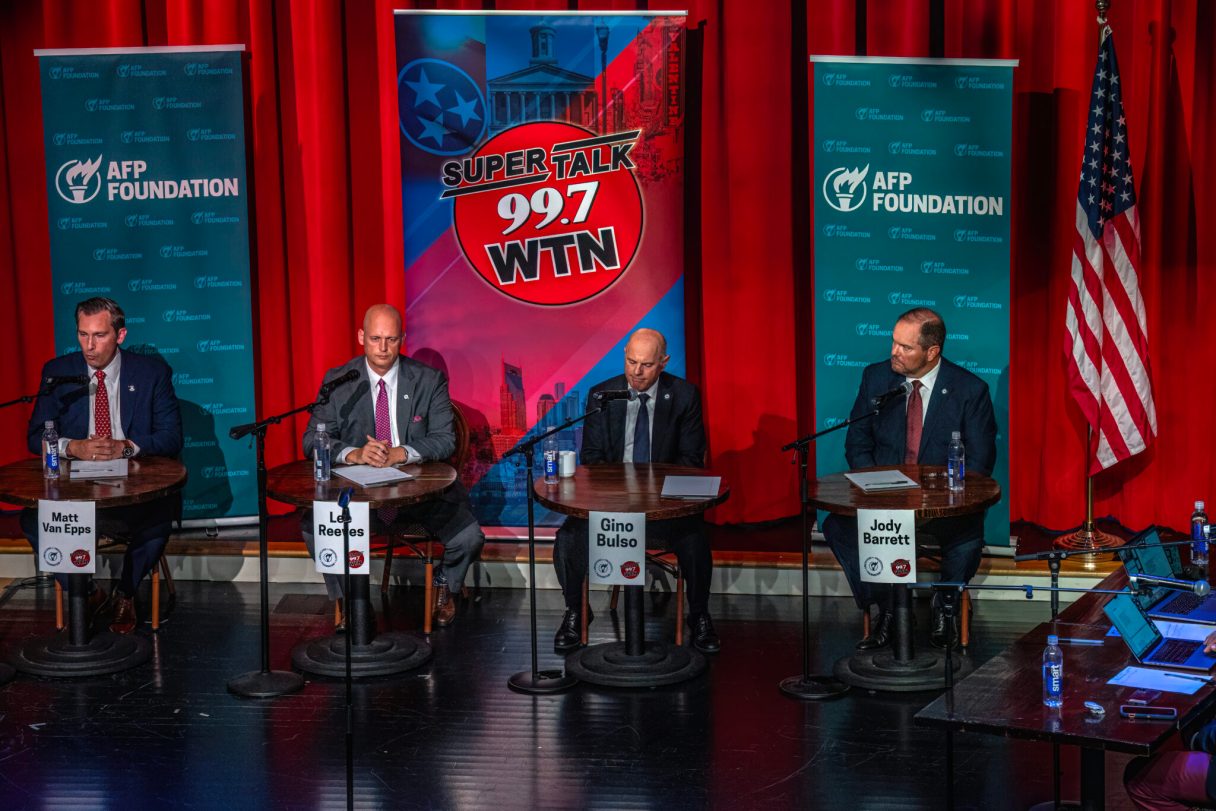
Rep. Jody Barrett opened the U.S. congressional debate with a provocative comment.
“I’m the only candidate with two different agencies giving me a 100% conservative voting record,” said Barrett, a state representative from Dickson, Tennessee. “The difference between being 100% and somewhere less is where the fight is.”
On Oct. 7, primary voters will go to the polls for a special election for the Tennessee 7th U.S. Congressional District. The election was triggered by the resignation of U.S. Rep. Mark Green, R-Clarksville, earlier this year.
Nearly a dozen candidates entered the Republican primary, but the conservative think tank Americans for Prosperity Tennessee invited only four to its Friday debate in West Nashville based on polling and fundraising numbers.
Barrett, Brentwood state Rep. Gino Bulso, Franklin state Rep. Lee Reeves, and former Tennessee General Services Commissioner Matt Van Epps are also the four candidates in the race with state-level legislative or government experience.
A pre-debate Americans for Prosperity poll of 500 voters showed the four men each getting between 15-20% support. The poll’s margin of error effectively means they are tied.
For two hours, moderators attempted to create some separation between the candidates, but the debate rules banned cross-talk between candidates, and they weren’t allowed to mention each other’s names.
The moderators also tried to distinguish any policy differences between the four men and President Donald Trump. Only Barrett criticized any of Trump’s actions, calling out his support for Operation Warp Speed to create the coronavirus vaccine.
Americans for Prosperity was one of the few conservative groups that didn’t endorse Trump in his 2024 presidential primary, backing former United Nations Ambassador Nikki Haley instead.
All the candidates agreed they would have voted for Trump’s “one big beautiful bill,” wouldn’t push legalization for marijuana and that the federal government needs to be smaller. The differences that emerged were more stylistic than substantial.
Bulso’s answers tended to linger as he attempted to show his legal knowledge. The state representative in his second term is a lawyer who often tries to argue political debates like they are written arguments before a court. Bulso cited clauses in the Constitution at least five times during the debate.
Reeves made it clear from the start that he wanted to be known as the “America First” candidate in the race, trying to tie himself to Trump. The first-term state representative hit all the key conservative points, calling for the elimination of the Department of Education, more immigration crackdowns and the defunding of “sanctuary cities.”
Van Epps on multiple occasions mentioned his military service and experience running a state department. He made it clear his priority in office will be working with Trump and on defense issues.
The congressional district borders the U.S. Army’s Fort Campbell base, which straddles the Tennessee-Kentucky border. Many of the district’s voters are current or former military, which helped Green as a former infantry officer when he first ran for the seat.
The district encompasses the western half of Middle Tennessee before taking a claw-like shape out of Nashville and Williamson County. Since it was partisanly redrawn in 2022, Green consistently won about 60% of the district’s vote.
Democrats are also holding a competitive primary between Nashville state Reps. Aftyn Behn, Vincent Dixie and Bo Mitchell, and Nashville businessman Darden Copeland. Despite it being a special election, political rating agencies still score the seat as solidly Republican.
The general election is Dec 2.
Read more at TennesseeLookout.com.