
FARMINGDALE, N.Y. — Rory McIlroy, who became only the sixth player in golf history to complete the career Grand Slam when he won the Masters in April, now faces another tall order.
McIlroy has been saying for the past few years that winning the Ryder Cup on the opponent’s home turf is the biggest accomplishment in golf.
The 36-year-old from Northern Ireland, who’s No. 2 in the Official World Golf Ranking, would know. McIlroy was on the last winning road team in this passionate competition between Europe and the United States. That was 13 years ago and required so much to go right on the final day in the Chicago suburbs that it became known as the “Miracle at Medinah.”
“We weren’t supposed to win in ’12,” McIlroy once said. “Even since then, the home team has won, each time pretty convincingly.”
The Americans were coming off a record rout of Europe — 19-9 at Wisconsin’s Whistling Straits in 2021 — when they went went to Marco Simone in Italy two years ago with hopes of ending 30 years without a road victory for the U.S. Europe swept the opening session and cleaned up without any trouble.
In the decade-plus since Europe’s win at Medinah, the home team has won by the following margins: five points in Scotland, six points in Minnesota, seven points in France, 10 points in Wisconsin and five points in Italy.
Europe returns Luke Donald as captain and 11 of the players who won at Marco Simone. Now, though, they face a big, loud crowd at Bethpage Black when the matches start Friday, and the Long Island course will be groomed to favor an American style of golf.
That led Donald to say winning a Ryder Cup in New York “is a different animal,” but the Europeans have met the challenge of winning on U.S. soil before — four times in the last 40 years.
Here’s a look back at how they did it.
Muirfield Village, 1987
Europe was coming off its first Ryder Cup victory since 1957, facing an American team with 18-time major champion Jack Nicklaus as the captain on the Muirfield Village course he built near his hometown of Columbus, Ohio.
Among the three captain’s picks for Europe was Jose Maria Olazabal, the perfect partner for fellow Spanish star Seve Ballesteros. They went 3-1 in team play as Europe, behind a 4-0 session in Friday fourballs, and built a five-point lead going into Sunday singles.
The American rally came up short, particularly on the 18th hole. Ben Crenshaw, who broke his putter in anger on the sixth hole and used a 1-iron, driver and wedge on the greens the rest of the way, drove into the water and lost his match. Dan Pohl lost his match with a double bogey.
Ballesteros closed it out by beating Curtis Strange for a 15-13 victory, the first time the Americans lost on home soil since the matches began in 1927.
Noteworthy: This was the last Ryder Cup in which the Americans did not have captain’s picks.
Quoteworthy: “We’re not frightened any more. In time, this could change the world of world golf.” — Europe captain Tony Jacklin
Oak Hill, 1995
American dominance appeared to be restored with wins at South Carolina’s Kiawah Island in 1991 and at the Belfry near Birmingham, England, in 1993. And then Corey Pavin chipped in on the 18th for a fourballs victory Saturday evening at Oak Hill for a 9-7 lead that looked insurmountable given the U.S. edge in singles.
An aging European team — this was the last playing appearance by Ballesteros — showed the moxie late and dominated the 18th hole, as it had done in its previous road victory. Five matches went 18 holes, and Europe won a full point from four of them.
England’s Nick Faldo got up and down for par from 93 yards away on the 18th to rally for a 1-up win over Strange, who bogeyed the last three holes. Philip Walton clinched it for Europe by holding on to beat Jay Haas in a 14 1/2-13 1/2 victory at the course in the Pittsburgh suburbs.
Noteworthy: Phil Mickelson went 3-0 in his Ryder Cup debut. It was the first of his record 12 consecutive appearances for the U.S.
Quoteworthy: “It just shows that the strength of golf in Europe is getting bigger and bigger all the time.” — Wales’ Ian Woosnam
Oakland Hills, 2004
Europe recorded its largest margin of victory in the Ryder Cup, 18 1/2-9 1/2, and yet this Ryder Cup will be best remembered for U.S. captain Hal Sutton pairing Tiger Woods and Mickelson for the first time.
They lost the opening match to Ireland’s Padraig Harrington and Scotland’s Colin Montgomerie. Sutton sent them out again and they lost to England’s Lee Westwood and Northern Ireland’s Darren Clarke.
Europe already had a five-point lead after the first day in the Detroit suburbs and won four of the five sessions with Germany’s Bernhard Langer at the helm.
Trailing 11-5 going into Sunday, Sutton decided to send out his players in the order they made the team. By the fifth of 12 matches, Europe already had secured the trophy.
Noteworthy: For the first since 1981, Europe had no major champions on its team.
Quoteworthy: “Believe it or not, there’s people that can play golf outside the States.” — Spain’s Sergio Garcia
Medinah, 2012
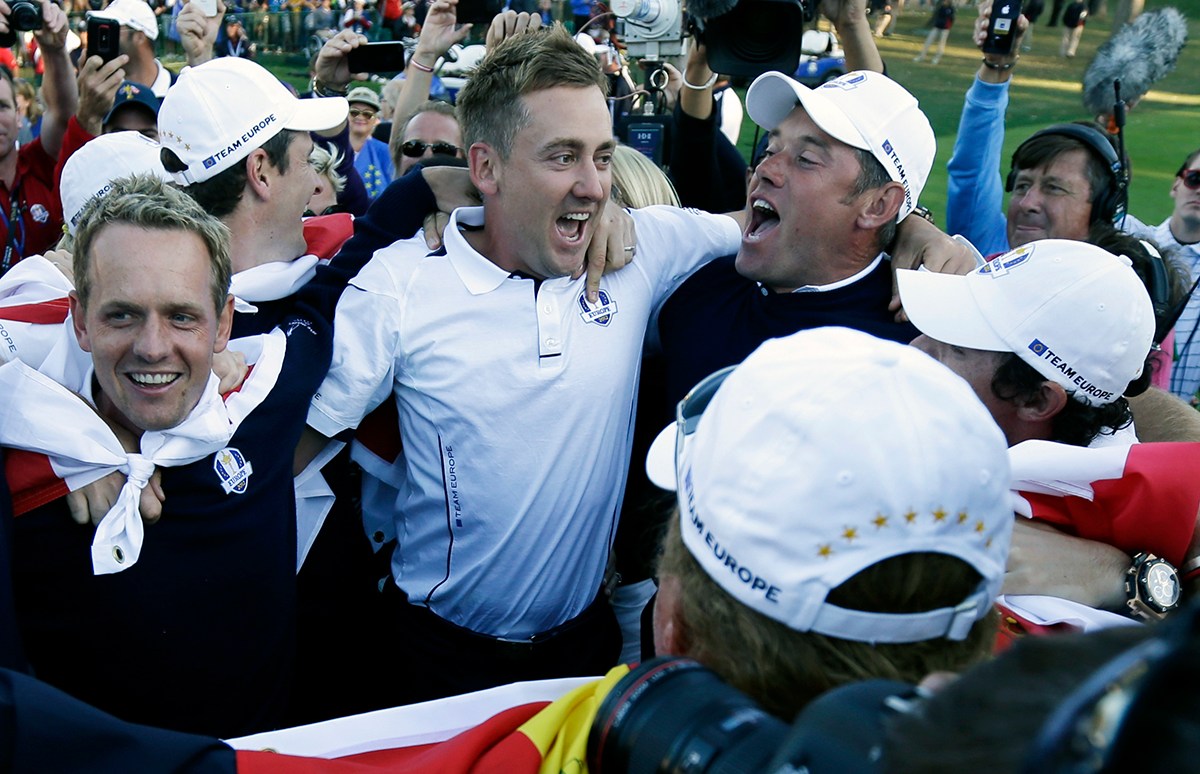
The Americans were poised to take an 11-5 lead into singles when England’s Ian Poulter finished with five straight birdies to carry him and McIlroy to a stunning point in the final fourballs match. The momentum was enormous.
The Americans still had a four-point lead. McIlroy forgot Chicago was in the Central time zone and nearly missed his tee time, arriving at Medinah with 10 minutes to spare. And then the Europeans staged the greatest comeback by a road team in Ryder Cup history.
Their top five players in the lineup won, none bigger than England’s Justin Rose making a birdie on the last two holes to beat Mickelson. Back and forth it went over the final hour until Germany’s Martin Kaymer made a six-foot par putt to beat Steve Stricker. The prize in Europe’s hands, Woods conceded a short par putt to Italy’s Francesco Molinari for a 14 1/2-13 1/2 victory.
Noteworthy: Europe captain Olazabal had an image of Ballesteros sewn into the sleeves of his team’s Sunday shirts. It was the first Ryder Cup since Ballesteros died from a brain tumor in May 2011.
Quoteworthy: “We’re all kind of stunned.” — U.S. captain Davis Love III