
This story was originally published by the Nashville Banner. Sign up for their newsletter at nashvillebanner.com/newsletters.
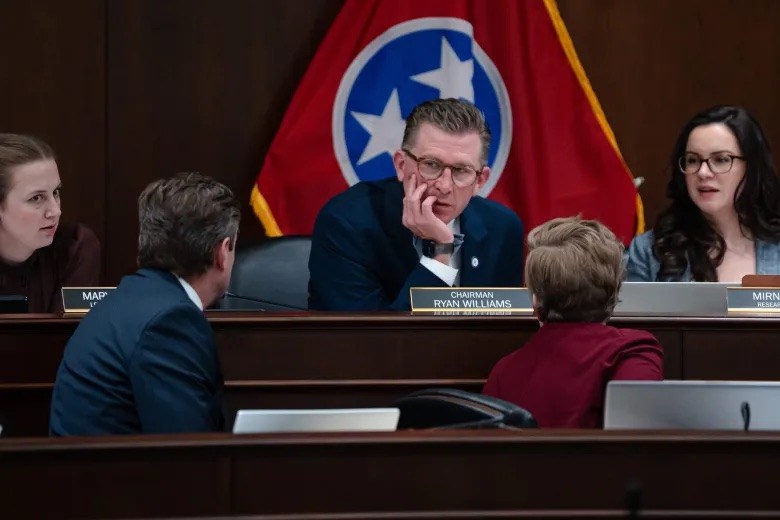
The Tennessee House Finance, Ways and Means Subcommittee voted to advance an expansion of the statewide private school tuition grant program by 15,000, with last-minute student immigration language and virtually no discussion on Wednesday morning.
The subcommittee moved so quickly through bills that, at one point, a bill was heard and voted on twice before the sponsor, clerk or chair recognized the issue and moved on to the next.
Shortly after that flub, the panel darted through the tuition program expansion bill and a complicated new amendment by Chairman Ryan Williams , R-Cookeville.
The untimely filed amendment combined some expected changes — detailing the prioritization process and reducing the number of added grants to 15,000 from the 20,000 requested by Gov. Bill Lee — but also added an immigration condition to public school funding that flew under the radar without discussion.
Williams offered a vague and brief description of the amendment during the committee meeting. He said that several amendments had been consolidated into one that would be considered with a single vote.
“This bill will modify the floor and create transparency as it relates to those currently being funded in our TISA school systems,” he said, referring to Tennessee’s school funding method. “It will also set aside, for lack of better terms, a ‘pecking order’ for the recipients of those scholarships going forward. It will be a reduction of the expansion from 20,000 to 15,000 new scholarships, totalling 35,000 total scholarships in two years.”
The “transparency” in question is language introduced Tuesday that would only entitle public school districts to benefit from the hold harmless clause of the program relative to the number of students verified to hold certain legal or pending immigration statuses. The clause was designed last year to protect state per-pupil funding under the funding formula for those districts that lose enrollment to private school grants.
In other words, school districts could lose money that was protected in the original tuition bill if they do not vet the immigration status of their students.
But the panel did little to discuss this substantial and arguably unrelated amendment tacked onto the bill in the 11th hour.
Rep. Johnny Shaw, D-Bolivar, asked broadly, “How will this amendment affect the public school system?”
“The effects on the public school system will be in regards to transparency, as it relates to the reporting of students that are there,” Williams responded.
No member mentioned immigration, status or citizenship in the brief discussion. House Majority Leader William Lamberth, R-Portland, did not offer any explanation of the bill that he is sponsoring or of the amendment.
The committee spent less than three minutes on the bill before voting 9-3 to recommend the amended bill for passage. Two Republicans — Rep. Gary Hicks, R-Rogersville, and Rep. Mark Cochran, R-Englewood — voted no.
House Speaker Cameron Sexton, R-Crossville, was the first to introduce the amendment with citizenship language and did not speak during the subcommittee meeting, though he was present as speaker.
The changes to the bill come after House Bill 793 — Lamberth’s student citizenship reporting bill born from a mostly abandoned effort to challenge Plyler v. Doe — hit a snag with its senate sponsor last week and after a harsher reporting bill with a potential criminal penalty attached for noncompliance fizzled in a Senate committee Tuesday.
After the vote, Lamberth told the Nashville Banner that he couldn’t comment on whether the amendment required schools to report documentation status, because it had been written by Williams.
“Well, it was just filed yesterday,” Lamberth said. “So we have talked, but it … I mean, everybody’s very busy down here. So I mean, I’ve seen the amendment, I’ve read the amendment, but I literally have just seen it yesterday.”
Asked why he would not have asked that question before the amendment was added to his bill, he said he “has read the words on the page so (he) understands them as they are written on the page.”
When asked after the meeting if the amendment would require reporting similar to House Bill 793, Williams said, “I am not aware of that,” adding that he had not seen the language of those bills to know whether or not they are similar to his amendment.
“This transparency portion, as it relates to citizenship and the floor, is an important component as it relates to, how many kids are we actually funding? We want to keep our first promise and fund every kid that’s in there that wants to stay there, so that locals are not impacted,” he said.
The amendment would also set a cap of 35,000 total private school tuition grants for the 2026-27 school year, less than the original proposal of 40,000, but still nearly doubling the program in its second year. This would require about $114 million in recurring funding each year, as compared to $150 million.
The original law creating the program set a limit of an increase of 5,000 vouchers per year. Williams told the Banner that future expansion of the program will depend on how much money governors appropriate.
“I don’t want to commit future legislators to a cost that they couldn’t do,” he said. “They could appropriate money to grow the program. But if they went over a certain threshold, much like we’re doing this year, they would have to appropriate the money in order to do that.”
The Senate Finance, Ways and Means Committee voted 6-4 on Tuesday for the original version of the bill without the amendment.
Just one day before the House subcommittee voted for the amendment adding conditions to school districts’ funding, Senate Majority Leader Jack Johnson, R-Franklin, assured senators that school districts would continue to be held harmless under the voucher bill.
“If, in fact, an LEA were to experience disenrollment that could result in a loss of funding through the TISA formula, they would be held harmless,” he said during the committee meeting.
This article first appeared on Nashville Banner and is republished here under a Creative Commons Attribution-NoDerivatives 4.0 International License.
