
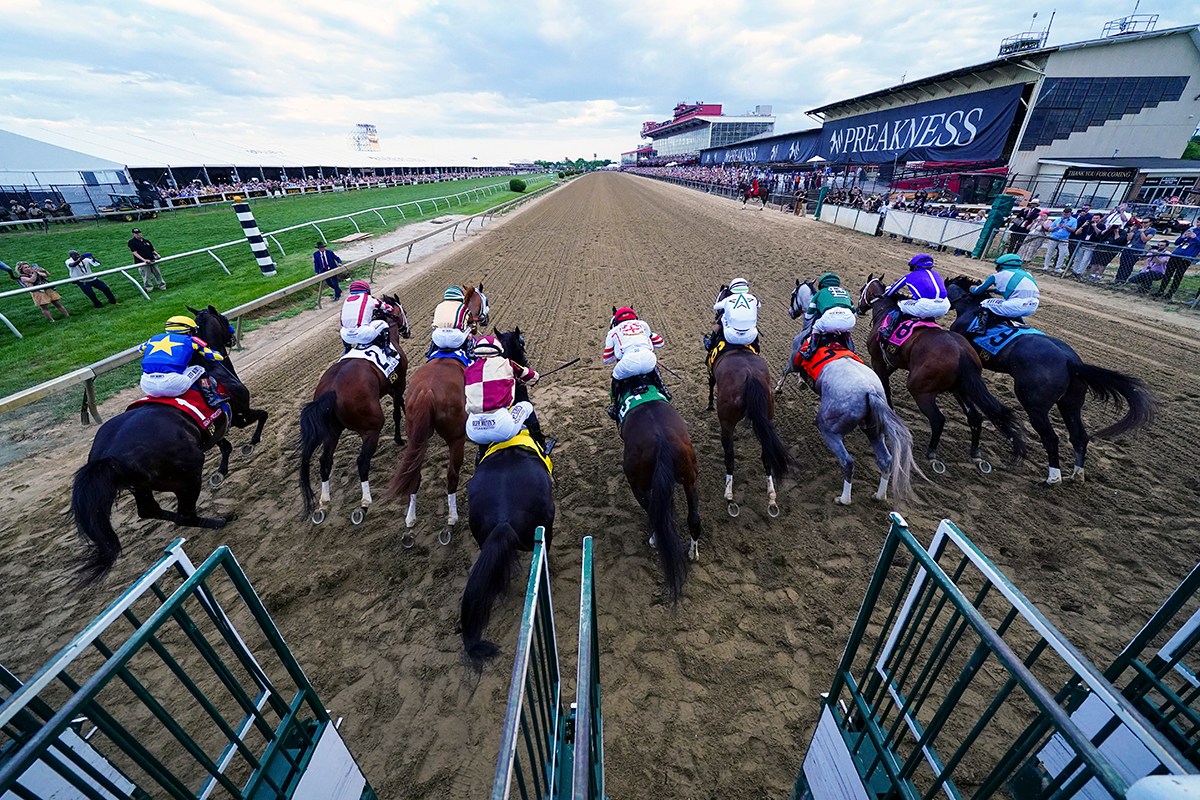
A big change is coming to thoroughbred racing’s Triple Crown next year, with the Preakness Stakes moving to three weeks and a day after the Kentucky Derby and being run on a Sunday for the first time.
Maryland Gov. Wes Moore and the Maryland Jockey Club announced the decision Wednesday.
No leg of the Triple Crown trail has ever taken place on a Sunday in the century-plus-old history of the series. The shift marks a major change on the horse racing calendar, and it comes after significant debate and speculation.
Except for 2020 during the coronavirus pandemic, the Preakness Stakes has been on the third Saturday in May, two weeks after the Kentucky Derby, since 1950. Maryland Jockey Club CEO Bill Knauf acknowledged the tradition while also calling this the time to move the Preakness back.
“It’s been discussed for a very long time; we recognized the different trends and training methods recently,” Knauf told The Associated Press. “We entered the discussion maybe even saying, ‘Hey, is two weeks the right amount?’ I think the week was the right placement. It still gives an incredible test for a horse and a champion to go through that, even at three weeks.”
The aim is to get more horses from the Kentucky Derby to participate in the second leg of the Triple Crown.
Competing in both was the norm for the country’s top 3-year-old thoroughbreds for decades, but it has become increasingly rare in recent years. Two consecutive and three of the past five winners of the Kentucky Derby have bypassed the Preakness Stakes to aim for the final jewel, the Belmont Stakes in June.
Of the 95 horses who took part in the “Run for the Roses” at Louisville’s Churchill Downs dating to 2022, just 13 have gone to the Preakness (13.7%), with just one Kentucky Derby winner in that group.
“We are going to move it back to be able to ensure that the winner of the Kentucky Derby will then be prepared to compete in the second leg of the Triple Crown,” Moore said at a news conference in Annapolis. “By moving the day, you’re then providing additional time and space for our horses and the people who compete in the Derby to be able to then now compete to be able to be part of that Triple Crown.”
For at least next year, it has the chance to produce the opposite effect, with the Belmont Stakes scheduled for June 5 in New York, as announced Monday. Going from a three-week to a 13-day gap between the final two Triple Crown races could force owners and trainers to choose between them, given that modern 3-year-olds typically get significantly more time off than those in the past. Knauf said it was a decision made for the long-term future of the Preakness Stakes.
U.S. Racing Hall of Fame member Bob Baffert, who with American Pharoah in 2015 and Justify in 2018 is the only trainer to win the Triple Crown since Affirmed in 1978, said in a social media post Monday that if he has the right horse from the Kentucky Derby, he will continue to go to the Preakness Stakes annually. That was in response to the unveiling of a new championship series of races at Churchill Downs, Belmont Park and Saratoga Race Course in upstate New York and does not — for now — include the Preakness Stakes.
Future changes to the schedule are always possible beyond 2027. The shift does put the Preakness Stakes, which is held at Baltimore’s Pimlico Race Course, on the Sunday of Memorial Day weekend beginning in 2028 and running through 2031.
“We believe this creates tremendous excitement for our local economy and businesses,” Knauf said. “Baltimore will become the place to be on Memorial Day weekends as the spotlight of the racing world descends on Pimlico.”
The Sunday of Memorial Day weekend is already a major day for motorsports, however, with a Formula 1 race, the Indianapolis 500 and NASCAR’s Coca-Cola 600 all typically scheduled for that day.
The change comes with an extension of the media rights agreement with NBC Sports through 2032. The Preakness Stakes — as well as the Black-Eyed Susan Stakes for fillies on the third Saturday in May — will air on NBC and Peacock for the next six years.
Jon Miller, the president of acquisitions of partnerships for NBC Sports, said at the news conference that the network as far back as 10 years ago broached the idea of pushing the Preakness back at least a week, but previous ownership was not interested.
“It’s a success factor for everybody by moving it to the eight days later,” Miller said. “The idea of doing it Saturday-Sunday, quite honestly, was to create a weekend celebration and not just have it be a one-day event in the middle of a Triple Crown series.”
Moving the Preakness Stakes coincides with its return to Pimlico in Baltimore as part of a $500 million reconstruction project after a one-time stop at Maryland’s Laurel Park. Next year, there is expected to be limited capacity, with the full new Pimlico scheduled to be completed by the spring of 2028.
“It’s something business has been a huge champion of,” Mark Anthony Thomas, the president and CEO of the Greater Baltimore Committee told the AP. “And so people are very enthusiastic around the state’s investments.”