
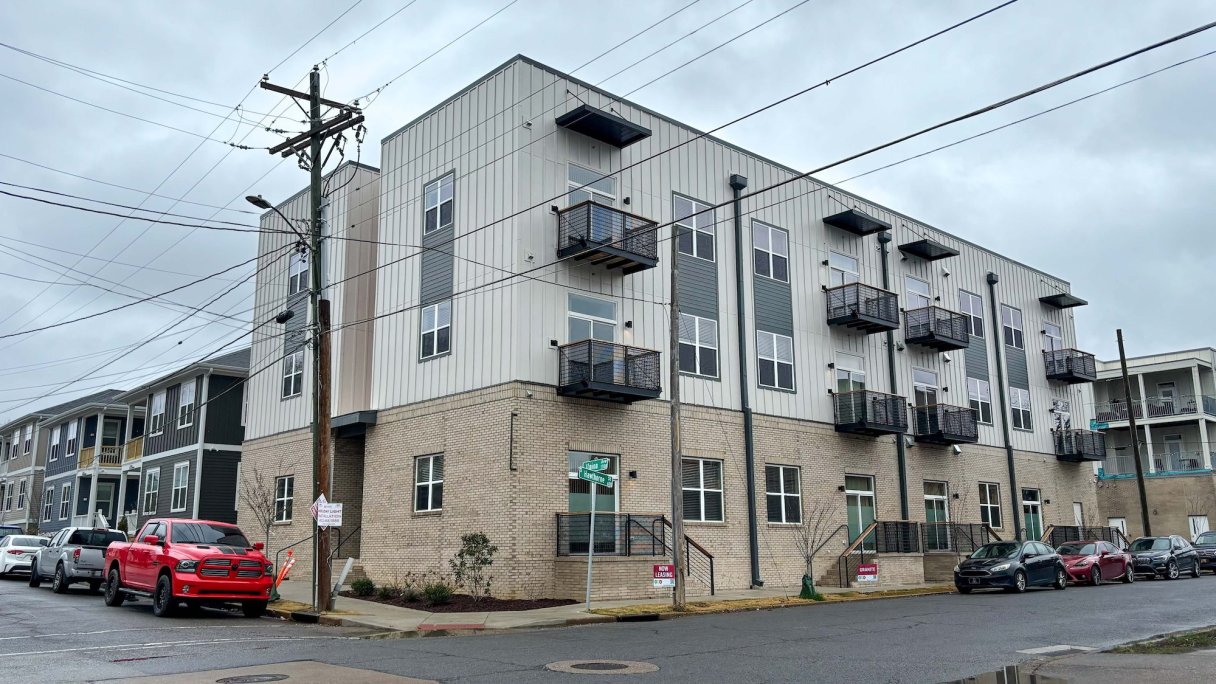
A new study on affordable housing construction has Chattanooga lagging other Tennessee markets — with some caveats.
The report from RentCafe and its sister company, Yardi Matrix, tracked affordable housing development over the past decade, splitting the data into two five-year tracts: 2015-2019 and 2020-2024. The two periods were labeled as pre-pandemic and post-pandemic construction, respectively.
Of the major Tennessee markets such as Chattanooga, Nashville, Memphis, Knoxville and Clarksville, Chattanooga had the second-lowest share of affordable apartments compared to total new apartment construction.
Nationally, affordable housing construction peaked in 2024 with over 91,000 units being completed that year alone. For the 2020-2024 period, Nashville ranked as the 16th-largest builder of affordable housing with 5,498 units, though its ratio of affordable housing to total apartment construction was relatively low at 11.64%.
Chattanooga, by comparison, constructed 642 new affordable units between 2020-2024. That’s about 10.42% of total apartment construction, a drop in proportion from pre-pandemic levels. However, the figures come with some caveats and may be missing a significant share of new affordable units.
When constructing its data set, Yardi Matrix only counted an individual apartment as affordable if the entire complex it was a part of was income-restricted and classified as affordable by the U.S. Department of Housing and Urban Development. Mixed-income developments, such as an upcoming 278-unit development on the North Shore and its 42 affordable apartments, would not count.
Fully affordable housing projects tend to rely on federal funding, usually through programs like the Low-Income Housing Tax Credit, which is the largest subsidy available for affordable housing.
States administer the tax credit funds through their own rubrics. According to Megan Miles, Chattanooga housing policy director, the city has been historically disadvantaged by Tennessee’s grading system, something city officials have worked closely with the Tennessee Housing Development Agency to rectify in the new year.
“We should be much more competitive for these projects in the future,” she said by email.
Many incentives offered by the city, like economic development tax breaks and its Invest Chattanooga mezzanine loan fund, revolve around affordable housing being built into market-rate products.
“The city promotes mixed-income development to expand access … prevent the concentration of poverty and ensure that new affordable units are located in amenity-rich neighborhoods,” Miles said.
Invest Chattanooga CEO Matt Bedsole says the semigovernmental organization plans to bankroll at least 75 affordable units as part of mixed-income developments each year.
Contact growth and development reporter Raymon Troncoso rtroncoso@timesfreepress.com or 423-757-6317.