Editor’s note: first in a two-part series.
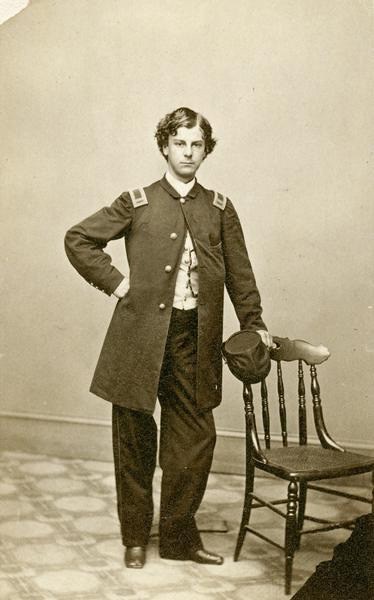
Arthur MacArthur Jr., father of General Douglas MacArthur, was a Union Civil War hero recognized for bravery at the Battle of Missionary Ridge. MacArthur was remembered for his mix of intense bravery, high ability, and equally striking ego and ambition.
Arthur MacArthur Jr. was born in June 1845 in Chicopee Falls, Massachusetts. His father, Arthur MacArthur Sr., was a Scottish-born lawyer and politician who became governor of Wisconsin and later a judge in Washington, D.C. His mother was Aurelia Belcher, who had important connections as the daughter of an industrialist. The family moved to Milwaukee when Arthur was a small child, where his father built a successful legal and political career. Arthur grew up in a household that emphasized education and achievement.
With the help of his father, he obtained a commission as first lieutenant and adjutant in 1862 and entered service as a very young officer in the 24th Wisconsin Volunteer Infantry. In October, MacArthur and the 24th Wisconsin fought their first battle at Perryville in Kentucky, where the unit was committed in support of an embattled Union battery and helped stop a Confederate advance. In the winter of 1862 to 1863, the 24th marched to the Murfreesboro area and went into the line at Stones River. When the colonel and lieutenant colonel became ill, command of the regiment fell to the 17-year-old MacArthur, who led the unit through heavy fighting and significant casualties.
In mid-1863, the regiment advanced with the Army of the Cumberland toward North Georgia. Led by MacArthur, the 24th Wisconsin fought at Chickamauga on Sept. 19 to 20, suffering heavy losses as part of the Union line that was driven back but helped cover the withdrawal toward Chattanooga.
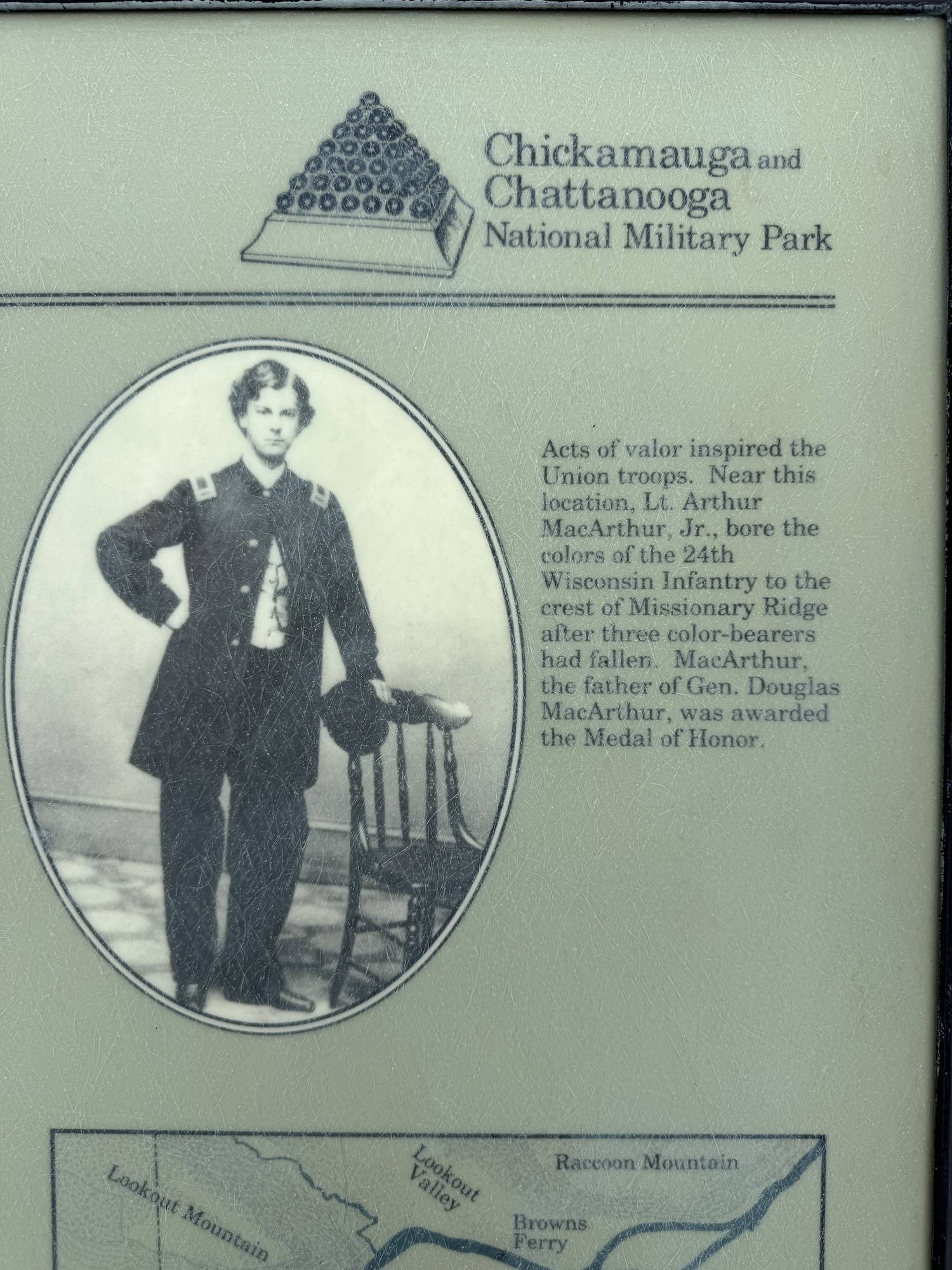
In November 1863, the Wisconsin unit took part in the Chattanooga campaign as part of the Union force ordered to assault Confederate positions on Missionary Ridge. The attack became a largely improvised, direct charge up a steep, fortified slope under first cannon and later heavy small-arms fire, with the Union line in danger of stalling halfway up the ridge. The 18-year-old MacArthur, then a first lieutenant and adjutant, was in the front ranks with the colors, where casualties were especially severe. Units across the assault front began to waver and lose cohesion as they struggled through “no-mans-land” and up the hillside.
As the 24th Wisconsin climbed, the official Army battle report described how the exhausted color sergeant dropped the flag — the National Park Service battlefield tablet says that three color-bearers dropped flags and fell. Nevertheless, MacArthur retrieved and “carried the flag in front of the regiment, cheering the men to follow him up the ridge.” Wounded but not incapacitated during the uphill assault, MacArthur reached the top of the ridge at or near the center of the Confederate line and planted the 24th Wisconsin’s flag on the captured works, symbolizing the collapse of the Rebel position. Today, a small stone marker 100 yards southeast of the Bragg Reservation entrance on South Crest Road commemorates the place where his brigade stormed the top. Following the Union’s victory, Confederate forces began a general retreat into North Georgia.
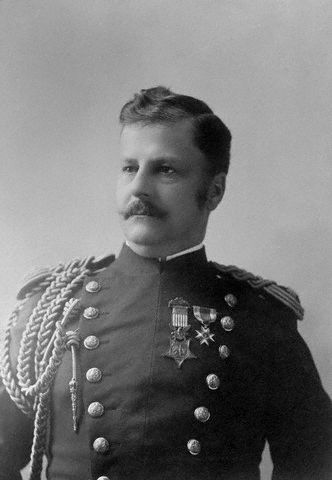
For his conduct at Missionary Ridge, Arthur MacArthur earned the nickname “Boy Colonel” and was later awarded the Medal of Honor. Observers noted that his personal qualities combined conspicuous courage, strong will and genuine leadership ability with pronounced vanity, pride and sensitivity about rank and recognition. These traits and the family ideal helped shape his son Douglas’ own sense of destiny, honor and relationship to civil authority.
MacArthur was wounded in the chest and the knee in the Battle of Franklin in late 1864 and walked with a limp the rest of his life. After the Civil War, Arthur remained in the Regular Army and continued to rise through the ranks. He served in the American West protecting settlers and railroads, in the Battle of Manila, and as military governor in the Philippines.
In May 1875, Arthur married Mary Pinkney “Pinky” Hardy of Norfolk, Virginia. The parents expected high performance from their sons, combining a demanding home life with the constant relocations of an Army family. Their third son, Douglas, was born in 1880 at the Little Rock Barracks in Arkansas and later became a Medal of Honor winner and the renowned five-star General of the Army serving in World War II and the Korean War.
Arthur MacArthur retired from active duty in 1909 with the rank of lieutenant general after a nearly half-century of service. On Sept. 5, 1912, while addressing a reunion in Milwaukee of his old Civil War regiment, he collapsed at the beginning of his speech and died moments afterward at age 67. “The old men of the 24th wrapped his body in the flag hanging on the wall, the flag he had carried to the top of Missionary Ridge as a teenager,” according to a retelling by the American Battlefield Trust. He was buried in Milwaukee and then in 1926 reinterred at Arlington National Cemetery.
Frank “Mickey” Robbins, a National Park Partners board member, coordinates the local history column. For more, visit Chattahistoricalassoc.org.