
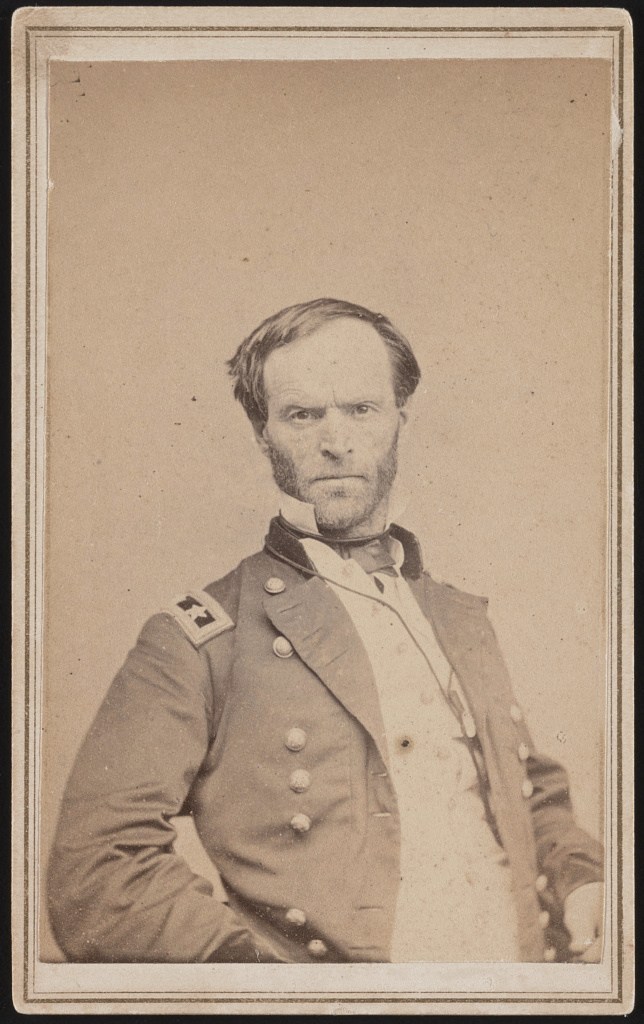
Editor’s note: part of a series on Civil War notables.
William Tecumseh Sherman was a Union general in the Civil War, best known for his campaigns in the Western Theater, including Chattanooga and his destructive “March to the Sea.”
Sherman was born in 1820 in Lancaster, Ohio. He graduated from West Point and served in the Mexican-American War before leaving the service. He first moved to San Francisco to manage the branch of a St. Louis banking firm during the chaotic boom years of the Gold Rush before seeing the branch close during the panic of 1857. He then organized what became Louisiana State University.
When the Civil War broke out, he rejoined the Union Army, rose quickly to become one of Ulysses S. Grant’s key lieutenants, fighting at Shiloh, then helped execute the Vicksburg campaign.
After success at Vicksburg, Sherman was ordered to reinforce Grant, where he was to face Braxton Bragg’s army besieging Chattanooga. Sherman arrived at the strategic railroad town in mid-November and joined Grant in reconnoitering the Confederate positions along Missionary Ridge and Lookout Mountain.
Before dawn on Nov. 24, Sherman ferried his men across the Tennessee River on pontoon boats at South Chickamauga Creek and secured a bridgehead with the surprise that Grant wanted. However, due to poor maps and lack of local guides, he advanced onto a separate detached height further north – today known as Billy Goat Hill and across Highway 58 – mistaking it for Missionary Ridge proper, while Patrick Cleburne’s Confederates held the true ridge line. On Nov. 25, Union guns opened correctly on Tunnel Hill (at the northern crest of the ridge over the East Tennessee and Georgia Railroad tunnel), pounding Cleburne’s fresh trenches.
Sherman followed with piecemeal attacks up the slopes of Tunnel Hill, each being thrown back by coordinated Confederate fire, as his troops struggled over rough terrain under enfilade (sweeping fire along a troop line). Cleburne’s division, outnumbered four to one, repulsed Sherman’s piecemeal assaults despite heavy pressure and costly fighting. By late afternoon, Sherman’s initiative had stalled as his exhausted men failed to turn Bragg’s right, as Grant had hoped.
With Sherman checked on the Union left and Joseph Hooker delayed in crossing Chattanooga Creek on the right, Grant ordered George Thomas’s Army of the Cumberland to advance and seize the rifle pits at the base of Missionary Ridge, a move that evolved into the famous, largely unplanned charge up the slopes that shattered Bragg’s center. Sherman’s hard-fought but unsuccessful pressure on the northern end of the Ridge tied down Cleburne and a sizable Confederate force, limiting the support Bragg could send toward his collapsing center and contributing indirectly to the Union breakthrough.
When Bragg’s army broke and retreated toward Ringgold, Georgia, the victory at Chattanooga opened the “gateway to the Deep South,” making Chattanooga the logistical base for Sherman’s 1864 Atlanta campaign and ultimately his March to the Sea.
Sherman’s difficult encounter at Tunnel Hill is one of the clearest cases where his reputation collided with a tactically superior opponent (Cleburne) – and he came off second best. Many historians argue that Sherman was a better strategist than battle tactician and became the commander recognized today only after Chattanooga, where he had been reminded of the importance of terrain, reconnaissance and coordination that shaped his later, more decisive operations.
After capturing Atlanta, Sherman led the famous March to the Sea, targeting railroads, factories, livestock, cotton gins, plantations and other infrastructure to cripple the Confederate war effort. Those operations exemplified his concept of “total war,” aiming at the South’s capacity to sustain armies, while they generated controversy for their destructive impact on civilians and property.
In 1865, he campaigned and accepted the surrender of Joseph Johnston’s Rebel forces in Georgia, Florida and the Carolinas. After the war, Sherman became commanding general of the U.S. Army, overseeing operations in the Indian wars.
In 1875, he published his widely read memoirs, which became one of the most important firsthand lively accounts of the conflict.
Sherman’s father, a prominent judge, died when the lad was nine years old, and he was raised in the household of Sen. Thomas Ewing, whose daughter Ellen he later married. Although she was a deeply religious Roman Catholic and he was generally skeptical about organized religion, their marriage lasted more than 40 years and produced eight children. He retired to New York City, where he died at age 70 of pneumonia. Confederate Gen. Johnston famously stood bareheaded in cold rain at the funeral out of respect for Sherman.
Sherman is often described as one of the first modern generals because of his emphasis on destroying an enemy’s economic base and morale as well as its armies. He remains a deeply polarizing figure – praised for strategic effectiveness in hastening the end of the war and condemned for the human and material cost.
Frank “Mickey” Robbins is a National Park Partners board member. For more on local history, visit Chattahistoricalassoc.org.