
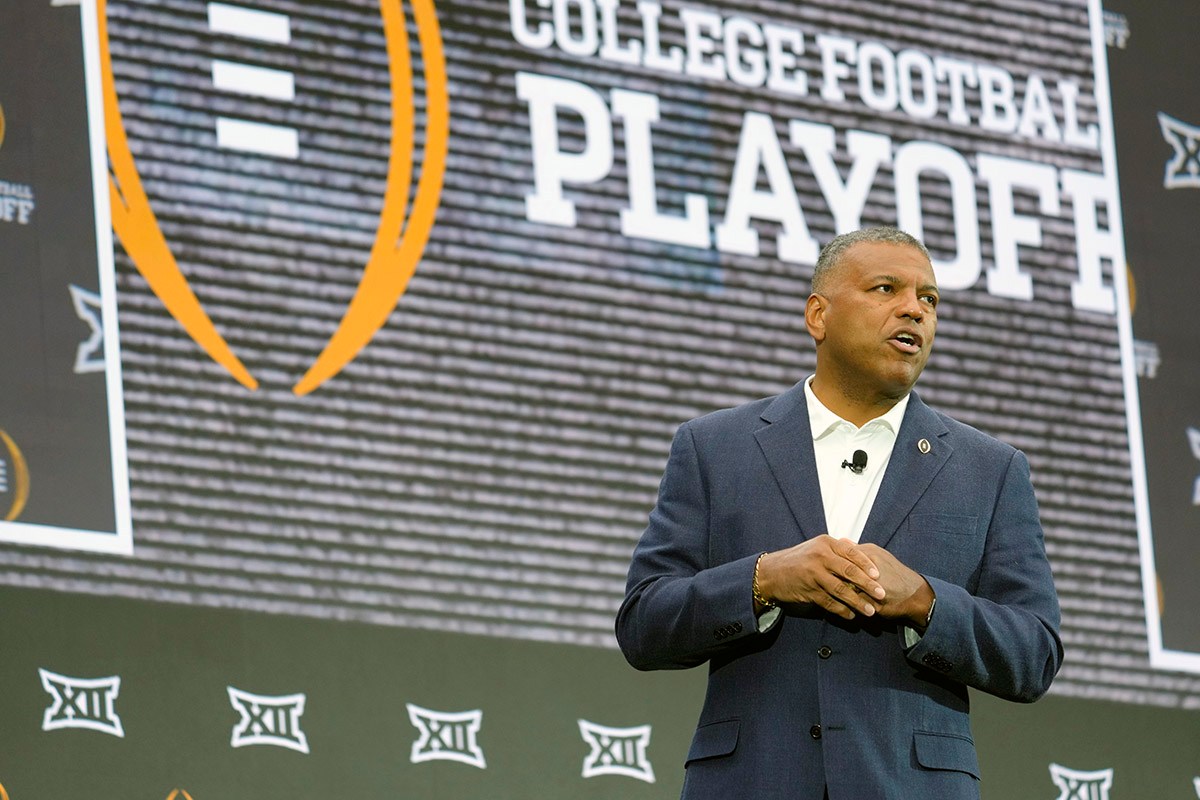
DENVER — College football leaders gathered Wednesday to debate the merits of expanding to 16 or 24 teams in the national championship tournament for NCAA Division I’s upper tier.
They need more time, though, to sort out the details of what could be the most important number: money.
Rich Clark, the executive director of the College Football Playoff, said the meetings between conference commissioners from the Football Bowl Subdivision and a few others were “very healthy” but didn’t lead to anything concrete.
“We’ve got a lot on the table to just help us to continue to move the ball forward,” Clark said. “We have a little homework to do coming out of there. … We have a good idea what we need to bring back to them to help them with their decisions.”
They will keep studying the impact that expanding the playoff from 12 to 16 or 24 teams could have on venues, the schedule, the future of now-imperiled conference title games — and of course, how much extra games might go for on the open market when it comes to media rights.
Southeastern Conference commissioner Greg Sankey has lobbied for 16 teams, while leaders in the Atlantic Coast Conference and the Big 12 have widely agreed on their preference for a 24-team bracket, an idea the Big Ten first put forward and still supports.
After being limited to four teams in its first 10 seasons as the successor to the Bowl Championship Series, the CFP tripled to a dozen entrants in 2024 and kept that format this past season. Executives have discussed expansion since then but failed to reach an agreement in time for the 2026 season, so a 12-team bracket will again determine the national champ for the highest level of college football.
“I feel like we made progress, and sometimes, even though you don’t get to the answers, you understand more about what you need to get to the answer,” Clark said. “My goal is for us to make the most informed decision that we can. If it takes time, I would rather be deliberate about this than rush into something that was half-baked or not fully thought through.”
The next such meeting is slated for September, but Clark said another session could be scheduled if decision makers are “able to gather the facts and the information that they need.”
For example: How scheduling might work — and certainly if more insight into revenue is available.
“We have to look at everything,” Clark said. “I feel very optimistic about the way the meeting went, and I know our team, we feel like we have some good marching orders on what we need to provide to the commissioners to help them.
“It’s just a matter of us now going through that process and getting that information.”
The Football Championship Subdivision, NCAA Division I’s lower tier, has used a 24-team bracket for its playoffs since 2013.
Meanwhile, when asked if there were any discussions on sports wagering, Clark responded: “Nothing that I’m wanting to talk about.”
It remains a hot topic in light of Brendan Sorsby, the 22-year-old transfer quarterback who now won’t play for Big 12 member Texas Tech this fall and instead plans to enter the NFL supplemental draft.
Sorsby’s decision — which was announced Monday in an open letter written by Cody Campbell, the billionaire booster who is chairman of the Board of Regents of the Texas Tech University System — ended the legal fight over the college eligibility of a player who had acknowledged betting on pro and college sports, including bets on his own team while on the roster for Big Ten member Indiana in 2022.
He also played for the Hoosiers in 2023, then spent the past two seasons in the Big 12 after transferring to Cincinnati.