
This story was originally published by the Nashville Banner. Sign up for their newsletter at nashvillebanner.com/newsletters.
Brynnox Wilson is an aspiring professional baseball player and engineer. The fifth grade student would usually prefer to be outside, playing baseball, basketball or football with his local teams. He’s a confident speaker and openly shares his story and goals with adults.
“He’s our social butterfly,” his mom, Casie Wilson, said with pride.
But he’s not able to attend school in person anymore.
Last August, Brynnox was diagnosed with chronic Epstein-Barr virus. It’s a rare disorder that causes chronic mononucleosis (or mono). Brynnox has a compromised immune system and suffers frequent injuries. He gets severe migraines, and the only cure for those is sleep — yet he struggles to sleep at night. He once took medication to sleep, but then lost mobility in his legs.
“I’m going to get emotional right now,” Wilson said, before tearing up. “We just felt so helpless. … As a parent, you want to fix everything for your child.
“We felt so out of control, and the goals that he wanted to meet felt so far-fetched if we couldn’t get him back on track with his health.”
This year, Brynnox missed 17 days of school that were doctor-excused. When he returned, his teachers raised concerns about chronic absenteeism that made him feel uncomfortable, Wilson said. It was clear that a traditional brick and mortar public school wasn’t the right fit for him anymore — both for his physical and mental well-being.
The chronic absenteeism comments frustrated Wilson, who’s been an educator for 15 years. She understands that teachers are held to state accountability measures, including attendance and standardized testing. Yet she believes a teacher’s success can best be measured by looking at the “whole child.”
“We have to be flexible and remember that every kid doesn’t fit into every accountability measure that we have for school systems,” she said.
ALTERNATIVES
In October after fall break, Brynnox enrolled at Tennessee Virtual Academy, a K-nine virtual public school that offers six-and-a-half hours of live instruction every day. He hasn’t missed a day of school since. Even when he’s feeling unwell, he can still log on for class, and his teachers give him the flexibility to finish his schoolwork on his own time.
Because he’s at home all day, he also has more energy to play sports after school.
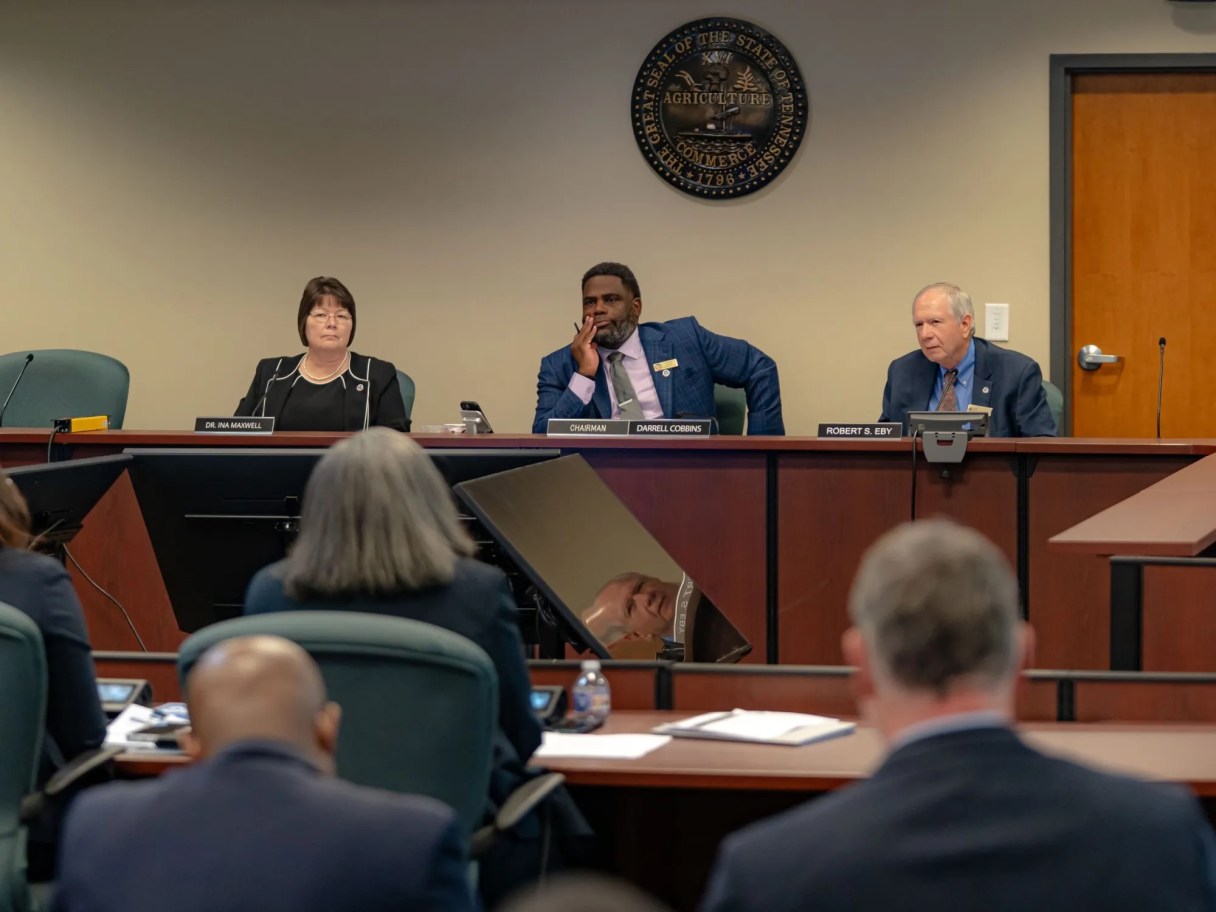
Tennessee Virtual Academy — where Wilson is not only a parent but also serves as assistant principal — is one of 12 virtual public schools serving a total of 8,000 students under threat of closure by a bill at the General Assembly due to a long history of poor academic performance. Tennessee Virtual Academy is also under scrutiny by the State Board of Education and was summoned for an “accountability hearing” on Thursday, due to two consecutive years of “F” ratings from the state.
Many families who choose virtual school have unique circumstances, like Brynnox. They have faced chronic health issues, housing insecurity or severe bullying. Many of the academy’s students have autism or anxiety, according to its leaders. Virtual school advocates argue that they are a necessary option for students who are not best served in a traditional school setting.
Yet legislators and experts argue that accountability is long overdue for virtual schools that have not improved academically over the years while evading state closure.
EQUAL TREATMENT
The General Assembly passed legislation in 2011 allowing school districts to open virtual schools. There are 65 virtual schools in Tennessee, 50 of which have opened since 2020. Many of these schools are operated by third-party, for-profit providers.
Tennessee Virtual Academy is operated by K12 Inc., a for-profit company that oversees virtual schools across the country. The school opened in 2011 in Union County, a rural county in East Tennessee, and enrolls students statewide.
The Department of Education attempted to close the school in 2014 after three years of a Level 1 TVAAS score — indicating student growth that is “significantly below expectations” — but relented after a group of parents at the school sued the state. Tennessee Virtual Academy is still a Level 1 school.
The education department is currently authorized to close a virtual school that is on the state priority list or stays at a Level 1 TVAAS score for three years. The General Assembly is considering a bill that would require, rather than authorize, the department to close these schools.
A version of the bill that passed on the Senate floor on March 19 with a 26-6 vote would close these schools immediately, whereas an amended version that would give the schools three years to improve their scores is scheduled to be heard in the House Education Committee this week. The bill has bipartisan support, with all six Democrats in the Senate voting in favor.
Virtual school leaders have argued that the bill creates an unequal accountability standard. Dr. Tonya Childress, executive director of Tennessee Virtual Academy, said that priority schools receive intervention and support from the Department of Education before a potential closure.
“HB 2420 would bypass Tennessee’s improvement framework and move directly into closure before the system has a chance to work,” Childress said during a subcommittee meeting on March 24.
“To say that virtual schools are treated the same as brick and mortar or charters is not a true statement,” Rep. Scott Cepicky, R-Culleoka, countered, before listing some examples that charter schools are subject to: Virtual schools do not undergo a rigorous application or approval process by the state, face enhanced financial oversight or ongoing evaluations or have fixed contract terms or a renewal process.
“I’m pretty sure that the virtual community who has these organizations, they don’t want to be treated like everybody else,” Cepicky said.
‘BLACK BOX’
Questions about oversight and evaluations arose during the State Board of Education accountability hearing on Thursday. The hearing committee spent a lot of time interrogating the relationship between Tennessee Virtual Academy and its home district, Union County.
The school’s students make up half of Union County’s enrollment — among the district’s 4,900 students, 2,300 attend Tennessee Virtual Academy, according to superintendent Greg Clay. Most of those students come from outside of Union County — with high concentrations in Shelby, Davidson, Knox and Rutherford counties. Just 20 students who reside in Union County attend Tennessee Virtual Academy.
Half of the district’s state funding for education also goes to Tennessee Virtual Academy. The virtual school received $25 million last year from the state.
“If it’s only 20 students out of Union County, why does Union County even associate with, you know, getting saddled with an ‘F’ school?” Board Chair Robert Eby asked.
“A part of it will go back to revenue,” Clay responded. “We are a poor county, so part of it is we do benefit on that side of things. I know that’s not the best answer.”
When asked whether the district oversees how Tennessee Virtual Academy spends that state funding, the school board chair responded that it does not.
“It’s almost like a black box,” Eby responded, incredulous. “From a board standpoint, I would want to know a little bit better (how) my money is being spent.”
“When we have record of continuous failure, it is very difficult for me to understand why a district would get half its funding from a failed project, and not stepping back and saying, OK, we definitely need to reevaluate,” State Board member Ina Maxwell added.
During the hearing, Childress said that 64% of students come to Tennessee Virtual Academy one to three grade levels behind. Teachers have spent most of their time reviewing material and filling in the gaps, rather than accelerating student learning to grade level, she argued.
After years working at traditional public schools, Casie Wilson joined Tennessee Virtual Academy as a teacher a few years ago before becoming assistant principal. She said that she chose this path in her career because of her children. After seeing how beneficial virtual education has been for her kids, she wanted to work with other students like them.
Virtual schools help children “heal” who struggled in traditional school settings, she said. “We pick up the pieces, and we see the whole child.”
This article first appeared on Nashville Banner and is republished here under a Creative Commons Attribution-NoDerivatives 4.0 International License.