
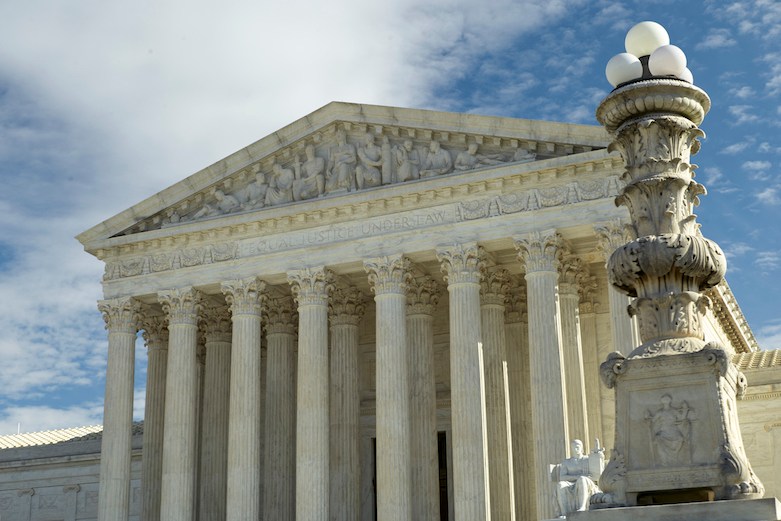
WASHINGTON — Georgia may not copyright its entire official code, which includes both the state’s laws and annotations interpreting them, the Supreme Court ruled Monday. The 5-4 decision featured unusual alliances and would most likely be widely felt, as about 20 other states have claimed that parts of similar annotated codes are copyrighted.
“If everything short of statutes and opinions were copyrightable,” Chief Justice John Roberts wrote for the majority, “then states would be free to offer a whole range of premium legal works for those who can afford the extra benefit. A state could monetize its entire suite of legislative history. With today’s digital tools, states might even launch a subscription or pay-per-law service.”
Justices Sonia Sotomayor, Elena Kagan, Neil Gorsuch and Brett Kavanaugh joined the majority opinion.
The case, Georgia v. Public.Resource.Org, No. 18-1150, concerned the 54 volumes of the Official Code of Georgia Annotated, which contains state statutes and related materials. The state, through LexisNexis, a legal publisher, makes the statutes themselves available online, and it has said it does not object to others doing the same thing. But people who want to see the annotations, prepared by lawyers working for LexisNexis as part of a financial arrangement with the state, must pay.
Public.Resource.Org, a group devoted to making government materials more accessible, put the entire code online. The state sued for copyright infringement, saying that the laws were public property but that the annotations were not.
A federal appeals court ruled against the state.
“The annotations clearly have authoritative weight in explicating and establishing the meaning and effect of Georgia’s laws,” Judge Stanley Marcus wrote for a unanimous three-judge panel of the court, the 11th U.S. Circuit Court of Appeals, in Atlanta.
Still, the annotations are not themselves law, Marcus wrote, making the case a hard one. But he concluded that the annotations were “sufficiently lawlike” that they could not be copyrighted.
That was the right result, Roberts wrote, although he offered a different reason. There is no question, he wrote, that judicial opinions cannot be copyrighted. The same is true, he said, of the official work of legislators, whether it articulates binding law or something less.
Since a commission created by the state Legislature was the author of the annotations for purposes of the copyright law, the annotations could not be copyrighted, Roberts wrote. He added that the annotations often offered important guidance.
“Imagine a Georgia citizen interested in learning his legal rights and duties,” the chief justice wrote. “If he reads the economy-class version of the Georgia Code available online, he will see laws requiring political candidates to pay hefty qualification fees (with no indigency exception), criminalizing broad categories of consensual sexual conduct and exempting certain key evidence in criminal trials from standard evidentiary limitations — with no hint that important aspects of those laws have been held unconstitutional by the Georgia Supreme Court.”
“Meanwhile,” he wrote, “first-class readers with access to the annotations will be assured that these laws are, in crucial respects, unenforceable relics that the Legislature has not bothered to narrow or repeal.”
Justice Clarence Thomas issued a dissent, which was joined by Justice Samuel Alito and, for the most part, Justice Stephen Breyer. The majority’s decision, Thomas said, turned on the characteristics of the Georgia commission and so offered little guidance to other states.
“The majority’s rule will leave in the lurch the many states, private parties and legal researchers who relied on the previously bright-line rule” between statutes and annotations, he wrote. “Perhaps, to the detriment of all, many states will stop producing annotated codes altogether. Were that to occur, the majority’s fear of an ‘economy class’ version of the law will truly become a reality.”
In a second dissent, Justice Ruth Bader Ginsburg, joined by Breyer, wrote that the annotations cannot be considered legislative work.