
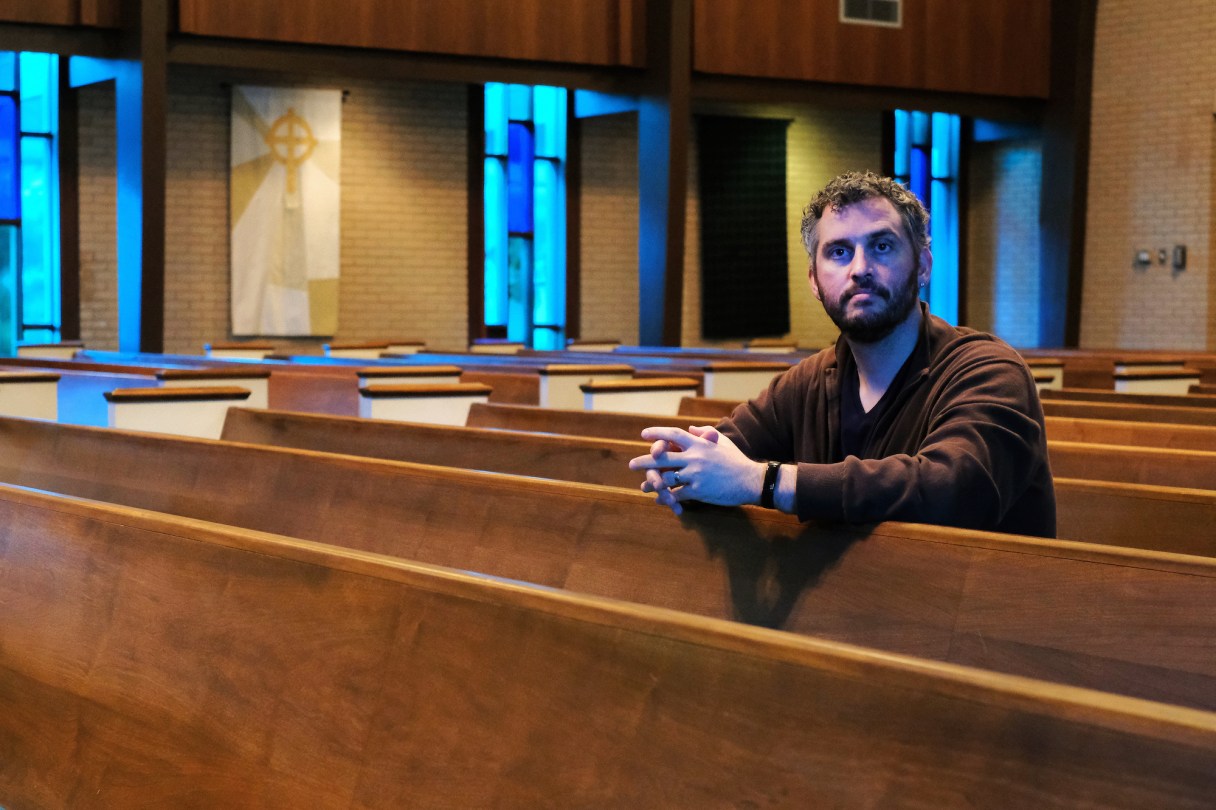
John Thomas McCecil was not going to go back.
Two and a half years earlier, McCecil was fired from a North Georgia Catholic church for his marriage. The experience was deeply painful for McCecil, a gay man who was raised Catholic.
But, in December, McCecil received an email from his alma mater, Notre Dame High School. The private Catholic school was asking whether he would be interested in directing music for the school’s production of “Godspell.”
His heart told him no. He talked to his husband. He talked to family members.
Maybe, McCecil thought, this could be a chance for reconciliation, for healing. Maybe.
He changed his mind and accepted.
Then, he was fired again.
The second firing of McCecil for his marriage set off a barrage of media attention and public scrutiny of the school from LGBTQ allies. The Diocese of Knoxville, which oversees Chattanooga and Catholic schools in the region, says it is upholding the church’s long-held convictions on marriage. And in America, with First Amendment protections, courts have repeatedly allowed religious groups to follow and enforce such doctrines.
“Our decision to terminate the contract wasn’t about his right to live as he chooses,” said Jim Wogan, director of communications for the Diocese of Knoxville, in an email. “It was about our right as a religious institution to abide by a belief that marriage is a church sacrament that unites one man and one woman.”
The Rev. Clay Thomas, pastor of Rivermont Presbyterian Church where McCecil works as director of music and the arts, said the Catholic Church’s insistence on pointing to doctrine, some of which has been changed over time, works to cut off meaningful conversation on the topic.
“It’s a fearful environment that prohibits any sort of constructive dialogue and conversations to support people who are in same-sex marriages,” Thomas said. “It’s been explicitly clear that you’re not welcome either if you support John Thomas. And so that stranglehold results in silencing, and that to me is what is also inhibiting any sort of growth or change.”
'A public stance'
McCecil grew up attending Notre Dame High School. He was closeted during his time there, he said, and left the church after graduating.
In 2009, he began working with the choir at Our Lady of the Mount Catholic Church on the Georgia side of Lookout Mountain. He was later promoted to lead the church’s music program.
In May 2019, McCecil married his husband, Jesse. Months later the church in Georgia forced McCecil to resign because, as leaders told him, he made his marriage public. The church’s pastor and a spokesperson for the Roman Catholic Archdiocese of Atlanta, which oversees Our Lady of the Mount, declined to comment at the time because it was a personnel decision.
In December, a faculty member with Notre Dame emailed McCecil asking if he would be interested in directing music for the school’s production of “Godspell.”
With some reluctance, McCecil accepted. This spring marks his 20-year graduation anniversary.
Faith-based institutions often require employees to sign morality clauses or statements of faith, which profess they will follow church teaching as part of their employment. But there was no such clause to sign in the third-party service agreement to direct the play, McCecil said.
In early February, McCecil was on campus, completing employment forms and meeting with more than a dozen students for auditions.
His contract with the school formally began Feb. 7. The evening before, a Sunday, McCecil said Notre Dame’s president, Kyle Schmitt, called him to say the contract would be voided because of McCecil’s marriage.
“We understand you are in a same-sex marriage, which conflicts with the teaching of the Catholic Church that marriage may only be between one man and one woman,” Schmitt wrote in a letter sent to McCecil days later.
Nearly two weeks later, and a day after McCecil’s story received attention in The Atlanta Journal-Constitution, Schmitt sent a letter to students, parents and alumni.
“Much of the current controversy and conflict is predicated on mischaracterizations of a recent event,” the letter said. “Our decision to terminate the service agreement was not about Mr. McCecil’s personal decision and right to live as he chooses. It was about our right as a religious institution to abide by our deeply held beliefs.”
The letter said the school follows policies from the Diocese of Knoxville.
“These policies require that everyone that works with our students and in our parishes and schools may not take public stances or make public advocacies in direct opposition to the teachings of the Catholic Church,” it said. “The diocese attempts to enforce this policy fairly and universally as was done in this situation.”
Questions from the Times Free Press to Notre Dame High School were directed to the diocese. In an email, the diocesan spokesperson Wogan said the public stance came into play because McCecil had “posted numerous pictures on social media that clearly show him in a same-sex relationship.”
“I’d say this is a public stance,” Wogan wrote.
On Feb. 25, Schmitt resigned from his role as president of Notre Dame High School, a position he held for less than a year. A reason was not given in the announcement. Wogan said the resignation was not connected to McCecil’s firing.
The school’s reasoning for terminating the contract left McCecil and his pastor confused – if the school would fire him because he is married to a man, why then ask him to work there?
“If they had never fired me, I would have come in, I would have done a job. I would have taught kids how to sing, teach them pitches, teach them rhythms,” McCecil said. “I would have come back and music directed an amazing show that is all about the love that Jesus Christ tells us we ought to share for each other. If they would have done nothing, nothing would have happened. There would be no news articles because somebody did a job.”
Ministerial exceptions
There are likely many Catholics who support McCecil and his marriage, Thomas said, but they are being silent in the face of the Catholic Church. Nearly seven in 10 American Catholics support same-sex marriage, according to a Gallup poll released in 2020. Gallup’s polling on the issue, which began in 2009, has consistently shown U.S. Catholics supporting same-sex marriage at higher rates than the national average.
But people do not speak up, Thomas said.
“All that silence is why things don’t change,” Thomas said. “We know your heart’s in the right place, and we invite you to not leave people like John Thomas out here all alone. And our kids are watching. And your family members are watching. And they need to hear you, in public, standing with them.”
The Presbyterian Church (USA) denomination, of which Rivermont is a member, supports same-sex marriage and LGBTQ leadership, unlike its denominational sibling, the Presbyterian Church in America.
People weaponize the Gospel and point to specific teachings when it is convenient, Thomas said. The Catholic Church has hundreds of rules on morality and living but, from the outside, the church seems to strictly enforce only some, he said. This critique is echoed by those who point out the church would need to fire Protestants and Jews, for example, or people who do not attend Mass.
The Catholic Church’s catechism states homosexual acts are a “grave depravity” and are “contrary to the natural law,” because same-sex attraction is not “genuine.” The church opposes same-sex marriages and instead calls people who are gay to a life of chastity. The church also teaches homosexuals should be accepted with respect and compassion, as well as calls for “every form of social or cultural discrimination” to be “eradicated.”
Title VII of the Civil Rights Act of 1964 bars employers from discriminating on the grounds of race, color, religion, sex and national origin. In 2020, in Bostock v. Clayton County, the U.S. Supreme Court ruled protections against sex discrimination include people who are gay or transgender.
However, Title VII allows “ministerial exceptions,” which through the First Amendment protects religious groups from having the government interfere with the operations of their organization, such as the firing of employees if the organization can prove the employee had a ministerial role.
Maxine Eichner, professor of law at the University of North Carolina, said courts of appeals have established different tests to determine whether a particular job is included in the ministerial exception but the Supreme Court, in cases it has heard, has not given clear guidance.
“There’s no definitive test,” Eichner said. “But the ministerial exception certainly extends to employees who are generally teaching in a manner that their schools see as relating to religious duties, even if that means just how to be a good Christian.”
Religious liberties are likely to be expanded given the Supreme Court’s conservative supermajority, Eichner said.
The petition
In mid-February, as the news of McCecil’s firing made rounds in local and regional media, Levi Brown was crafting an online petition in support of McCecil and other LGBTQ staff at the school.
Policies are hard to change, said the senior at Notre Dame High School, which is why he wanted to draw attention to the problem so it was not just one person, or a few, speaking out.
“I’m more raising the petition to say to anyone who could be listening – in Notre Dame and other schools, other Catholics, non-Catholics – this is what happened. I feel like we need to protect LGBTQ+ rights, and especially as Christians – and going to a Catholic school – it would be the best representation of our mission statement of diversity to actually have diversity, actually have an open heart and open mind to every walk of life,” Brown said.
The petition, hosted on Change.org, had received more than 2,200 signatures as of Friday.
Brown said the school has been supportive of him making the petition and speaking up in support of McCecil.
McCecil said he hopes people recognize gay or gender-nonconforming people have a place in Christianity. He thinks specifically about students who may be unsure about their sexuality and just saw a gay man get fired.
“Kids who are struggling to reconcile their faith and their sexuality, or gender identity, there is a place for them and they are loved and accepted and celebrated. There are no parentheticals. There’s no superscript tiny, you know, fast-spoken speech at the end of the commercial. And Notre Dame, I don’t believe, understands how harmful they’re being,” he said. “The Gospel of Jesus should not turn people away from the church.”
In January, McCecil and his husband were approved to become foster parents. Within hours they were caring for a newborn, now 2 months old.
While the attention is focused on McCecil and his marriage, he is more than his sexuality, Thomas said. His being gay is just part of the conversation.
“It’s more important, I feel, to see him as another human being, a child of God who is trying to be good, be a disciple, rather than an issue,” Thomas said. “When we make it an issue, it’s a lot easier for people to be against him because they have a position on the issue. But if they make it about the person, I think, it would be really hard to not say this was not a fair way to treat another person.”
Contact Wyatt Massey at wmassey@timesfreepress.com or 423-757-6249. Follow him on Twitter @news4mass.