
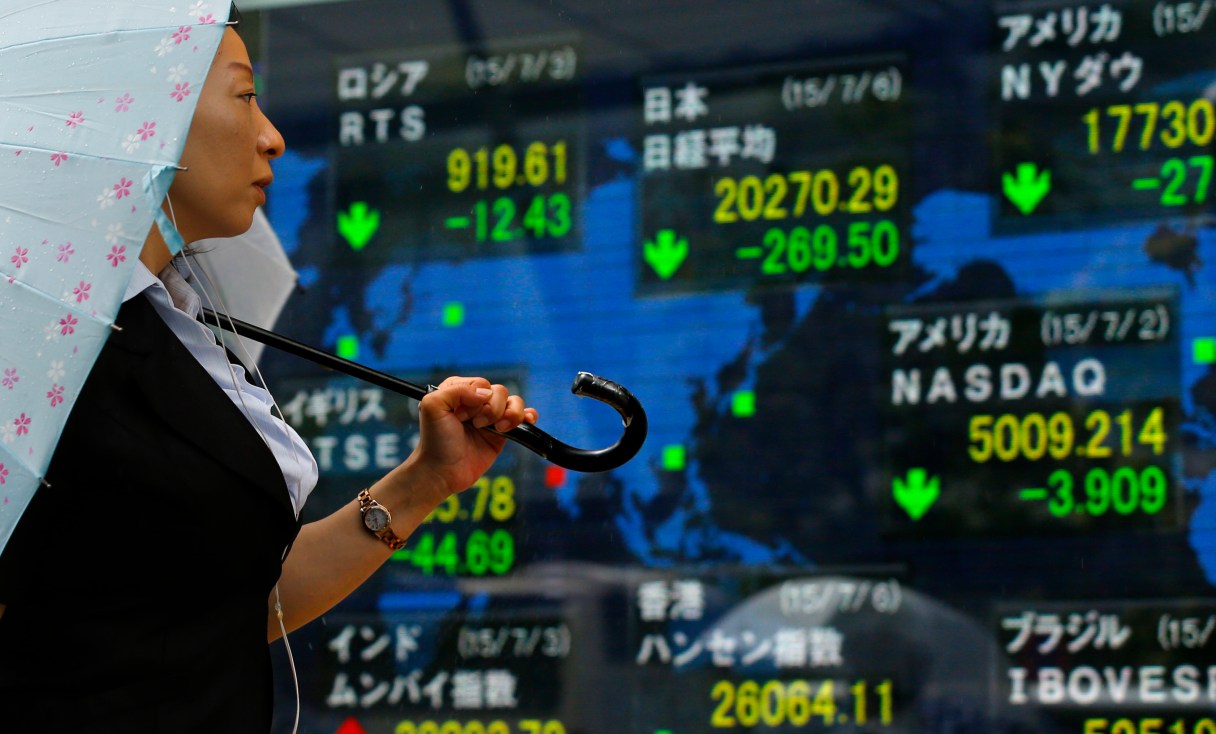
TOKYO (AP) – Asian shares tumbled Monday after Greece’s voters vehemently rejected conditions set by its international creditors, deepening doubts over their future in the 19-nation eurozone.
China’s benchmark initially rebounded from last week’s heavy losses after regulators and the securities industry intervened to prop up the markets, but gave up those gains as the day wore on.
Greece’s debt problem has long overshadowed the market and with a European summit expected Tuesday, the implications of Sunday’s “no” vote remain unclear. So the initial response to Sunday’s Greek referendum was negative but not panicked.
Japan’s Nikkei 225 stock index dropped 2.1 percent to 20,212.12, while Hong Kong’s Hang Seng sank 4.4 percent to 24,916.16. South Korea’s Kospi fell 2.3 percent to 2,056.88. By late afternoon the Shanghai Composite index was up 0.5 percent at 3,705.16.
Mainland Chinese shares are somewhat isolated from world markets thanks to capital controls limiting the scope of foreign investment. The Shanghai Composite index surged nearly 6 percent after the market opened after the central bank pledged support for market investments; 28 companies agreed to postpone planned initial public offerings, and major brokerages pledged more than $19 billion for a fund to stabilize the free-falling markets.