
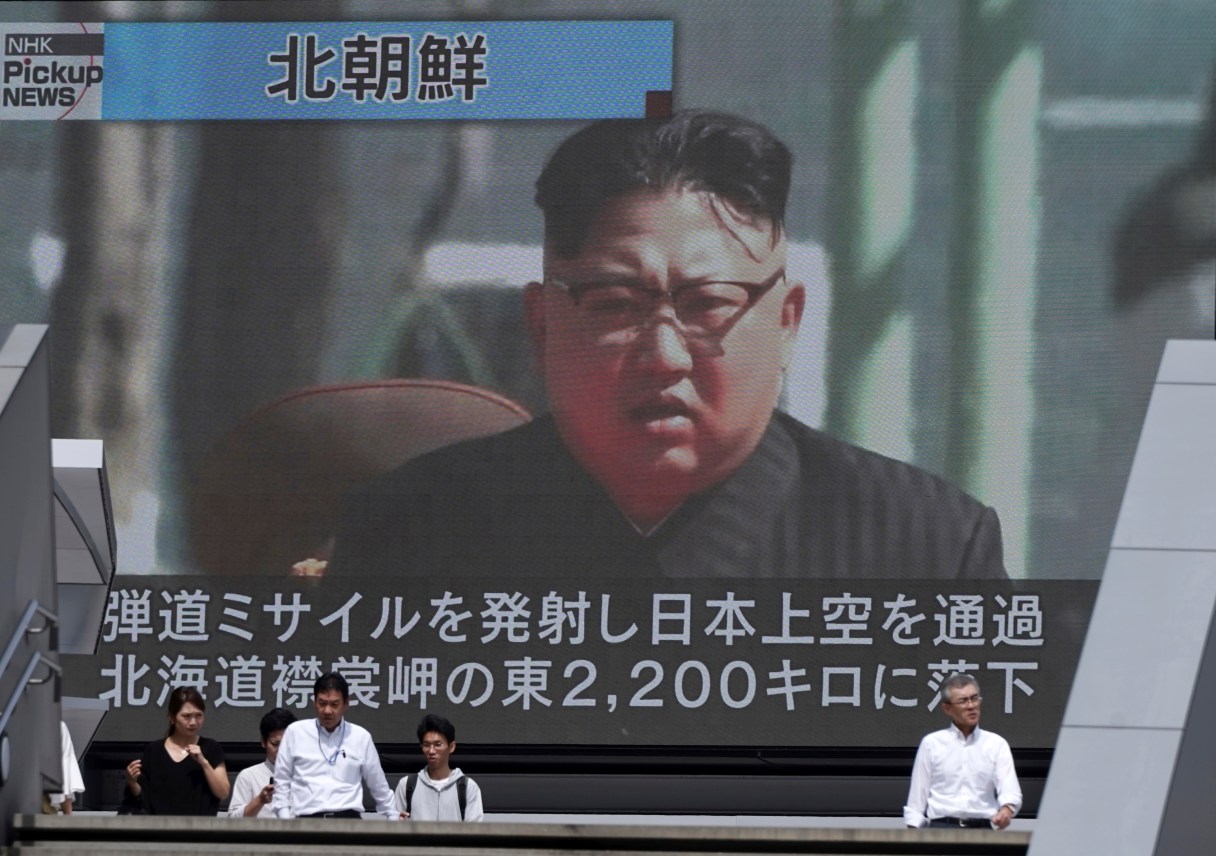
SEOUL, South Korea (AP) – North Korea conducted its longest-ever test flight of a ballistic missile Friday, sending an intermediate-range weapon hurtling over U.S. ally Japan into the northern Pacific Ocean in a launch that signals both defiance to its rivals and a big technological advance.
Since President Donald Trump threatened the North with “fire and fury” in August, Pyongyang has conducted its most powerful nuclear test, threatened to send missiles into the waters around the U.S. Pacific island territory of Guam and launched two missiles of increasing range over Japan. July saw its first tests of intercontinental ballistic missiles that could strike deep into the U.S. mainland when perfected.
The growing frequency, power and confidence displayed by these tests seem to confirm what governments and outside experts have long feared: North Korea is closer than ever to its goal of building a military arsenal that can viably target both U.S. troops in Asia and the U.S. homeland. This, in turn, is meant to allow North Korea greater military freedom in the region by raising doubts in Seoul and Tokyo that Washington would risk the annihilation of a U.S. city to protect its Asian allies.
South Korea’s Joint Chiefs of Staff said the latest missile traveled about 3,700 kilometers (2,300 miles) and reached a maximum height of 770 kilometers (478 miles). Guam, which is the home of important U.S. military assets, is 3,400 kilometers (2,112 miles) away from North Korea.
North Korea has repeatedly vowed to continue these tests amid what it calls U.S. hostility – by which it means the presence of nearly 80,000 U.S. troops stationed in Japan and South Korea. Robust international diplomacy on the issue has been stalled for years, and there’s little sign that senior officials from Pyongyang and Washington might sit down to discuss ways to slow the North’s determined march toward inclusion among the world’s nuclear weapons powers.