
Wednesday, November 11, 2026Nov 11

Space agency starts to unfold atlas of 1 billion stars in 3D

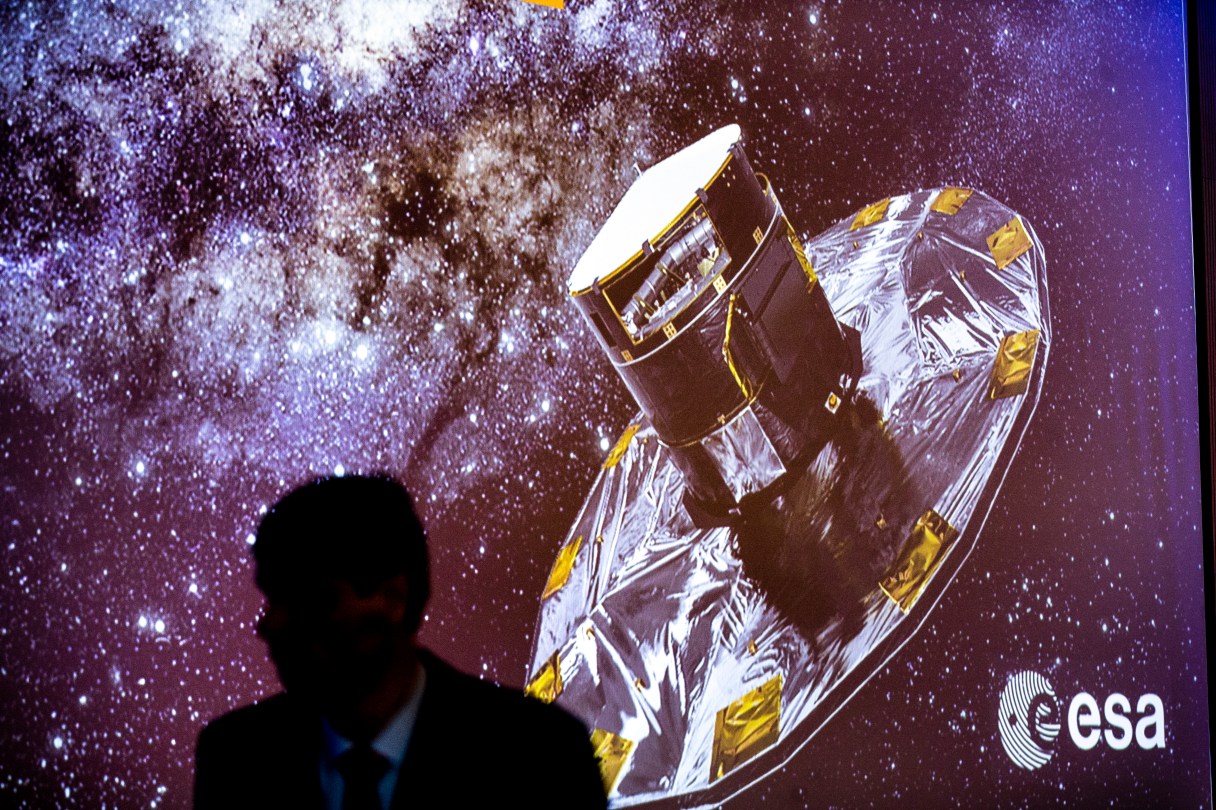
A man walks in front of a slide show depicting a representation of the ESA Gaia Project, at the ESA center in Villanueva de la Canada, near Madrid, Spain, Wednesday, Sept. 14, 2016. the European Space Agency said Wednesday its mission to chart more than 1 billion stars in the Milky Way is on track for completion in a year's time. The agency released the first data from its ongoing effort, called the Gaia Mission, to draw the biggest and most precise three-dimensional map of our galaxy. (AP Photo/Daniel Ochoa de Olza)
A man walks in front of a slide show depicting a representation of the ESA Gaia Project, at the ESA center in Villanueva de la Canada, near Madrid, Spain, Wednesday, Sept. 14, 2016. the European Space Agency said Wednesday its mission to chart more than 1 billion stars in the Milky Way is on track for completion in a year's time. The agency released the first data from its ongoing effort, called the Gaia Mission, to draw the biggest and most precise three-dimensional map of our galaxy. (AP Photo/Daniel Ochoa de Olza) A man walks in front of a slide show depicting a representation of the ESA Gaia Project, at the ESA center in Villanueva de la Canada, near Madrid, Spain, Wednesday, Sept. 14, 2016. the European Space Agency said Wednesday its mission to chart more than 1 billion stars in the Milky Way is on track for completion in a year's time. The agency released the first data from its ongoing effort, called the Gaia Mission, to draw the biggest and most precise three-dimensional map of our galaxy. (AP Photo/Daniel Ochoa de Olza)

MADRID (AP) – If space is the final frontier, it will help to have an accurate map, and the European Space Agency said Wednesday its mission to chart more than 1 billion stars in the Milky Way is on track for completion in a year’s time.

The agency released the first data from its ongoing effort, called the Gaia Mission, to draw the biggest and most precise three-dimensional map of our galaxy.

Mission manager Fred Jansen told a news conference in Madrid that the project has already collected some 500 billion measurements and he is “extremely happy” with the precision of the data. It is being distributed among scientists for analysis.

At the heart of the five-year mission is the 10-meter (33-foot)-wide Gaia spacecraft, which resembles a barrel sitting on a silver saucer. It carries two telescopes and is orbiting slowly around the sun.

Anthony Brown, head of the scientific consortium processing Gaia data, said the highly precise calculations represent “a revolution” in astrophysics. The high-resolution methods have already helped identify some 400 million new stars.