
April 22, 2019, marked the 50th anniversary of a referendum approving the incorporation of Soddy-Daisy as a new municipality.
Soddy, one of the oldest areas of Hamilton County, and Daisy, the site of the county’s first courthouse at Poe’s Tavern, had, according to the late James Livingood, grown relying “on an economic base of coal, coke and tile before the Great Depression. After World War II the motor car and good roads helped bring a new spirit to the area, and it was at that time that it experienced its greatest growth.” Notwithstanding that new growth, the area was the home of only 2.7% of the county’s population in 1967, which meant that the two communities were of necessity a low priority for a county government trying to efficiently serve more populous areas.
There actually was an effort to incorporate a 6-square-mile area of Soddy in 1958 led by the Soddy Lions Club, but voters rejected the initiative. In 1969, the petition for a referendum to incorporate was circulated by the Soddy-Daisy Jaycees, spearheaded by a committee led by pharmacist Ralph Gibbs. Eventually, 520 residents signed the petition. Unlike the incorporation proposed for Soddy in 1958, a 9-mile stretch along Dayton Pike from Thrasher Pike to Hotwater Road was designated as the central corridor of the proposed new city, an area of nearly 23 square miles. There were 7,502 residents in the proposed corporate limits.
Gibbs and his fellow Jaycees enlisted the aid of attorney Glenn McColpin, who shepherded the successful incorporation of Collegedale the year before. In the weeks before the vote, public meetings were held at both Soddy and Daisy Elementary schools, and Gibbs listed three primary advantages to incorporation: 1) progress; 2) attracting industry; and 3) improving fire and police protection. At one of the meetings, Collegedale Mayor Fred Fuller answered questions about his city’s recent experience. Fuller related that if fire and police protection could be improved, residents might actually save money on insurance sufficient to more than offset taxes. The meetings also addressed rumors that the new city, still largely in a rural area, would prohibit mobile homes, ban outdoor plumbing or require sidewalks.
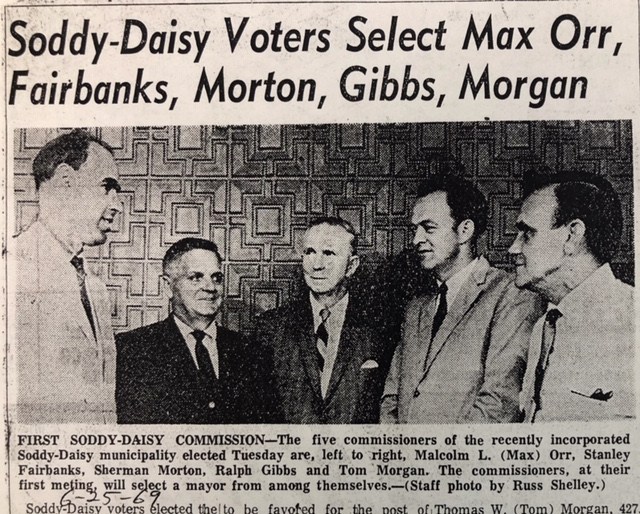
As noted above, incorporation was approved but by a relatively narrow 744-689 vote. In June, five city commissioners were elected, Gibbs, M.L. (Max) Orr, Stanley Fairbanks, Sherman Morton and Thomas Morgan. Orr, a World War II veteran of the Army Air Corps, received the most votes and was elected by his fellow commissioners as the city’s first mayor, and Gibbs as vice-mayor. These men faced the Herculean task of starting a government from scratch. On Jan. 1, 1970, 36-year-old Virgil Adams, previously the executive director of the South Pittsburg Housing Authority, was hired as the municipality’s first city manager. As he had with Collegedale, McColpin became Soddy-Daisy’s first city attorney. Now-legendary local lawyer Jerry Summers was appointed the first city judge.