
Across the U.S., state and local officials are trying to balance the competing priorities of protecting their citizens from the coronavirus while keeping the economy running. Add into the mix strong feelings about individual freedom, weak and sometimes contradictory guidance from the federal government, and a highly partisan political atmosphere, and that balancing act suddenly becomes a wrestling match.
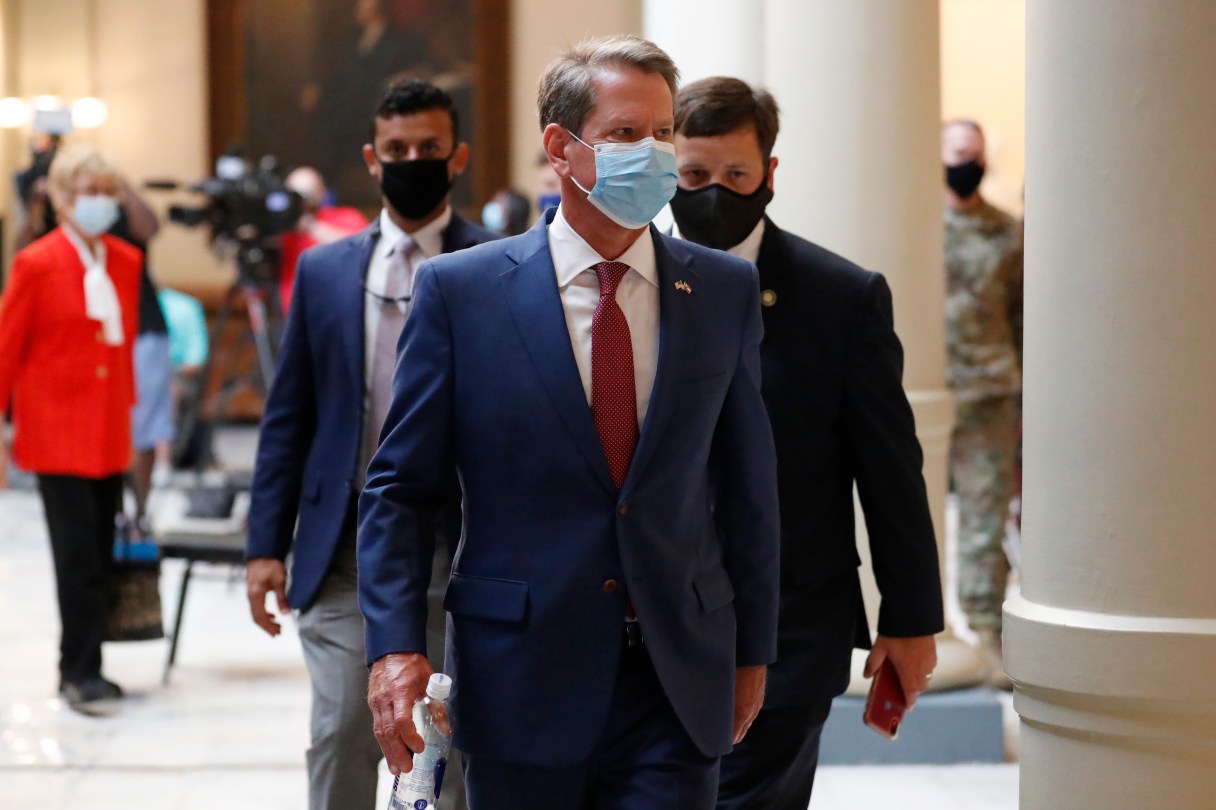
Take Georgia for example, where Republican Gov. Brian Kemp is suing the Democratic mayor of Atlanta over its face mask mandate. Kemp filed the lawsuit Thursday, a day after issuing an executive order banning cities from requiring face coverings. President Donald Trump also visited Atlanta on Wednesday, arriving at the airport without a face mask. The circumstance prompted Atlanta Mayor Keisha Lance Bottoms, who earlier tested positive for the virus but was asymptomatic, to question the timing of the lawsuit.
With case counts rising rapidly in Georgia, more than a dozen cities and counties have defied Kemp and issued local orders requiring masks.
Meanwhile, in Louisiana, Republican Attorney General Jeff Landry issued a legal opinion from quarantine on Wednesday stating Democratic Gov. John Bel Edwards’ order requiring face coverings and limiting bar service and indoor gathering is “likely unconstitutional and unenforceable.” Landry is in quarantine after announcing Tuesday that he tested positive for the virus but had no symptoms.
Edwards’ initially had resisted a statewide mask order, but changed his mind as case numbers began rising rapidly in Louisiana. The order went into effect Monday. In the legal opinion requested by a group of eight Republican lawmakers, Landry wrote that “mask police could face liability if individual civil rights are violated due to the proclamation.” The opinion doesn’t carry the force of law but could form the basis of a lawsuit if someone challenges Edwards’ regulations.