
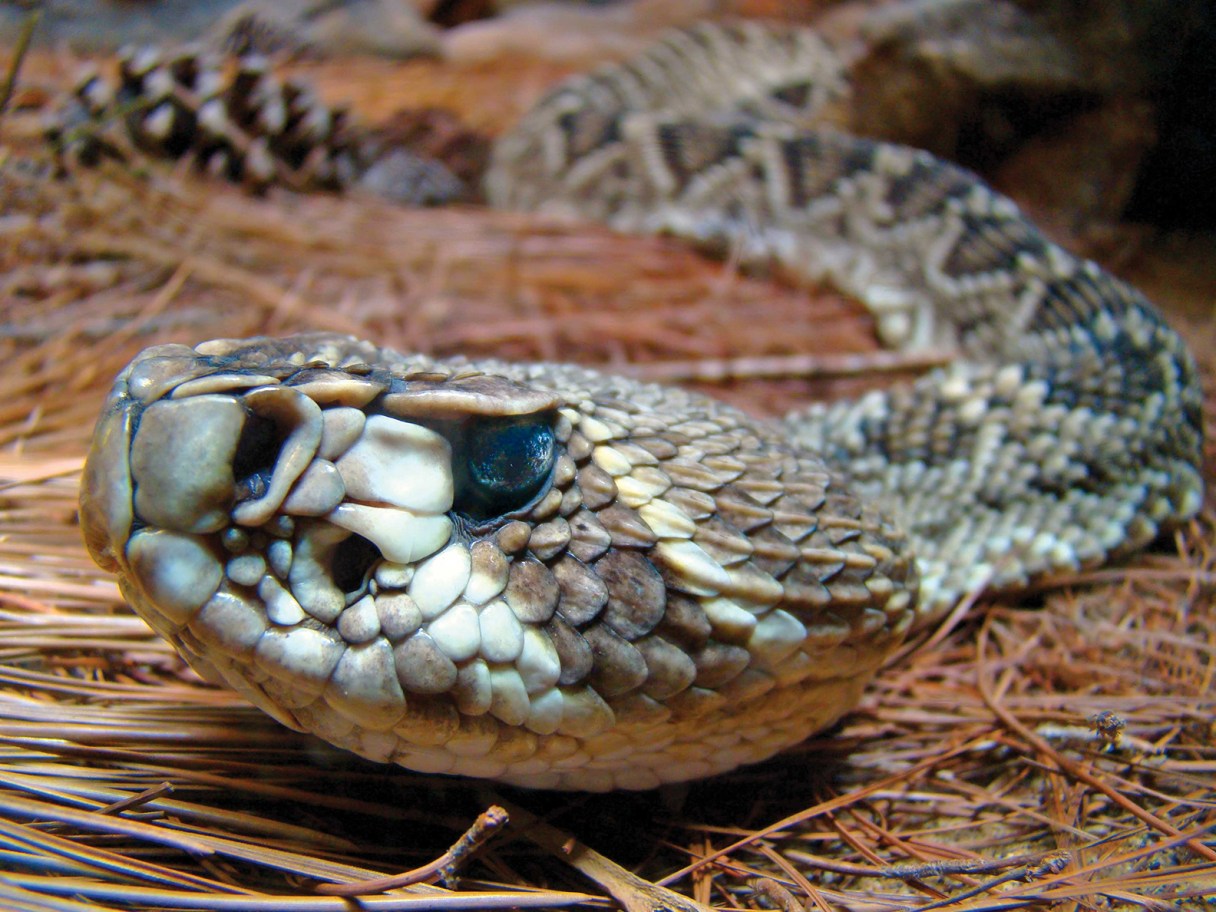
Venomous or Not?
Aside from coral snakes, nonvenomous snakes traditionally have:* Tapered head* Double row of subcaudal scales on the distal anal plate* Round pupils and fixed teethTraditionally, venomous snakes have:* Triangular head* Single row of subcaudal scales* Heat-sensitive pit, elliptical cat-like eyes, retractable fangs, which are their only teeth.Who Cares? Stay Away!Moore strongly advises just staying away from the snake. “All of these things are true, but they are really subtle and things can change,” he says, adding that the hog snake, a nonvenomous snake, has evolved to learn how to triangulate and flatten its head to appear venomous.Note: Coral snakes are very different. They have a round head, fixed teeth and can generally be determined by their striping. Remember this rhyme: “Red next to yellow will kill a fellow. Red next to black is a friend to Jack.”
Did You Know?
Many people might see a snake swimming in a body of water and automatically assume it’s a water moccasin, but this isn’t necessarily true. “All snakes swim,” says Moore.
 Dr. Chris Moore
About Our Expert
Dr. Chris Moore is a medical doctor who has held many wilderness safety roles in the community during his tenure. He was the director of wilderness and event medicine at the UTC College of Medicine, helped start Baylor’s Walkabout program and Outdoor Chattanooga, and has served as trip physician on multiple outdoor excursions far and wide.
When Dr. Chris Moore gives educational presentations on snakebites, he likes to make his audience squirm with a nice, big picture of a snake to kick off his lecture.After watching their collective shudder, he’ll ask, “Why is it we are so afraid of something that is a fraction of our size?”
It’s a good question. Moore says whenever he gets the chance, he tries to educate outdoor lovers on the truth about these slithering reptiles. Should you happen to run into one on your next trek in the woods, here’s what you should know.