
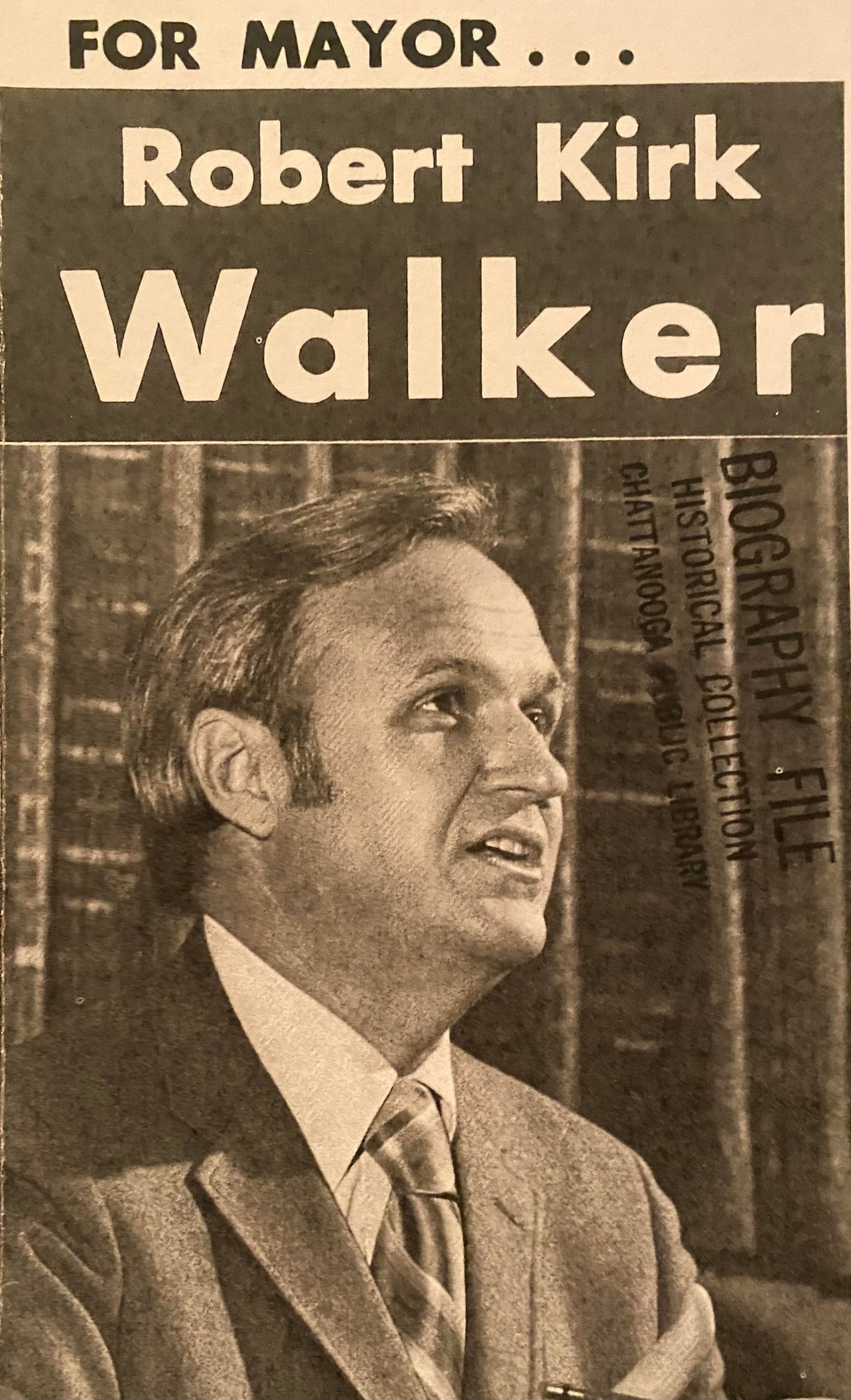
(Editor’s note: Second of two parts)
On Jan. 9, 1971, Chattanooga attorney Robert Kirk Walker announced his candidacy for mayor: “I extend the call to every citizen to join me in a united campaign to build a greater Chattanooga. With a spirit of mutual understanding and trust, progress is certain. Whether rich or poor, black or white, Democrat, Republican or Independent, Catholic, Jew or Protestant, the times demand intelligent, cooperative action.”
In the 25 years since his return from the U.S. Navy during World War II, briefly interrupted by a return to the military during the Korean conflict, Walker had gained the respect and recognition of Chattanooga’s leaders and its citizens. He had been honored by the Chattanooga Education Association as its “Citizen of the Year,” with the Boy Scouts’ Silver Beaver Award, and by Sertoma International with its “Service to Mankind” Award. During the same years, the Chattanooga Realtors presented him with its Citizenship Award, while his “eloquent addresses on our nation’s heritage of liberty” resulted in four major awards from Freedoms Foundation.
Professionally, he was elected president of the Chattanooga Bar Association in 1962. Three years later, he took the helm of the Tennessee Bar Association, which praised his “leadership in modernization of court systems and improvement of the administration of Justice.”
A partner in the law firm of Strang, Fletcher, Carriger, Walker and Hodge, the future mayor fought for “educational opportunity for Chattanoogans of all races.” As the chairman of the special four-year state college committee and chairman of the educational task force, he was credited with bringing the “University of Tennessee to Chattanooga” and orchestrating the “merger of Chattanooga City College with the University of Tennessee at Chattanooga.” At the same time, he worked to establish a vocational-technical school and obtain approval for a major expansion of Chattanooga State Technical Institute’s facilities, allowing it to double its enrollment.