
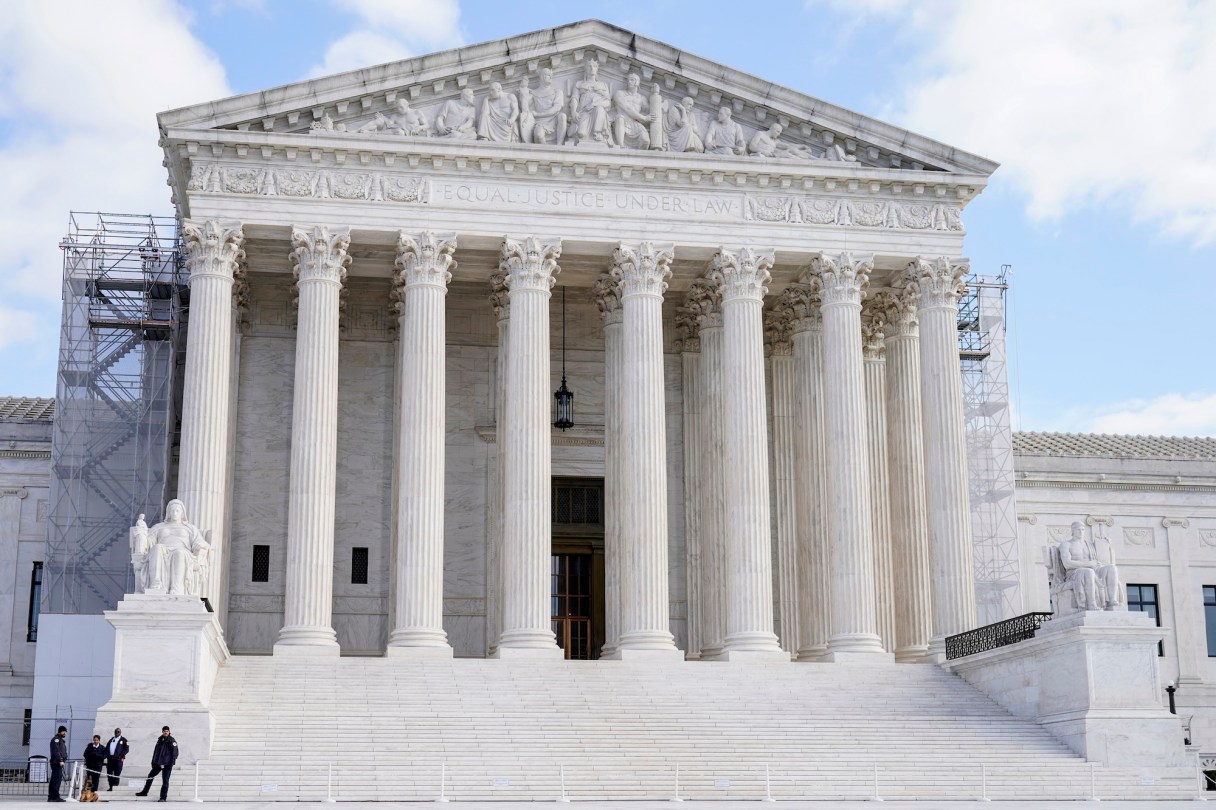
More than any U.S. Supreme Court case in decades, former President Donald Trump’s appeal of the Colorado decision disqualifying him from the state’s primary ballot combines huge political moment with a scarcity of guiding law. For the court, which announced last week that it would hear the case on a warp-speed schedule, that is a precarious combination that exposes it to accusations of political bias.
So how will the court rule? I think it will be loath to permit a patchwork result in which Trump appears on the ballot in some states but not in others. To avoid such a patchwork, a majority of the justices is likely to reverse the Colorado Supreme Court’s ruling that Trump engaged in insurrection and is therefore ineligible for office under the 14th Amendment. And the court will probably do so in a way that also prevents other states from removing the former president from the ballot.
As the court arguably has in other landmark decisions, it may well act politically in the sense that it will be most concerned about the practical result. That’s different from saying that the decision will break down along party lines.
The majority could well consist of those most likely to share Chief Justice John G. Roberts Jr.’s concern for the court’s standing and hesitation to intrude on the election. Such a majority would be more likely to include justices open to institutionalist arguments, such as Elena Kagan and Brett M. Kavanaugh, than far-right rebels Samuel J. Alito Jr. and Clarence Thomas.
An early sign of such a consensus is the court’s unanimous order accepting the case and setting an expedited timetable, with oral argument scheduled in a month.