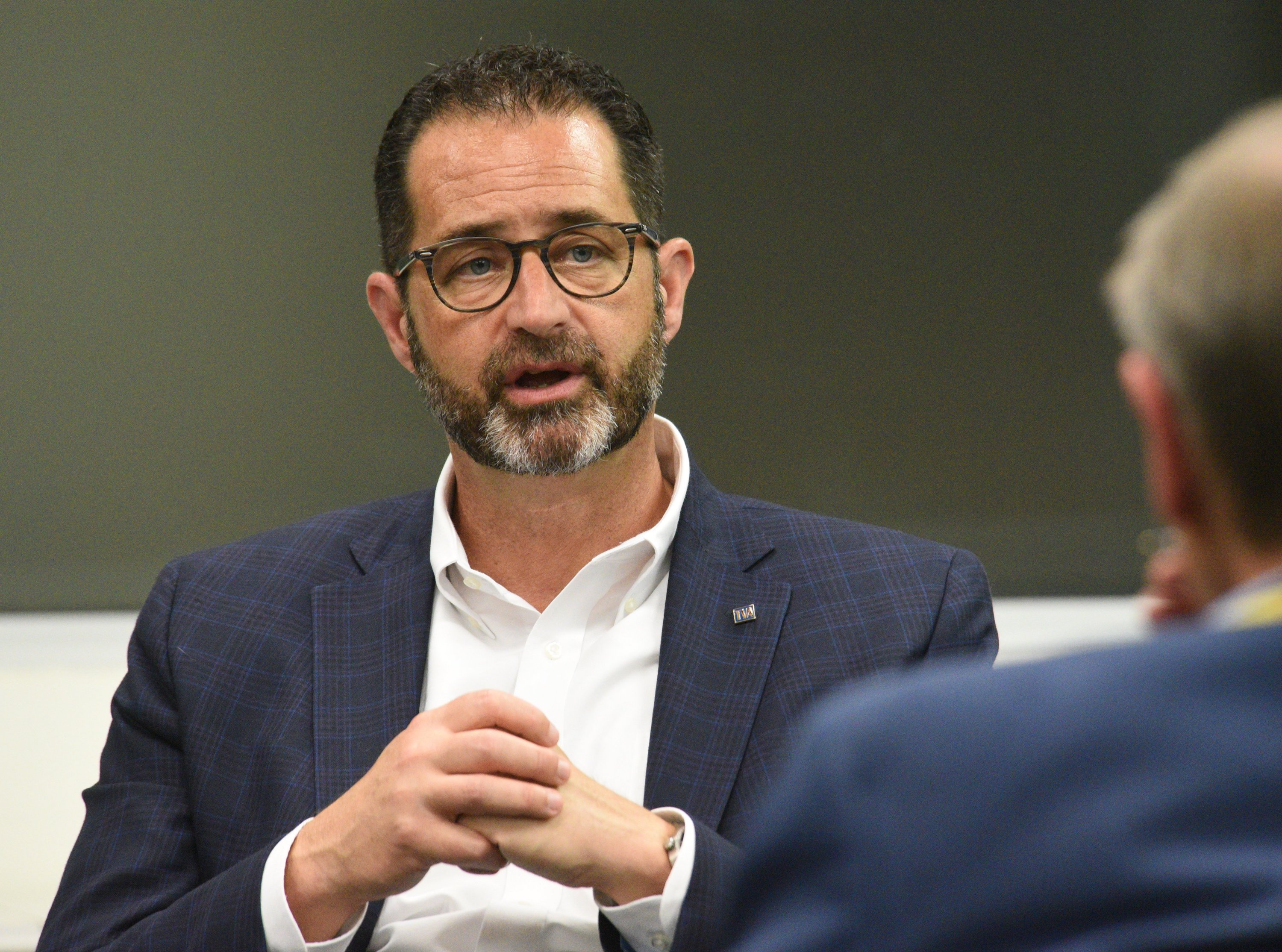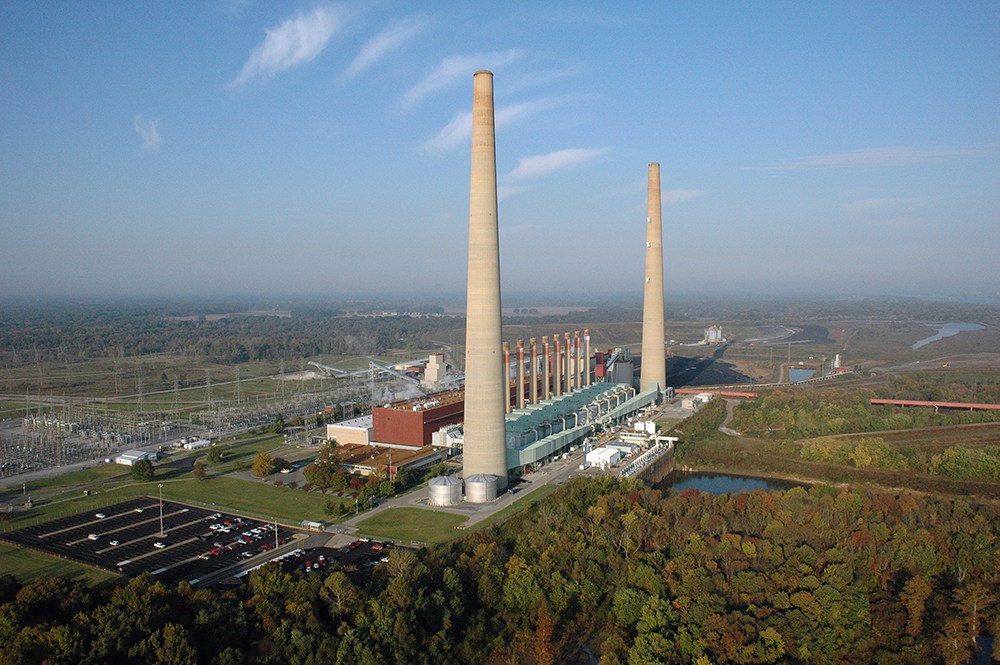
Prompting pushback from environmental groups, CEO Don Moul said it’s possible TVA could maintain at least part of its coal fleet past 2035, which is the year the agency had initially set to shut down the aging facilities.
In early April, President Donald Trump, a longtime champion for coal, signed a series of executive orders designed to boost the struggling industry, according to The Associated Press. Those actions would enable some older coal-fired power plants set for retirement to keep producing electricity to meet rising power demand.
Trump also signed a proclamation offering coal-fired power plants a two-year exemption from federal requirements to reduce emissions of toxic chemicals like mercury, arsenic and benzene.
The Tennessee Valley Authority, a federal utility that supplies power to 10 million people across parts of seven states, previously said it would retire its entire coal fleet by 2035. Thursday, Moul said TVA officials are assessing the president’s recent orders.
(READ MORE: TVA’s long-term power planning sparks concerns from clean energy advocates)
“We are reevaluating the end of life study that we did on our coal fleet, and we’re taking a hard look at our asset strategy with regard to the regulatory environment in front of us,” Moul said. “We really have to fall back on least cost planning principles per the TVA Act,” which is the federal law that established the agency in 1933.
Trey Bussey, a staff attorney at the Southern Environmental Law Center, said TVA decided to retire its coal plants because they are dirty, unreliable and expensive.
“That hasn’t changed,” Bussey said in a statement. “Continuing to operate these antiquated coal plants would not only threaten families in the Tennessee Valley with additional pollution, but also risks saddling TVA customers with more expensive and more unreliable power.”
(READ MORE: TVA’s long-term power planning sparks concerns from clean energy advocates)
Moul said there’s strong potential for the Shawnee and Gallatin fossil plants in West Paducah, Kentucky, and Gallatin, Tennessee, to operate for the foreseeable future. Officials will also take a close look at the Kingston and Cumberland plants, he said.
TVA’s coal plants are operating “well beyond their book life” and were among the oldest still in operation in the nation, according to a May 2021 evaluation of the fleet.
The utility has four coal plants with a total of 24 units in operation. Outages are planned at all four sites this spring so officials can inspect and make updates ahead of peak power demand during the summer, Moul said. The agency’s board also recently approved two additional sulfur dioxide scrubbers at its Shawnee plant.
PIVOTAL MOMENT
Moul stepped into the top job at TVA on April 9, succeeding former CEO Jeff Lyash. The agency is at a pivotal moment, he said.
“When you think about the growth of our economy, it’s going to be determined by the strength of our energy and infrastructure, and TVA is leading that charge,” Moul said. “Our region is in a period of substantial growth. At TVA, we’re making some of the largest capital investments in our history to ensure we have reliable, resilient power today and for the next generation of American industry and jobs.”
TVA plans to invest $16 billion over the next three years that will include constructing about 5,500 megawatts of new power generation by 2029. This builds on $22 billion the agency has spent on its system over the past decade.
In March, TVA announced it was seeking proposals for a 100 megawatt battery storage system at the Kingston Energy Complex, which it’s building in East Tennessee. Once complete, this facility will deliver more than 700 megawatts of combined cycle natural gas, 800 megawatts of flex-fuel aeroderivative turbines, 100 megawatts of battery storage and up to 4 megawatts of storage. That’s enough electricity to power 900,000 homes, Moul said.
(READ MORE: TVA to boost electric rates this fall by biggest amount in a decade)
“Aeroderivative” means something is designed to create power from the exhaust of a separate engine, and the term is often used to describe gas turbines derived from aviation technology.
TVA’s new aeroderivative combustion turbine facility in New Johnsonville, Tennessee, is almost ready for operation and will provide 500 megawatts of power to help meet summer energy demand, Moul said. The utility is also planning a 500-megawatt combustion turbine facility at its New Caledonia site in Mississippi, and it’s exploring another 200-megawatt project in Memphis.
Business investment in the region is accelerating, Moul said. Before 2020, TVA averaged about 30 industrial requests per year. In the 2024 budget year, the utility received 180 new inquiries, translating to the equivalent of nearly 22,000 megawatts of electric power, Moul said. That’s about two-thirds of TVA’s entire system capacity.
“For our region, that sort of growth is great,” Moul said.
Over the past five years, the region’s gross domestic product has outpaced the national average, and the population has grown faster than the country overall.
“To continue delivering on our mission, ensure reliability and drive growth in the region, TVA must invest in new generation capability and new technology,” Moul said.
QUICK AND PRUDENT
Trump recently fired two members of the agency’s board of directors, leaving it without a quorum. The panel and the utility have also received criticism from Tennessee’s two Republican U.S. Senators, Marsha Blackburn and Bill Hagerty, who have slammed the pace of a small, modular nuclear reactor project the utility is planning near Oak Ridge.
TVA holds the nation’s first early site permit for a small nuclear reactor at its Clinch River site, and the agency is getting ready to request a construction permit from the Nuclear Regulatory Commission.
The utility has already invested $200 million into the project, and the TVA board has approved another $150 million. TVA and its partners are now seeking $800 million from the U.S. Department of Energy to speed up construction.
(READ MORE: Hagerty calls TVA ‘limiting factor’ on economic development projects in Tennessee)
Moul said TVA is moving as quickly and as prudently as it can.
“We understand that we can’t put first-of-a-kind costs on our customers, and we’re looking for partners that are looking for this type of generation to offset those first-of-a-kind costs,” Moul said. “We want to be very careful to maintain affordable rates for our customers and not socialize first-of-a-kind costs across the whole Tennessee Valley.”
Hagerty recently called TVA “the limiting factor” for economic development projects in Tennessee, noting brownouts across the state during Winter Storm Elliot in 2022 revealed the agency’s lack of generating capacity. He also pointed to the utility’s decision to shut down coal plants.
The 2022 winter storm caused both units at TVA’s Cumberland Fossil Plant to shut down and several gas-powered units to fail. TVA has since spent $430 million to harden its system and boost the reliability of its natural gas, coal and hydro fleets. That has included building shelters for equipment and installing new, real-time sensors and more insulation around critical components.
Moul said Thursday the utility has since met record power demands in 2024 and 2025, which is largely thanks to lessons learned in 2022.
“We are continuing to invest in our existing fleet, making sure we have reliable, resilient power,” he said.
BAND-AIDS
Amy Kelly, who manages the Beyond Coal campaign at the Sierra Club, said TVA decided to retire its coal fleet because the plants were expensive to maintain. They also pump millions of tons of carbon into the atmosphere per year.
“There’s only so much retrofitting, Band-Aids you can apply to an old machine before it just doesn’t work anymore, so it’s really costing us because all the infrastructure improvements go right back down to the ratepayers,” Kelly said in a phone call. “Any debt that they wrack up on these plants by continuing to repair them, that’s going to inflate costs for us.”
Most utilities are turning away from coal, Kelly said.
“The only thing that’s changed is who we have in the White House,” she said. “We’ve seen that there is pressure that has been applied to all federal agencies, and that includes TVA. So it looks like they’re going against their own studies and what’s best for consumers.”
Contact David Floyd at dfloyd@timesfreepress.com or 423-757-6249.