
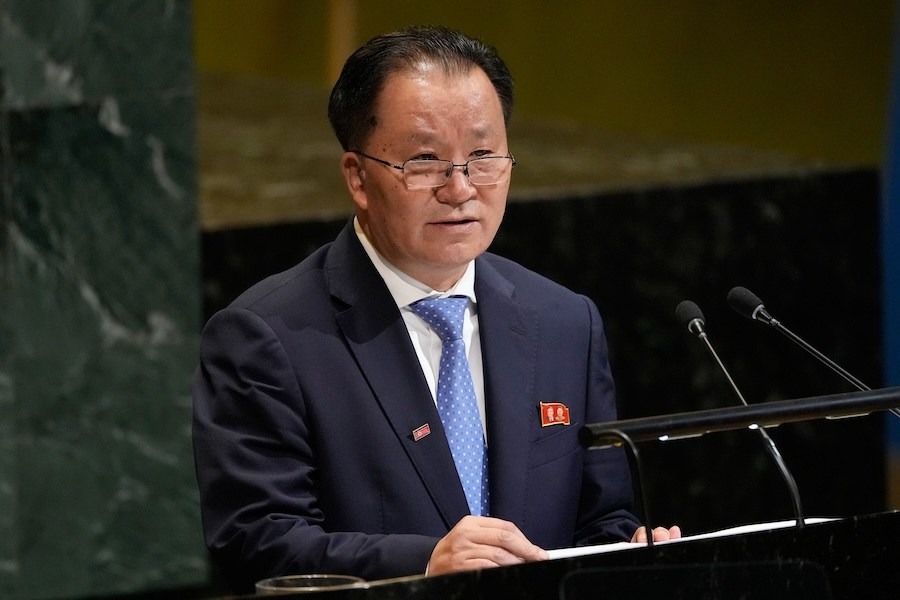
UNITED NATIONS (AP) — A senior North Korean diplomat reiterated at the U.N. Monday that his country won’t give up its nuclear weapons despite numerous international demands to do so, calling them crucial to keeping a “balance of power” with South Korea. “We will never walk away from this position,” he said.
Under the spotlight of the General Assembly’s annual meeting of world leaders, Vice Foreign Minister Kim Son Gyong amplified his country’s longstanding complaints about U.S.-led military exercises with South Korea and Japan. Complaining that the U.S. and its allies are mounting a “growing threat of aggression,” he portrayed his own country’s arsenal as the reason “the balance of power on the Korean Peninsula is ensured.”
Still, his address was more tempered, especially toward the United States, than many of his country’s prior remarks on the world stage and elsewhere. While Kim lambasted — without naming names — “hegemonic forces” and an “indiscriminate tariff war,” there were no direct references to U.S. President Donald Trump or personal insults, and there was more sternness than over-the-top bellicosity.
Kim vowed that “we will never give up nuclear,” noting that North Korea’s nuclear program is enshrined in its constitution.
He asserted that security on the Korean Peninsula “is faced with serious challenges more than ever,” saying that the U.S.-Japanese-South Korean exercises “are breaking all the previous records in terms of scale, nature, frequency and scope.” The North routinely characterizes such war games as preludes to an attack.