
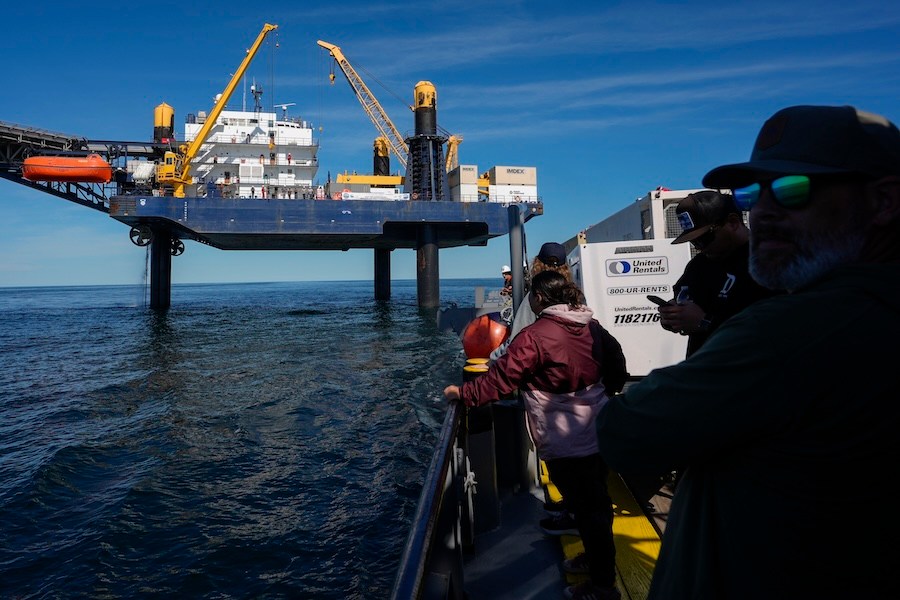
ABOARD LIFTBOAT ROBERT, North Atlantic (AP) — Deep in Earth’s past, an icy landscape became a seascape as the ice melted and the oceans rose off what is now the northeastern United States. Nearly 50 years ago, a U.S. government ship searching for minerals and hydrocarbons in the area drilled into the seafloor to see what it could find.
It found, of all things, drops to drink under the briny deeps — fresh water.
This summer, a first-of-its-kind global research expedition followed up on that surprise. Drilling for fresh water under the salt water off Cape Cod, Expedition 501 extracted thousands of samples from what is now thought to be a massive, hidden aquifer stretching from New Jersey as far north as Maine.
It’s just one of many depositories of “secret fresh water” known to exist in shallow salt waters around the world that might some day be tapped to slake the planet’s intensifying thirst, said Brandon Dugan, the expedition’s co-chief scientist.
“We need to look for every possibility we have to find more water for society,” Dugan, a geophysicist and hydrologist at the Colorado School of Mines, told Associated Press journalists who recently spent 12 hours on the drilling platform. The research teams looked in “one of the last places you would probably look for fresh water on Earth.”