
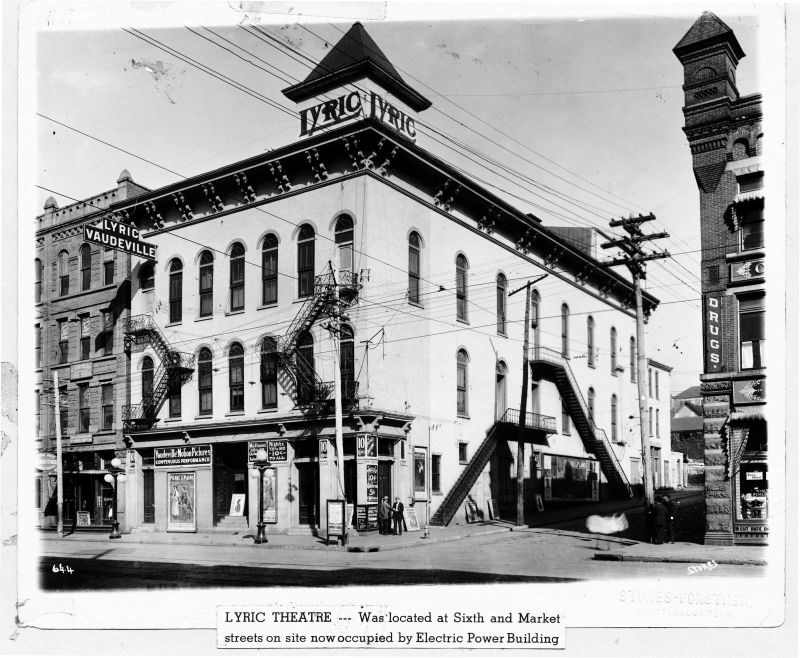
The name evolved as the theater increased in size and opulence. The original James Hall was soon called the New Opera House and then the Opera House. Finally it came to be known as the Lyric Theater and City Auditorium as it hosted a wide variety of cultural performances, including opera, drama and instrumental works.
On Jan. 8, 1885, the Chattanooga Daily Times announced that lumber dealer Samuel M. Winchester was negotiating for funds to construct an “opera house worthy of the name and city.” His potential investors were described as “outside capitalists,” who were considering relocating to Chattanooga. Winchester had secured a lot fronting on Market and Seventh Streets that extended to Broad Street. His plans called for a large structure with five levels facing Market Street and five facing Broad Street. Its two upper units were to include an opera house accommodating musical and theatrical performances and including balconies, dressing rooms, galleries and family circles. Unfortunately, investors failed to step forward.
Plans for the opera house stalled. Then in February 1886, new shareholders responded to an invitation to gather in James Hall to vote on a charter and form committees regarding laws, building construction and more. The ultimate goal for the meeting, if a vote to purchase the James Hall property occurred, was to finalize preliminary matters and begin alterations. Harry Stoops Sr., treasurer, projected revenues, costs and profits and concluded that, after improvements of approximately $40,000 for the completion of an opera house, the required investment would receive an adequate return from rent generated from three stores on the first floor and the building on the rear.
The Chattanooga Daily Times announced the following week that “public-spirited citizens and a progressive journal joined forces, and $40,000 — all that was required — was subscribed in a few days.” The purchase of the property was finalized, with the deed transferred on March 18. Physician Dr. J.H. Van Deman, chair of the Finance Committee of the Chattanooga Opera House Company, announced on March 27 that the first investment had been made by shareholders, and the construction bid process was to start. The shareholders expected the contract to be awarded by early April with the “work of remodeling the building” commencing on May 1.
The work progressed rapidly. By Sept. 19, 1886, the project neared completion, and Paul R. Albert, manager, Chattanooga Opera House Company, announced the advance sale of reserved seats for the first season would be ongoing until Sept. 22. Net receipts for season tickets amounted to more than $2,000. While the total was more than management initially expected, Albert admitted that he had hoped for a greater response but also understood why all the seats had not been sold: “The main reason for the unwillingness to pay a high premium for seats is the fact that there are a large number of choice seats. Indeed, there are more than four hundred that might be chosen as the best, while there is not a really bad seat in the house, which has 788 reserved chair seats.”