
Bracketnomics
Look Bracketology is a common made-up word. If we need new made-up words, this is the place to come to, because when the situation absolutely calls for a really futile and stupid gesture to be done on somebody’s part, Delta House has just the guys to do it.
When the situation calls for a really nonsensical and unnecessary word creation on somebody’s part, well, even Dean Wormer knows where to turn.
Right. Flippin. Here.
So welcome to the real Bracketnomics, and shouldn’t that have been the starting part to begin with? Sure Bracketology flows a bit better — and it was hatched in the taboo era of non-legalized sports betting — but this is about finding avenues to cash checks.
Hence, the comics. Or as Ferris’s teacher tried to get Simone and Co. to recall, “Does anyone know what Vice President Bush called this in 1980? Anyone? Something-d-o-o economics. ‘Voodoo’ economics.”
Let’s explore some of the math behind this, and try to put some theories on it.
Rock chalk. Look back, Kansas, at your own risk. They have been to my brackets through the years what scissors were to Sampson.
No, this chalk is about the favorites and we’ll go back to something I posted Monday in the comments from excellent ESPN betting reporter David Purdum.
The NIL divide and the portal possibilities translate to there being fewer upsets — Vegas upsets in terms of spreads, not seed upsets determined by the committee — last year in any tournament since it expanded to 64 teams in 1985.
And that divide in Vegas’s analytics continues to grow. To wit:
> Each of the 5 seeds in this NCAA bracket are at least 8-point favorites over 12 seeds for first time since the field expanded to 64;
> The average spread in Nos. 4-13 games is minus-14.3, which is the largest ever;
> The average spread in Nos. 3-14 games is minus-19.5, which is the largest ever;
> All of the four 2 seeds are at least 20-point favorites over 15 seeds for the first time since 1986.
So look at the spreads infinitely more than the seeds, people.
Check IDs. For all the one-and-done hullabaloo over the last quarter century, there have been only three net-cutting crews on the Monday before the Masters to be freshman-led. Syracuse (Carmelo Anthony) in 2004, Kentucky (Anthony Davis and others) in 2012 and Duke (Jahlil Okafor and others) are the ones from the 2000s.
Yes, this freshman class has been different all season. Boozer. Dybansta. Acuff. The Arizona trio. Peterson. Flemings. Ament and Brown (if they are healthy).
It’s an amazing group. And those guys are outliers to the trend.
The average age of teams getting to the second weekend of the dance over the last decade is soaring.
In 2015, there were seven teams with an average age of 21 or older among starters to reach the Sweet 16. Last year, 13 teams had an average age of 21 or older.
In fact, only three programs in the decade since have reached the Sweet 16 with an average age of its starting five under 20. The lone outlier here is Duke, the new prince of the one-and-done, which continually advances despite a majority of its stars celebrating with cider more than champagne.
Some experienced names to know for your bracketnomics final include Gonzaga, which has two dudes with more than 150 career college games as well as a 26-year-old; Purdue; Utah State; SEC runner-up Vandy; and Iowa State, which has five guys with at least 99 career games.
Coaching matters. Right, this feels like something Ben Stein would be dropping to Ferris’s class.
“What matters? Anyone? Anyone? ‘Blank’ matters? Coaching matters.”
But the critical swing moments are on the Saturdays and Sundays of the next two weeks.
Those weekend dates are when tensions escalate and scouting time is minimized since the 48-hour turnaround against an unknown foe is intensified.
Look for edges in terms of coaching experience — not just age but accomplishments in this format — and strategical flexibility.
Guys that rank atop that metric in my prism are Pitino, Hurley, Izzo, Sampson and maybe Scheyer. That’s a true blend of Jimmys and Joes with the Xs and Os.
Merge the -ology and the -nomics. Upsets may be down percentage-wise, but they are critical to bracket success, clearly. And it’s more about the toppled than the topic. Depending on the size of the pool you are entering, the margins are not decided by the folks that get the Santa Claras making the second weekend than the majority of folks who have Duke and Florida in the Final Four.
I generally pick the championship game first, then the Final Four and work back accordingly.
I also try to maximize my upset picks, and by that I mean the following:
If, say, I think there is an oversewed team — like Purdue, for instance — and don’t see them getting to the Final Four or even the Elite Eight, I likely will pick their demise a round earlier than that.
Same goes with whatever double-digit darling I am riding to be the talk of of the draw next Monday-through-Wednesday.
I am already bullish on No. 13 Troy, which is bigger than most Sun Belt teams, is well coached by Scott Cross and has a roster composed with a majority of dudes who have been in that program for multiple seasons.
Know the metrics. Entering the tournament, know that 22 of the last 23 NCAA champs have been elite-level balanced and started dancing ranked in the top-25 in offensive and defensive efficiency, according to KenPom. For this year’s tournament, that is eight teams — Duke, Arizona, Michigan, Florida, Houston, Iowa State, Michigan State, and Louisville.
And while we all pay attention to seeds, the most important poll of the season may have been the Week 6 AP poll. It blends a fair amount about what the experts thought before the year and what the experts saw through the first part of the season without the momentum and buzz of a hot conference tournament run or a February to celebrate.
Now injuries are a part of that, as is growing together as a roster.
But this number blew me away:
Every national champ since 2004 was ranked in the top 12 of the Week 6 AP poll, and every year but Syracuse since 1990. So, finally, the top 12 in that fateful Week 6 poll:
1. Arizona
2. Michigan
3. Duke
4. Iowa State
5. UConn
6. Purdue
7. Houston
8. Gonzaga
9. Michigan State
10. BYU
11. Louisville
12. Alabama
Thoughts?
Up in smoke?
Of the above teams in the Week 6 poll, Alabama’s tournament chances appear to be going to pot.
Quite literally.
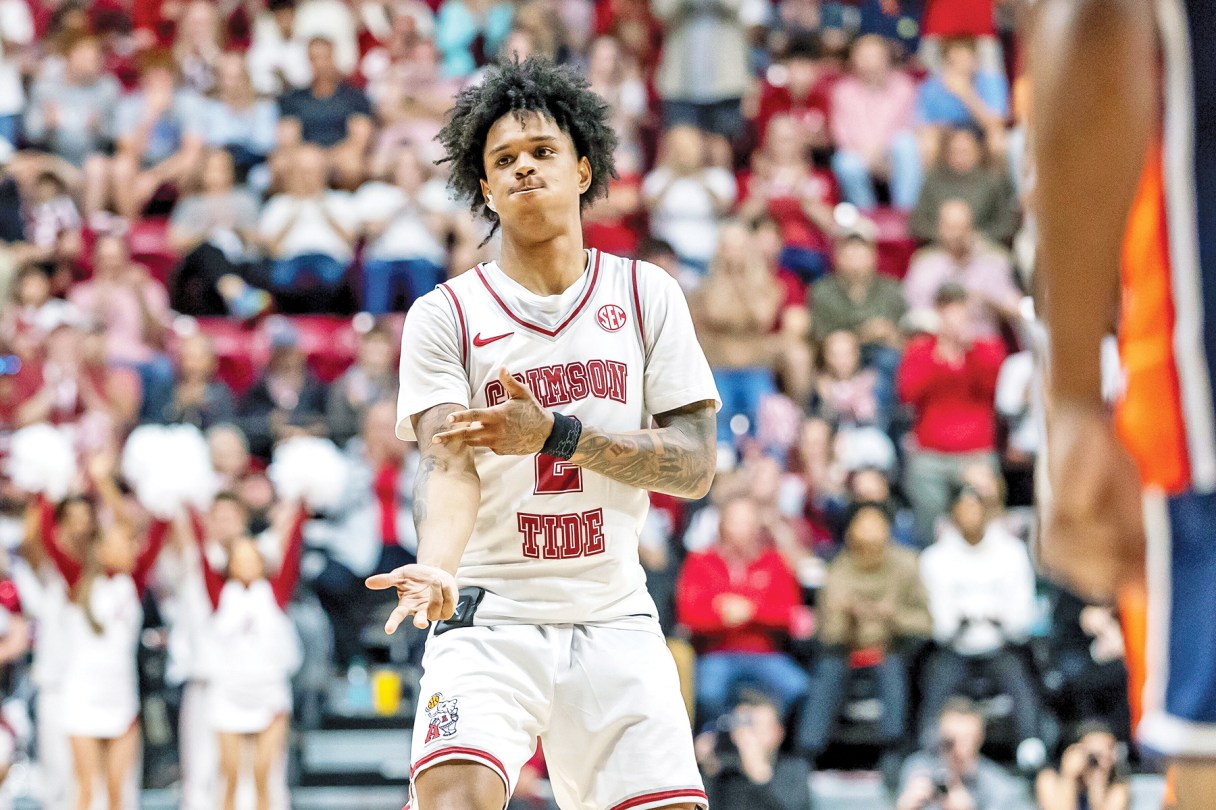
Aden Holloway has been arrested on felony charges when authorities found a pound of pot in his dorm room.
First, a pound of pot is a lot of pot.
Second, Holloway is Alabama’s No. 2 scorer and one of the best 3-point shooters in the country with unlimited range. That aspect can’t be overstated considering the pace and distance at which Alabama operates.
Finally, for a guy who slap coaches his whistle off, this is the second serious charge against a Nate Oats player late in a season with high hopes for the Tide program.
Holloway has been suspended indefinitely as the team investigates the situation.
Here’s my SE16 podcast on the Holloway situation.
Baseball been berry berry good to us
Wow, that bracketnomics got wordy. Sorry, Clint.
But two baseball stories have caught my eye.
First, the WBC is now down to two teams with the U.S. playing Venezuela tonight in Miami in what should be a raucous event.
(Side question: Has the global sports stage been perfect for the Trump international grudges of late? First the U.S. v. Canada in men’s and women’s hockey and now U.S. v. Venezuela in baseball. Who’s up for U.S. v. Iran in pickleball and let’s get gas prices sorted out? Deal? Deal.)
Anywell, it should be fun.
Finally, baseball writing Hall of Famer Jayson Stark had a tremendously informative story in The Athletic about some of the new rules ideas that will be tested in the minor leagues this summer.
Of note, second base is being moved to create a symmetrical diamond on the diamond; only one disengagement (read pick-off throw) from pitchers against would-be base-stealers (and yes, this one is coming to the Southern League and the Lookouts); checked swings will be determined by technology (thank goodness), and batters can call for a technology review on bad checked swing calls as well; and expanded crackdowns on ways to circumvent the pitch clock to fewer and shorter batter timeouts and pitch system requirements.
Thoughts?
This and that
> Remember the Last-In, First-Out Challenge this week where you pick the last double-digit seed left standing and the first 1 seed to get bounced. Deadline Thursday at noon.
> The NBA will vote later this month on expanding to Seattle and Las Vegas. There could even be expansion drafts. That’s what we need, more drafts. Wanna know who loves the draft? Yeah, you know.
> Uh oh. Bob Barker’s legacy will go under the microscope this week — again — with some cable exposé called “Dirty Rotten Scandals.” Here’s more.
> Rules, friends. Paschall has a look at the massive spring roster turnover for the Vols and coach Josh Heupel. Sign of the times that there are 46 new Vols on the roster for spring practice, I suppose.
> The Chiefs traded for Justin Fields to be the QB2 behind Patty Mahomes. Smart move since Mahomes likely will start the season in street clothes after hurting his knee late in 2025.
Today’s questions
True or False, it’s Tuesday. Morning, Ernie.
True or False, you will be in a March Madness pool.
True or False, Aden Holloway will play this weekend for Alabama.
True or False, you like the rules changes above for baseball.
True or False, you will watch WBC rather than basketball tonight.
You know the drill, answer some Ts or Fs, ask some Ts or Fs.
As for today, March 17, let’s review.
Happy St. Patrick’s Day, everyone.
Kurt Russell is 75 today. Pretty sure we’ve done his Rushmore before.
Bobby Jones would have been 106 today.
Rushmore of Bobby and be creative.