
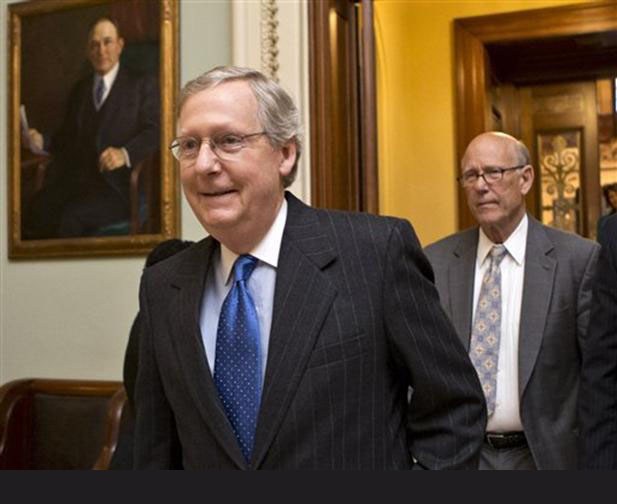
 Senate Minority Leader Mitch McConnell of Kentucky, followed by Sen. Pat Roberts, R-Kansas, leaves the Senate chamber on Capitol Hill in Washington.
Now that Senate Minority Leader Mitch McConnell has helped forge a path off the fiscal cliff by corralling Republican support for making Bush-era tax breaks permanent for all but the top 2 percent of American taxpayers, he pretends to think that he and his party are off the hook on reform of business taxes. He has spent most of the past week saying that now that President Barack Obama has gotten a tax increase on the wealthy, other tax reforms are off the table – and that it’s time to cut spending on the earned entitlements, Social Security and Medicare.
His turn-around was predictable, but it’s wrong. The biggest problem isn’t spending; it’s the decline in tax revenue, which is at a 60-year low of barely 16 percent of gross domestic product, well below the average level of 18-to-18.5 percent of GDP. A large portion of the slide owes to the Great Recession of 2007-2009, but it also reflects business tax loopholes, tax preferences and a range of other gimmicky tax expenditures for business interests.
These loopholes and tax expenditures carry a cost estimated at $1.1 trillion in lost tax revenue, or in shifts of tax burdens to other taxpayers. Until the loopholes are closed and business taxes are broadened, lowered and leveled, Washington can’t begin to pull the country out of excessive national debt. It certainly would be premature, and unfair, to make earned entitlements the next subject for cutting.
President Obama, in fact, agreed to spending cuts, in the 2011 debt-ceiling deal, that would trim federal debt in scheduled future spending by more than $1.2 trillion over the next decade. Yet Republicans, for all their talk before the November elections about closing tax loopholes, have yet to specify a single tax loophole they would eliminate.
It’s not hard to see why. Most members of Congress routinely trade political protection for business lobbyists and their crafty loopholes in return for campaign contributions and political support. Once they began talking about closing tax loopholes for businesses and corporations that make their tax-filing departments profit centers, lobbyists bombarded them.