
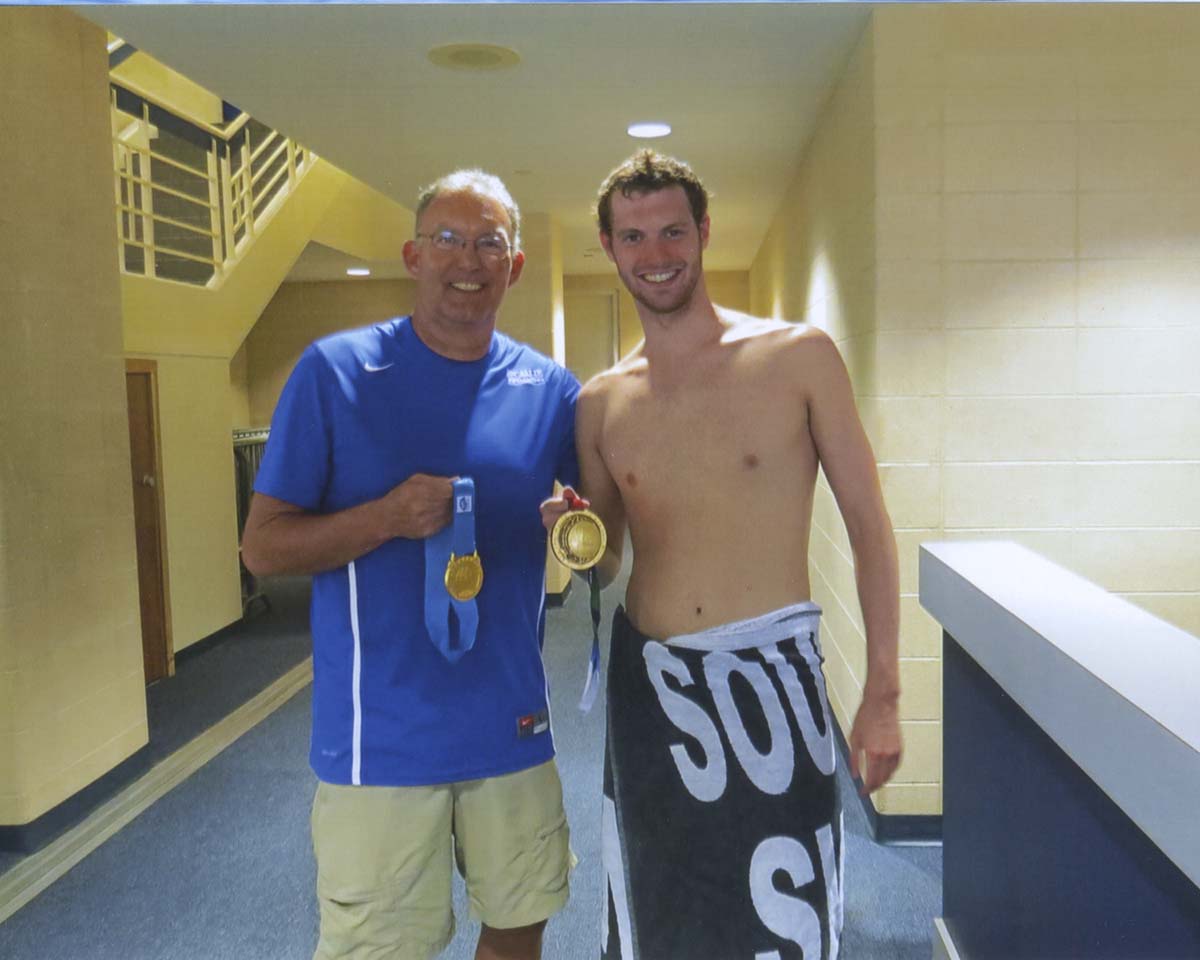
 Sean Ryan (right) displays his 2013 World Championship gold medal, and his 2011 gold medal for the team realy with McCallie swimming coach, Stan Corcoran.
On Friday morning, Aug. 12, when she is standing at the starting line for the 10,000 meters race in Rio de Janeiro, Canadian distance runner Lanni Marchant won’t be thinking about the Zika virus. Nor will she be worried about the drinking water in Rio. Any concerns about terrorist attacks will be gone, as will thoughts about crime in the streets of the Brazilian city.
She won’t be thinking of her apartment in Chattanooga, or the cases she is researching for her law firm there, Speek, Webb, Turner & Newkirk, where she is a criminal defense attorney.
“I don’t try to ignore what’s going on in the world around me,” said Marchant, who has a B.A. in economics from the University of Tennessee at Chattanooga, as well as a law degree from Michigan State. “It’s very much having tunnel vision, to focus on what I’m doing. I can only be as prepared as I can be to run as fast as I can and race well – that’s in my control.”
For months now, reporters have been writing stories about everything wrong with Rio: how the Zika virus can cause deformities in babies, how terrorists can’t resist a gathering where the whole world will be watching, how Rio is just not ready – raw sewage is still spilling into the bay, police officers are threatening to strike, there hasn’t been time to test a new subway line.
But if interviews with athletes and doctors with ties to Tennessee are any indication, all of that is just so much background noise when the moment comes for which they have trained for years.