
EDITOR’S NOTE – This story is part of Divided America, the AP’s ongoing exploration of the economic, social and political divisions in American society.
The oldest millennials – nearing 20 when airplanes slammed into New York City’s Twin Towers – are old enough to remember the relative economic prosperity of the 1990s, and when a different Clinton was running for president. The nation’s youngest adults – now nearing 20 themselves – find it hard to recall a reality without terrorism and economic worry.
Now millennials have edged out baby boomers as the largest living generation in U.S. history, and more than 75 million of them have come of age. How they vote on Nov. 8 will shape the political landscape for years to come. Yet with less than three months to go before Election Day, the values of young Americans whose coming-of-age was bookended by the Sept. 11, 2001, terrorist attacks and the Great Recession are emerging as an unpredictable grab bag of fiscal conservatism and social liberalism.
What they share is a palpable sense of disillusionment.
As part of its Divided America series, The Associated Press and Times Free Press spent time with millennial voters in the Chattanooga area, around the country and in five states where the oldest and largest swath of this generation – ages 18 to 35, as defined by the Pew Research Center – could have an outsized influence in November. They are a uniquely American mosaic, from a black teen in Nevada voting for the first time to a Florida-born son of Latino immigrants to a white Christian couple in Ohio.
Taken individually, these voters illustrate how millennials are challenging pollsters’ expectations based on race, class and background in surprising ways, reacting to what they see as the loss of the American Dream. They are intent on shaping something new and important that reflects their reality – on their own terms.
“Millennials have been described as apathetic, but they’re absolutely not. I think you can see from this election year that they’re not, and that millennials have a very nuanced understanding of the political world,” said Diana Downard, a 26-year-old Bernie Sanders supporter who will vote for Hillary Clinton. “So yeah, I’m proud to be a millennial.”
Just 5 percent of young adults say that America is “greater than it has ever been,” while 52 percent feel the nation is “falling behind” and 24 percent believe the U.S. is “failing,” according to a GenForward poll released last month. The first-of-its kind survey of young people between the ages of 18 and 30 was conducted by the Black Youth Project at the University of Chicago with the Associated Press-NORC Center for Public Affairs Research.
Fifty-four percent believe only a few people at the top can get ahead in today’s America, and 74 percent say income and wealth distribution are uneven, according to the poll.
Briana Lawrence, a 21-year-old videographer and eyelash artist from Durham, N.C., identifies with those numbers.
She was just 7 on Sept. 11, and the immediate aftermath of the terrorist attacks is the only time she can remember the nation feeling united, even if only by grief. With $40,000 in student debt, she’s working hard to establish her own cosmetic business after graduating from North Carolina Central University. She plans to vote for Hillary Clinton, but feels America has lost its way.
“My biggest hope for this country is for us to come back together as a community. As a United States of America, to unite together again,” she said.
But millennials know that getting to that place won’t be easy. Many, like Lawrence, are saddled with college debt and have struggled to find jobs.
In Denver, 1,600 miles to the west, Downard also has almost $40,000 in student debt that’s already changed her path. A dual U.S. and Mexican citizen, she feels she can’t afford to work for an overseas organization – one of her dreams – and plans to delay having a family at least 10 years.
“We went to college in pursuit of a better life and really, now, we’re kind of just paralyzed by our student debt,” said Downard, who works for a nonpartisan organization that works to improve youth voter registration. “You can’t even think about those sorts of alternative options.”
In part because of these economic pressures, a 2014 Pew Research Center poll found that – for the first time in more than 130 years – adults ages 18 to 34 were slightly more likely to be living with their parents than with a spouse or partner in their own residence. And one in four millennials say they might not ever marry, a Pew survey found.
Only 8 percent of young adults feel their household’s financial situation is “very good,” and education and economic growth ranked No. 1 and No. 2 as the issues that will most influence their vote, according to the GenForward poll.
Tucker Krajewski said that he has become politically engaged recently, as he is now legally independent from his parents as the first presidential election in which he is eligible to vote looms. The 20-year old Indianapolis native, who is studying communications at the University of Tennessee at Chattanooga, is not overly concerned about his own prospects, however.
“I’ve listened to a lot of people say that they’ll be affected by what happens in the election,” he said. “White, upper class males are in the group that probably won’t be too affected, so I care for other people. I care for the reputation of our country, but I’m not sure how it affects me.”
Krajewski, who is a Christian, said he supported Sanders in the primary.
“I want America to be great, obviously,” he said. “I don’t know what that looks like. I don’t know if I can say that it is or isn’t right now.”
Laura Davis, also from Indianapolis, is studying English at Covenant College and said it is discouraging to be entering adulthood with Trump and Clinton as the presidential choices.
“But it doesn’t feel hopeless,” said Davis, also a Christian, adding that the wrong response for millennials is apathy or anger.
“We can’t put our faith in men,” she said. “That’s kind of the problem right now with both parties, is that we’re putting our faith in two people who are flawed.”
Anibal David Cabrera, the son of a Honduran mother and Dominican father, graduated from college in 2008 as the recession was picking up steam. A finance major, he wanted to work for a hedge fund or bank, but the economic collapse meant jobs had dried up. Eventually Cabrera, now 31 and living in Tampa, Fla., got an accounting job at a small tech firm.
He feels he’s entering the prime of his life a few steps behind where he could have been, through no fault of his own.
A Jeb Bush die-hard in the primaries, he’s now supporting Trump and hopes the business mogul can make good on his promises.
“My biggest hope for the country would be a prosperous economy. That is something my generation has kind of never seen,” Cabrera said. “We never got to experience the rapid growth of the ’80s or the ’90s, and I think my generation would love to see that.”
Shared pain, however, does not lead to shared views among his generation.
Millennial voters’ disdain for traditional party affiliation have made them particularly unpredictable. Half describe themselves as political independents, according to a 2014 Pew Research report – a near-record level of political disaffiliation. As a generation, they tend to be extremely liberal on social questions such as gay marriage, abortion and marijuana legalization. Yet they skew slightly conservative on fiscal policy and are more in line with other generations on gun control and foreign affairs.
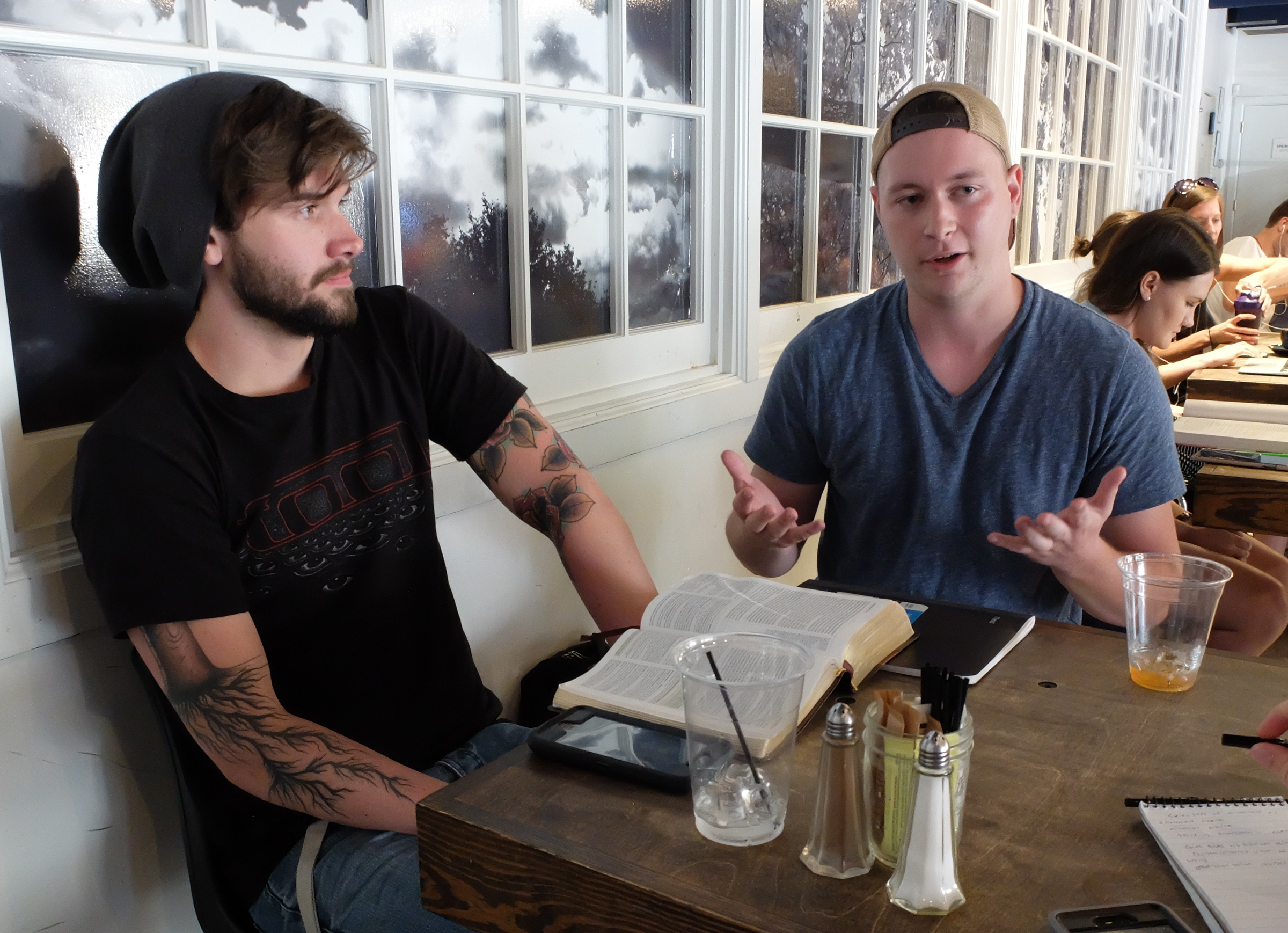
Marshall Jones and Thomas Rose, both UTC students and also Christians, agreed that the country will struggle to thrive if something does not change to alleviate the distrust and polarization they sense in today’s national social and political climate.
They have seen division within the millennial generation, even at UTC in the spring, when debate raged after a UTC student government leader was asked to resign for making chalk drawings in favor of Donald Trump on campus.
Rose said he supported Sanders in the primary but doesn’t necessarily fit in either political party. As a Christian, he said he sides more with Republicans on some issues, like abortion, but is skeptical of the party’s current views on immigration.
“If we keep the status quo, it’s only going to get worse,” he said. “I don’t know how we change or how we address that. But if it keeps going the way it’s going, it’s only going to get worse.”
Jones agreed.
“If we keep doing the same thing, it’s not going to get better,” he said.
Trip Nistico, a recent Colorado law school graduate, is a gun rights advocate who visits shooting ranges – but also supports same-sex marriage. He backed President Barack Obama in 2008 and Mitt Romney in 2012. The 26-year-old is voting for Trump this year.
Still, Trump remains unpopular among millennials and nearly two-thirds of Americans between the ages of 18 and 30 believe the Republican nominee is racist, according to GenForward’s poll. Views of Hillary Clinton also were unfavorable, though not to the same extent.
Bill and Kristi Clay, young parents and devout Christians from rural Ohio, offer a portrait of millennials struggling to choose a candidate who matches their values.
Kristi Clay opposes same-sex marriage and abortion and names those as her top issues this election. Yet the 32-year-old school librarian is still reluctantly leaning toward voting for Clinton. “You have to look at the big picture,” she says.
Bill Clay, meanwhile, shares his wife’s views on the more conservative issues, but they hold what some would consider more liberal views on matters such as immigration.
The Clays say they will vote no matter what, but whether their millennial brothers and sisters do the same is an open question.
The millennial vote rose steadily beginning in 2002 and peaked in 2008, with excitement over Obama’s first campaign. In 2012, however, just 45 percent of millennials cast ballots and participation has dropped ever since, said John Della Volpe, director of polling at Harvard University’s Institute of Politics.
“They have a somewhat different perspective in terms of politics,” Della Volpe said. “It hasn’t really worked. They haven’t been part of a movement that’s been effective.”
“If we’re going to try to be Christian-like, and embrace people, I don’t think you can shut the borders to an entire group of people just because of the fear that some of them don’t like us,” said Clay, 33, who voted for Barack Obama in the last two elections but supported Republican Marco Rubio this time.
Yet that strong faith has not helped him find much inspiration in the current candidates, both of whom he sees as self-serving and unwilling to budge on important issues.
“I’m feeling a little pessimistic this year,” he said.
Yet Tillett, the teen in Nevada, exudes youthful idealism as he talks about casting his first vote in a presidential election.
“It means a lot to me personally because I’m making a difference in my life and in the country. My vote does matter,” he said. “It really does.”