
Thursday, November 12, 2026Nov 12

Police: stolen Nazi camp gate probe could be complicated

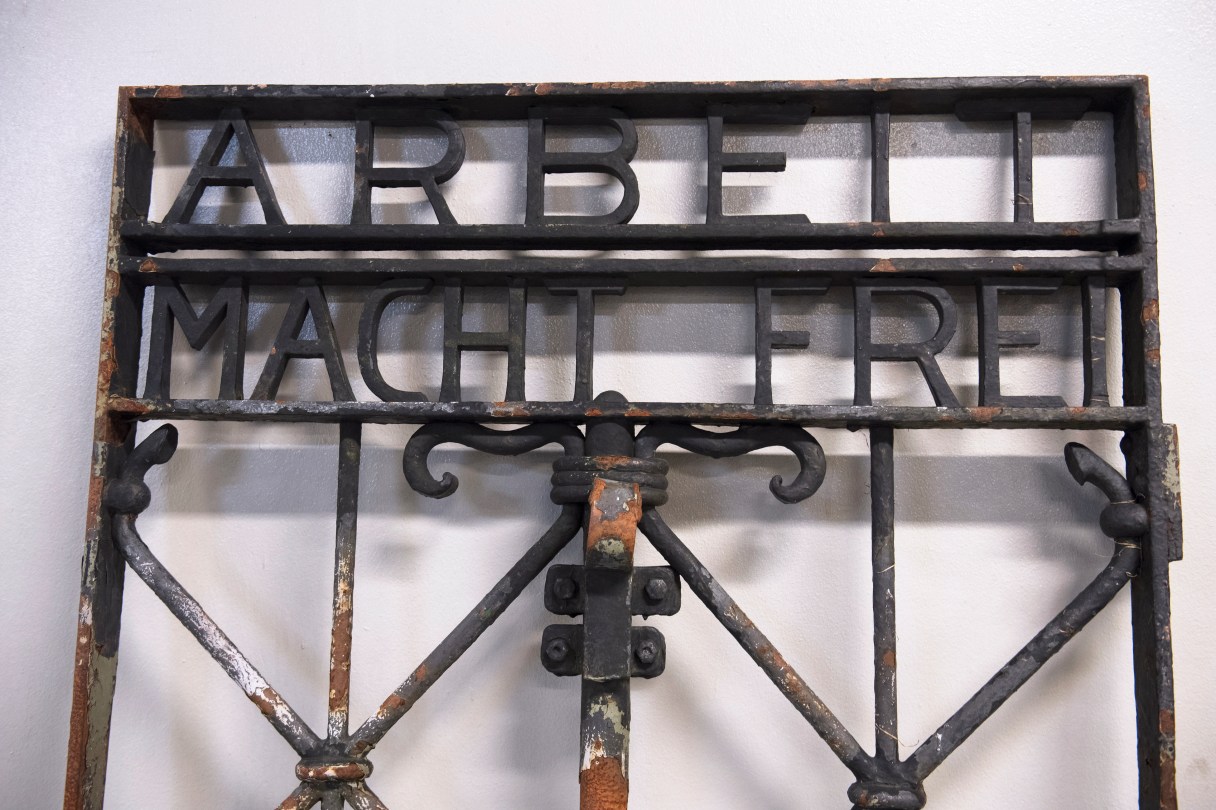
The iron gate from the former Nazi concentration camp in Dachau, southern Germany, with the slogan "Arbeit macht frei" ("Work will set you free") is displayed Saturday Dec. 3, 2016, after being found earlier this week by police in Bergen, Norway.  The infamous wrought iron gate was stolen two years ago, and is being cared for by police in Bergen before being returned to Germany. (Marit Hommedal / NTB scanpix via AP)
The iron gate from the former Nazi concentration camp in Dachau, southern Germany, with the slogan "Arbeit macht frei" ("Work will set you free") is displayed Saturday Dec. 3, 2016, after being found earlier this week by police in Bergen, Norway. The infamous wrought iron gate was stolen two years ago, and is being cared for by police in Bergen before being returned to Germany. (Marit Hommedal / NTB scanpix via AP) The iron gate from the former Nazi concentration camp in Dachau, southern Germany, with the slogan "Arbeit macht frei" ("Work will set you free") is displayed Saturday Dec. 3, 2016, after being found earlier this week by police in Bergen, Norway. The infamous wrought iron gate was stolen two years ago, and is being cared for by police in Bergen before being returned to Germany. (Marit Hommedal / NTB scanpix via AP)

COPENHAGEN, Denmark (AP) – The investigation into how an iron gate stolen from the Nazis’ Dachau concentration camp in southern Germany ended up in western Norway may be complicated because “no useable evidence” has been found, police said Saturday.

Police spokeswoman Kari Bjoerkhaug Trones says the gate with the cynical slogan “Arbeit macht frei” – “Work sets you free” – was found Nov. 28 under a tarpaulin at a parking lot in Ytre Arna, a settlement north of Bergen, Norway’s second-largest city.

“It has been there for quite some time with some junk under a tarpaulin. Our forensic teams have found no useable evidence like DNA,” Bjoerkhaug Trones told The Associated Press. The gate was now in police care, she said, adding they have no suspects.

The concentration camp near Munich was established by the Nazis in 1933. The missing gate, measuring 190 by 95 centimeters (75 by 37 inches), originally was set into a larger gate at the camp’s entrance.

More than 200,000 people from across Europe were held at Dachau, and more than 40,000 prisoners died there.