
Tuesday, November 10, 2026Nov 10

Andrew Jackson: populist war hero and no fan of paper money

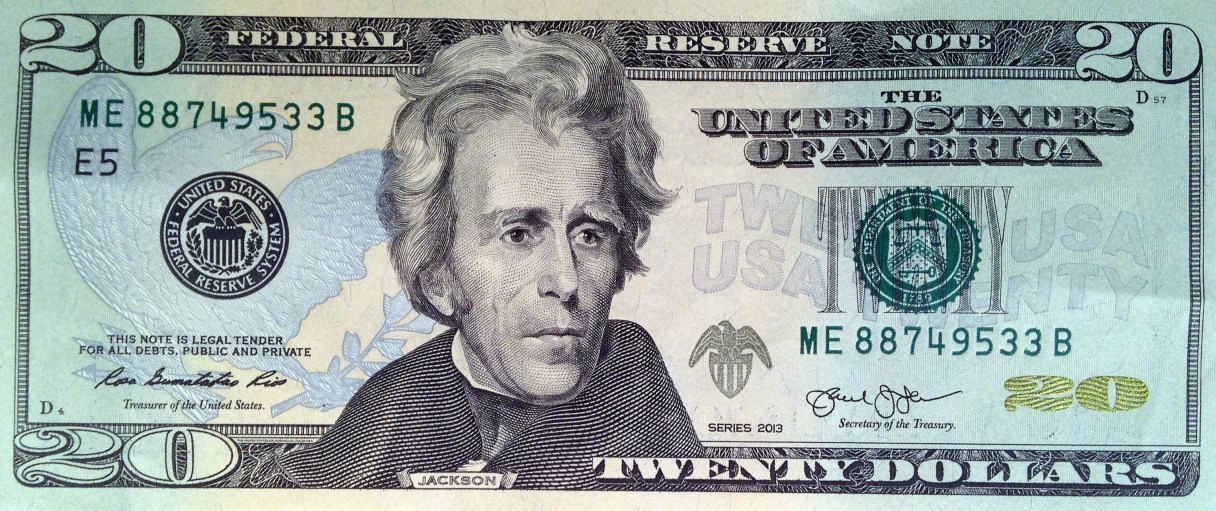
FILE - This April 17, 2015, file photo provided by the U.S. Treasury shows the front of the U.S. $20 bill, featuring a likeness of Andrew Jackson, seventh president of the United States. A Treasury official said Wednesday, April 20, 2016, that Secretary Jacob Lew has decided to put Harriet Tubman on the $20 bill, making her the first woman on U.S. paper currency in 100 years. (U.S. Treasury via AP, File)
FILE - This April 17, 2015, file photo provided by the U.S. Treasury shows the front of the U.S. $20 bill, featuring a likeness of Andrew Jackson, seventh president of the United States. A Treasury official said Wednesday, April 20, 2016, that Secretary Jacob Lew has decided to put Harriet Tubman on the $20 bill, making her the first woman on U.S. paper currency in 100 years. (U.S. Treasury via AP, File) FILE - This April 17, 2015, file photo provided by the U.S. Treasury shows the front of the U.S. $20 bill, featuring a likeness of Andrew Jackson, seventh president of the United States. A Treasury official said Wednesday, April 20, 2016, that Secretary Jacob Lew has decided to put Harriet Tubman on the $20 bill, making her the first woman on U.S. paper currency in 100 years. (U.S. Treasury via AP, File)

NASHVILLE, Tenn. (AP) – After nearly a century as the face of the $20 bill, President Andrew Jackson is being replaced by abolitionist Harriet Tubman, who helped free slaves from the Southern landowners he defended. What should Americans recall about his legacy?

A POPULIST TO THE CORE

America’s seventh president campaigned as the champion of the common man against the rich and powerful. Preceding him in office were four Virginia plantation owners and two Harvard-educated Massachusetts lawyers. Jackson, by contrast, was born to Irish immigrants near Lancaster, South Carolina, on March 15, 1767, and was orphaned by 14, a year after he volunteered to fight the British in the Revolutionary War. At 17, he became an apprentice to several lawyers, and moved to the frontier outpost of Nashville after earning his license.

“Andrew Jackson came from nowhere. He had no family, few advantages, little education,” Feller said.

“Old Hickory” was a bona-fide Washington outsider, and the enthusiasm of his supporters was evident at his raucous first inauguration, which was overrun by drunken well-wishers who were only persuaded to leave when the alcohol-laced punch was moved onto the lawn. Jackson himself had to escape from a window.