
The first minute is complete chaos as you leap from a helicopter, its rotors roaring right above you, stirring up a blizzard of loose powder and making it difficult to get your bearings.
But moments later, as the last whirring sounds of the helicopter fly out of earshot, you find yourself in complete silence, awestruck at the beauty and magnitude of this remote spot. “You look up all of a sudden and realize everything is completely quiet and you are on top of the world,” says Dr. Todd Bonvallet, an orthopedic surgeon and medical director of the Interventional Center at Spine Surgery Associates.
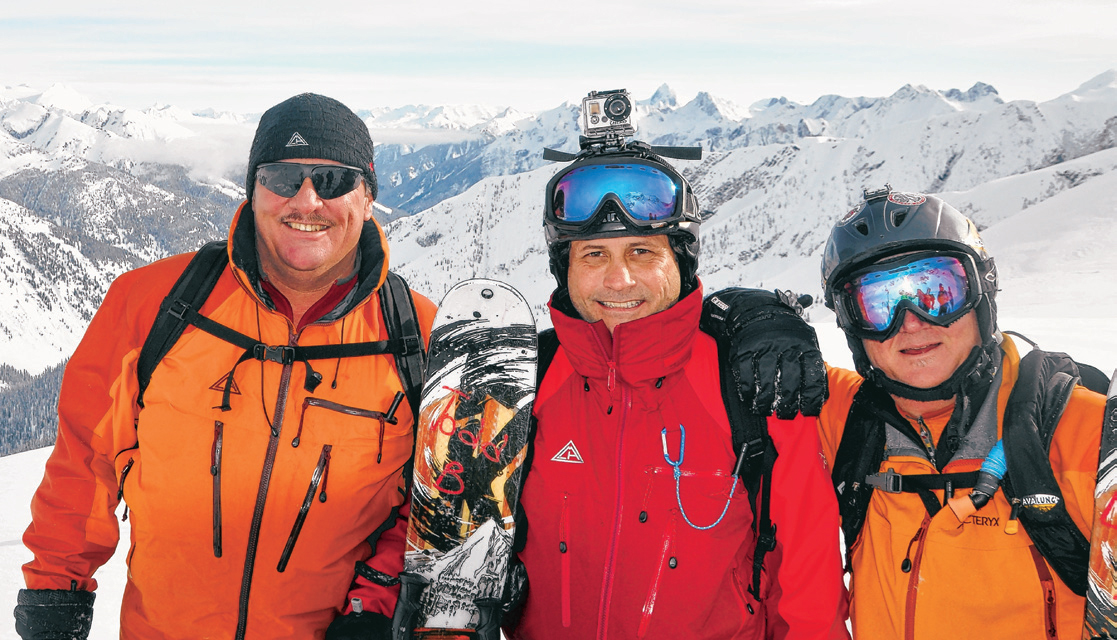 Pete Serodino, Todd Bonvallet and David Musgrave
Heli-skiing takes the adventurous, expert and adrenaline-fueled resort skier to whole new levels, literally, replacing the tram lift with a helicopter hop to some of the highest peaks for an experience so far removed from other ski trips that even five-year veterans have a tough time describing the overall atmosphere.
“This is a really hard thing to describe to anyone. No matter how many pictures you show or movies you show or stories you tell, the mere fact of being there really tells the story,” says Bonvallet, a native of Spokane, Wash., who attended college in Montana and spent most of his life on the slopes, even spending time on a junior national freestyle circuit in middle and high school. Since taking his first heli-ski trip while in medical school he has accumulated more than 2.6 million vertical feet on these remote, extreme ski adventures.

Once he moved to Tennessee, it was many years before he found others here in Chattanooga willing and able to tackle the treacherous drops and dangerous conditions of backcountry skiing. Businessman and Chattanooga native Pete Serodino and local anesthesiologist David Musgrave each now total about 750,000 vertical feet of heli-skiing experience after joining Bonvallet on his ventures to the far reaches of the Canadian Rockies. All three added about 135,000 feet apiece during their most recent Canadian Mountain Holidays trip last month.