
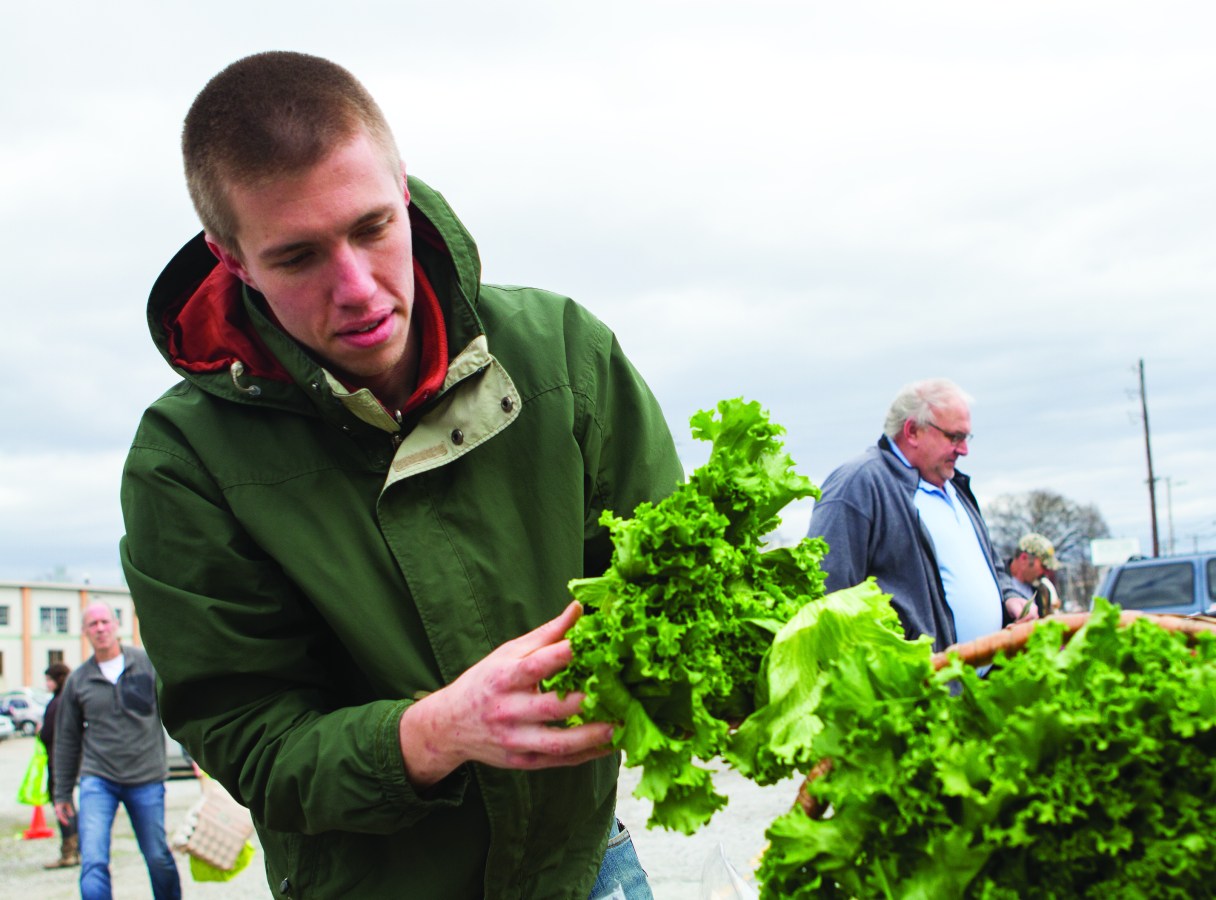
Even on a winter-like afternoon, the farmers market is the place to be. Wind gusts, overcast conditions and shocking chills be damned, Chattanooga is lined up and waiting for the market to open.
At the triangle-bell’s ring, shoppers open their bags and reach out for produce. There are young professionals, still suited from the office; families with small children, gripping a bunch of broccoli like it’s an ice cream cone and taking a bite at a time; older women who, with crow’s feet and silver hair, are the embodiment of youth as they gab and recommend Asian lettuce blends and radishes. For one day a week, a fenced-in gravel lot on Main Street becomes the middle-man of farm-to-table.
SPINACH
FROM GULLEY FAMILY FARM, CLEVELAND, TENN.This isn’t your grocery store baby spinach. It’s not flat and soft, it’s sturdy, dark green, with creases and crevices from the deep, thick stem. Work these with an acidic vinaigrette for spring salad.
I’m at the Main Street Farmers Market on an unsettlingly blustery Wednesday. Most of Chattanooga’s markets won’t open for another month as farms aren’t yet ready to harvest, and on a day like today, I almost can’t believe there are people waiting in line for green leaf lettuce, potatoes and broccoli. I got here 30 minutes early and I’m joining the shoppers in lurking around tables as farmers hurriedly set up baskets of vegetables, greens and goods while simultaneously trying to keep their tables, signs and hats from blowing away.
But as Laura Snell, the market’s manager, tells me, people just don’t miss the market. That’s where they pick up a week’s worth of eggs and milk and in the spring and summer, CSA boxes. And from that, they see other vegetables and fruits, cheese and plants and get hooked. Just take her word for it; she was a shopper of the market before she stepped into a leadership role last fall.
“The sense of community is so strong between the buyers and the farmers,” she says, toboggan topped and bundled in a peacoat. “People really just get a thrill out of it. Talking to the farmer, learning about the farm and the process, it’s a conversation they love to have.”
RADISHES
FROM TANT HILL FARM, LAFAYETTE, GA.These aren’t big, waxy and as bright red as you’d imaginethem, but they’ll still pack a peppery punch. I’m told the only way to enjoy these is thinly sliced with butter and salt, all atop bread or crackers.
Main Street’s market features farms from within 75 miles of Chattanooga who are responsible growers with a sustainable, natural method. Within 30 minutes of the hour the market is open, produce stands are thinning out and bags are full of goose eggs, kohlrabi, acorn squash, Brussels sprouts and flowers.
There are many buzzwords that markets like to throw around. Local. Sustainable. Responsible. But the message is clear. Fresh farmed food is for everyone and should be celebrated.
And Chattanooga is eating it up. Ever-popular Chattanooga Market is adding a third market this year, an intimate Wednesday afternoon affair. Brainerd, Signal Mountain, Hixson-all have weekly markets and they are all growing increasingly popular. The Ooltewah Farmers Market will celebrate a whole year of operation this month, a feat that has exceeded expectations, says market manager Faith Sharpe and marketing director Angel Miller.
“We’re just so pleased with it. It’s really a special market and people are really enjoying it,” Angel says. She’s a farmer herself, of mushrooms of all kinds, at 2 Angels Mushroom Farm.
Beyond the health benefits, as most of the farmers at the markets aren’t enhancing growth with chemicals or using pesticides, why are markets so important right now? How can Chattanooga sustain so many markets? At this rate, I’m thinking, there could be a market for every day of the week (I could only be so lucky).
SHITAKE MUSHROOMS
FROM CRABTREE FARMS, CHATTANOOGA, TENN.A little drizzle yielded a dozen or so bags of shitake mushrooms for one market. These are meaty and pack such unique flavor, don’t overcook them. Instead, add them to the end of a stir fry or to soups for a zing.
“People want to get connected to our land, to our agricultural history and our heritage,” Angel says. “And really, there’s such a relationship involved. People share advice about growing their own food, in hopes that these people try to grow their own. Everyone is helping each other.”
Faith visits each farm personally before they are allowed to come to Ooltewah’s market. That not only certifies that the farmed goods are local, healthy and viable, but it also forges a bond between the market and its farmers. It’s a community all its own.
For instance, as Laurie Gulley of Gulley Family Farms helps customers, Faith tells me that Laurie lived in many different countries and has knowledge of different vegetables we don’t usually see here. Though on the Thursday I was there only spinach and carrots filled her baskets, I ask Laurie about it later. Turns out, she grows melabar spinach in the summer.
“When normal spinach would wilt in the summer, this spinach just loves the dry heat,” she says. “It’s kind of a carefree plant. I didn’t get any bugs or diseases on it at all last year.”
Soft spoken, Laurie is squinting in the sun, standing between her car and card table. Aside from carrots and spinach, she’s selling grape jelly by the jar. When spring’s bounty comes, she’ll sell beets and more things, but compared to some other local farms, she’s a small operation.
HEN’S EGGS
FROM CIRCLE S FARMS, RISING FAWN GA.These eggs are speckled browns, light greens and blues and pale copper,and the product of healthy raised chickens. These are almost too pretty to eat, but they’ll proudly take the place of any white egg you have.
“I started off just growing things, always, and didn’t think to come to market until last year,” she says. “It’s just fun. I love being close to nature and I love coming out here to be a part of it.”
As a mother and child inspect fresh carrots-they’ve never seen them outside of the grocery store-she tells me about a song she sang with her children long ago, to accompany the task of pulling weeds before they grow and take over the garden.
“Really, it was also about bad habits and stopping them when they are beginning,” she says. “I think we pull so many things from growing things that are really about life and metaphors for life.”