
Thursday, November 12, 2026Nov 12

A closer look at the Ferguson Police Department

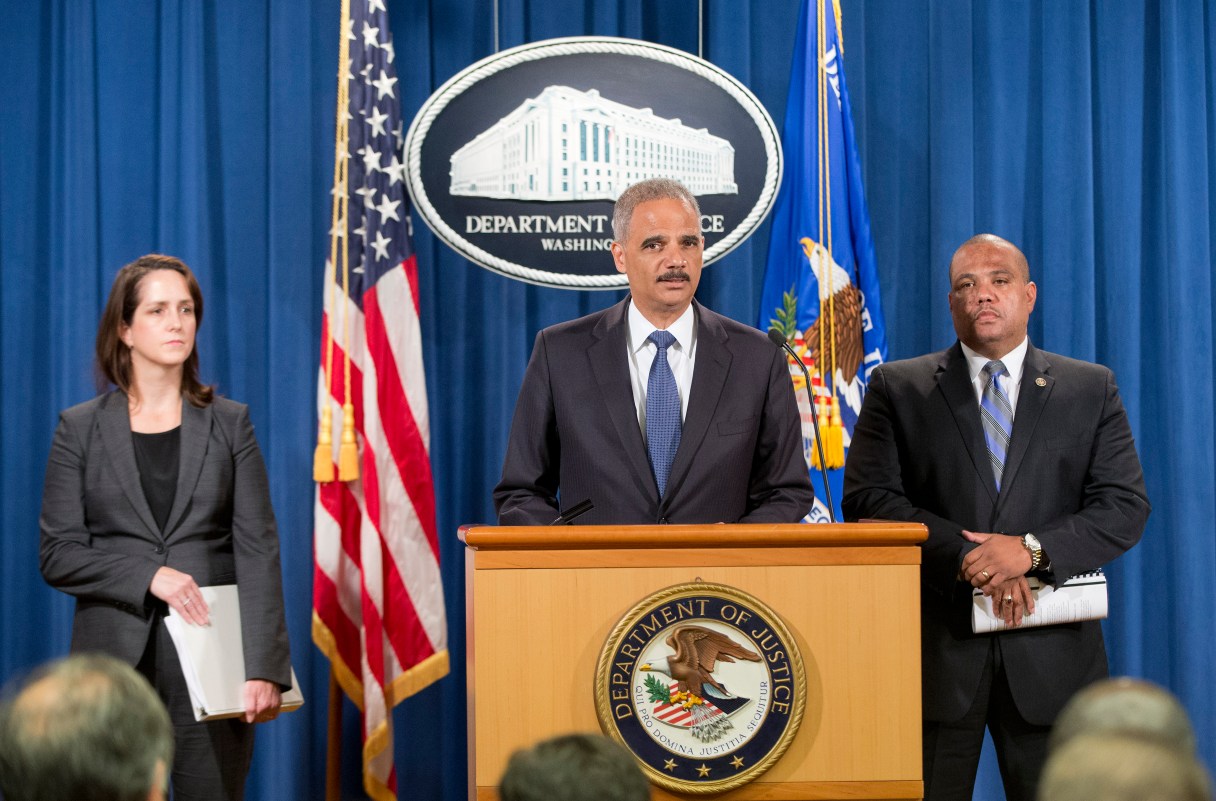
Attorney General Eric Holder, center, accompanied by Acting Assistant Attorney General for Civil Rights Division Molly Moran, left, and Ronald Davis, director of the Office of Community Oriented Policing Services (COPS), speaks during a news conference at the Justice Department in Washington, Thursday, Sept. 4, 2014, to announce the Justice Department's civil rights division will launch a broad civil rights investigation in the Ferguson, Mo.  (AP Photo/Pablo Martinez Monsivais)
Attorney General Eric Holder, center, accompanied by Acting Assistant Attorney General for Civil Rights Division Molly Moran, left, and Ronald Davis, director of the Office of Community Oriented Policing Services (COPS), speaks during a news conference at the Justice Department in Washington, Thursday, Sept. 4, 2014, to announce the Justice Department's civil rights division will launch a broad civil rights investigation in the Ferguson, Mo. (AP Photo/Pablo Martinez Monsivais) Attorney General Eric Holder, center, accompanied by Acting Assistant Attorney General for Civil Rights Division Molly Moran, left, and Ronald Davis, director of the Office of Community Oriented Policing Services (COPS), speaks during a news conference at the Justice Department in Washington, Thursday, Sept. 4, 2014, to announce the Justice Department's civil rights division will launch a broad civil rights investigation in the Ferguson, Mo. (AP Photo/Pablo Martinez Monsivais)

ST. LOUIS (AP) – The announcement that the Justice Department will conduct a civil-rights investigation of the Ferguson Police Department comes nearly a month after Michael Brown’s death first raised doubts about the suburban law-enforcement agency.

Many Ferguson residents say the intervention is long overdue, citing long-held suspicions about racial profiling and police brutality. Their complaints are shared by others in the predominantly black inner suburbs of St. Louis known collectively as North County, where people describe routine harassment by officers working for a jumble of tiny city and village police forces, some of which patrol neighborhoods with only a few hundred residents.

Here’s a closer look at Ferguson, its neighbors and small-town police work in the shadow of a major Midwest city:

___

OUTSIDERS IN UNIFORM: Nearly 70 percent of Ferguson’s 21,000 residents are black. Among its 53 police officers, just three are black. And few officers live within the city limits, which critics say makes them less vested in the community they serve. Darren Wilson, the officer who killed Brown, lives 20 miles away in the suburb called Crestwood. Police Chief Thomas Jackson and Mayor James Knowles have pledged to improve minority recruitment and hiring efforts. But both of them acknowledged the difficulty of finding qualified applicants of color and keeping those hires from leaving for better-paying jobs in bigger departments.