
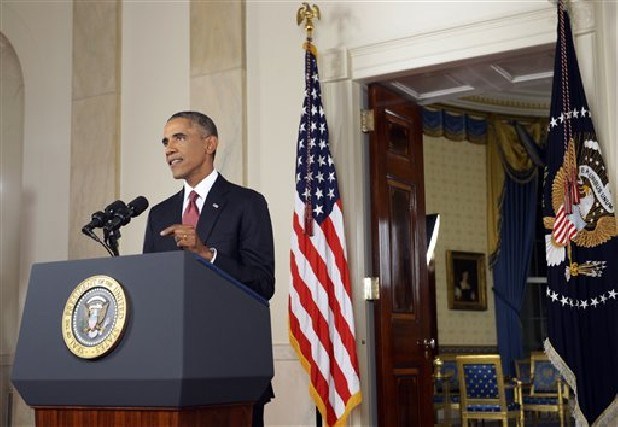
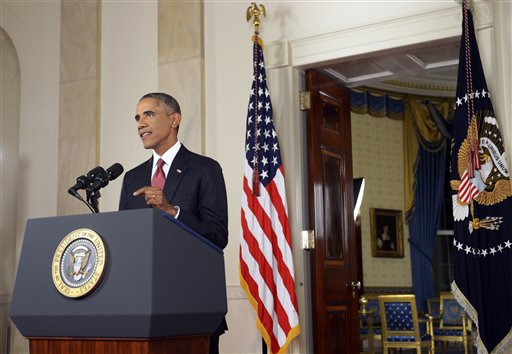
 President Barack Obama addresses the nation from the Cross Hall in the White House in Washington on Wednesday, Sept. 10, 2014.
WASHINGTON – The U.S. and five Arab countries launched airstrikes Monday night on Islamic State group targets in Syria, expanding a military campaign into a country whose three-year civil war has given the brutal militant group a safe haven.
Using a mix of manned aircraft – fighter jets and bombers – plus Tomahawk cruise missiles, the strikes were part of the expanded military campaign that President Barack Obama authorized nearly two weeks ago in order to disrupt and destroy the Islamic State militants, who have slaughtered thousands of people, beheaded Westerners – including two American journalists – and captured large swaths of Syria and northern and western Iraq.
U.S. officials said the airstrikes began around 8:30 p.m. EDT, and were conducted by the U.S., Bahrain, Qatar, Saudi Arabia, Jordan and the United Arab Emirates. The first wave of strikes finished about 90 minutes later, but the operation was expected to continue for several more hours, according to one U.S. official, who spoke on condition of anonymity because he was not authorized to speak publicly by name about an ongoing mission.
Syria’s Foreign Ministry said the U.S. informed Syria’s envoy to the U.N. that “strikes will be launched against the terrorist Daesh group in Raqqa.” The statement used an Arabic name to refer to the Islamic State group.
At a conference on Sept. 11 with Secretary of State John Kerry, key Arab allies promised they would “do their share” to fight the Islamic State militants. The Obama administration, which at a NATO meeting in Wales earlier this month also got commitments from European allies as well as Canada and Australia, has insisted that the fight against the Islamic State militants could not be the United States’ fight alone.