
Wednesday, November 11, 2026Nov 11

Scientists find closest thing yet to Earth-sun twin system

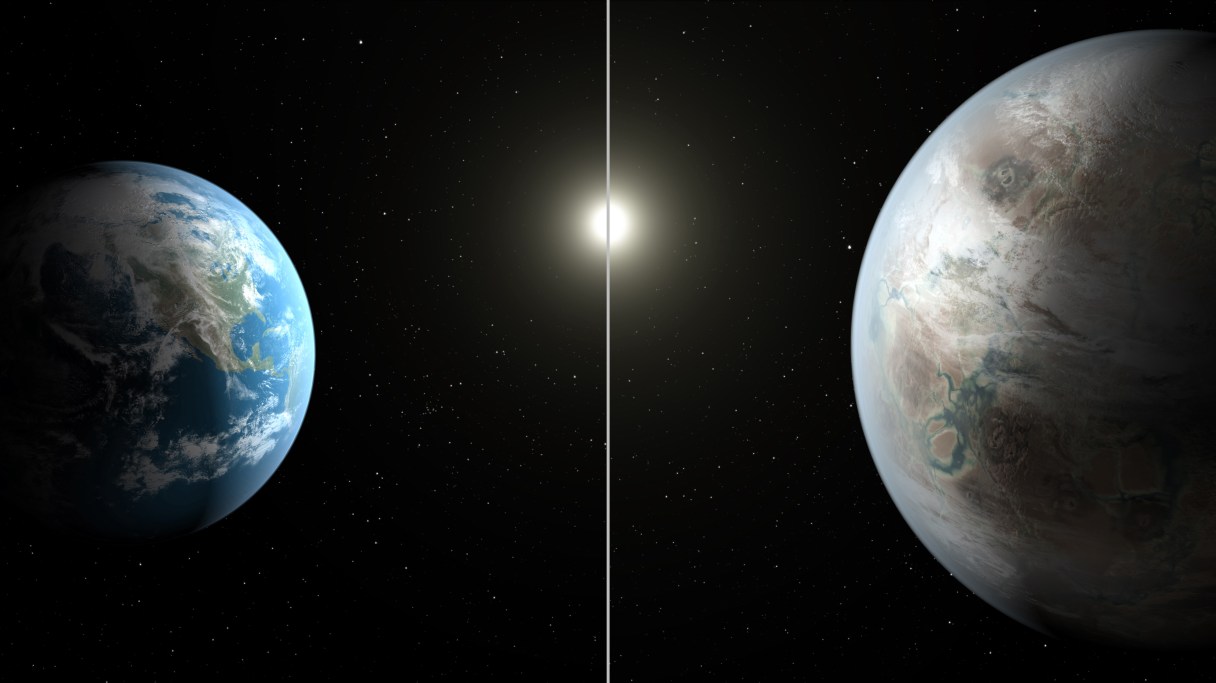
This artist's rendering made available by NASA on Thursday, July 23, 2015 shows a comparison between the Earth, left, and the planet Kepler-452b. It is the first near-Earth-size planet orbiting in the habitable zone of a sun-like star, found using data from NASA's Kepler mission. The illustration represents one possible appearance for the exoplanet - scientists do not know whether the it has oceans and continents like Earth. (NASA/Ames/JPL-Caltech/T. Pyle via AP)
This artist's rendering made available by NASA on Thursday, July 23, 2015 shows a comparison between the Earth, left, and the planet Kepler-452b. It is the first near-Earth-size planet orbiting in the habitable zone of a sun-like star, found using data from NASA's Kepler mission. The illustration represents one possible appearance for the exoplanet - scientists do not know whether the it has oceans and continents like Earth. (NASA/Ames/JPL-Caltech/T. Pyle via AP) This artist's rendering made available by NASA on Thursday, July 23, 2015 shows a comparison between the Earth, left, and the planet Kepler-452b. It is the first near-Earth-size planet orbiting in the habitable zone of a sun-like star, found using data from NASA's Kepler mission. The illustration represents one possible appearance for the exoplanet - scientists do not know whether the it has oceans and continents like Earth. (NASA/Ames/JPL-Caltech/T. Pyle via AP)

CAPE CANAVERAL, Fla. (AP) – Scientists have identified a “close cousin” to Earth that’s orbiting a sun-like star and might harbor life.

The researchers announced their discovery Thursday based on observations from NASA’s Kepler space telescope.

“It is the closest thing that we have to another place that somebody else might call home,” said Jon Jenkins, the lead data analyst from NASA’s Ames Research Center in California.

This older, bigger cousin to Earth is called Kepler-452b. What makes this planet remarkable is that it orbits its star at about the same distance that Earth orbits the sun. What’s more, its home star looks to be similar to our sun.

Based on what scientists know today, Jenkins added, “This is the closest thing we have to another Earth-sun twin system.”