
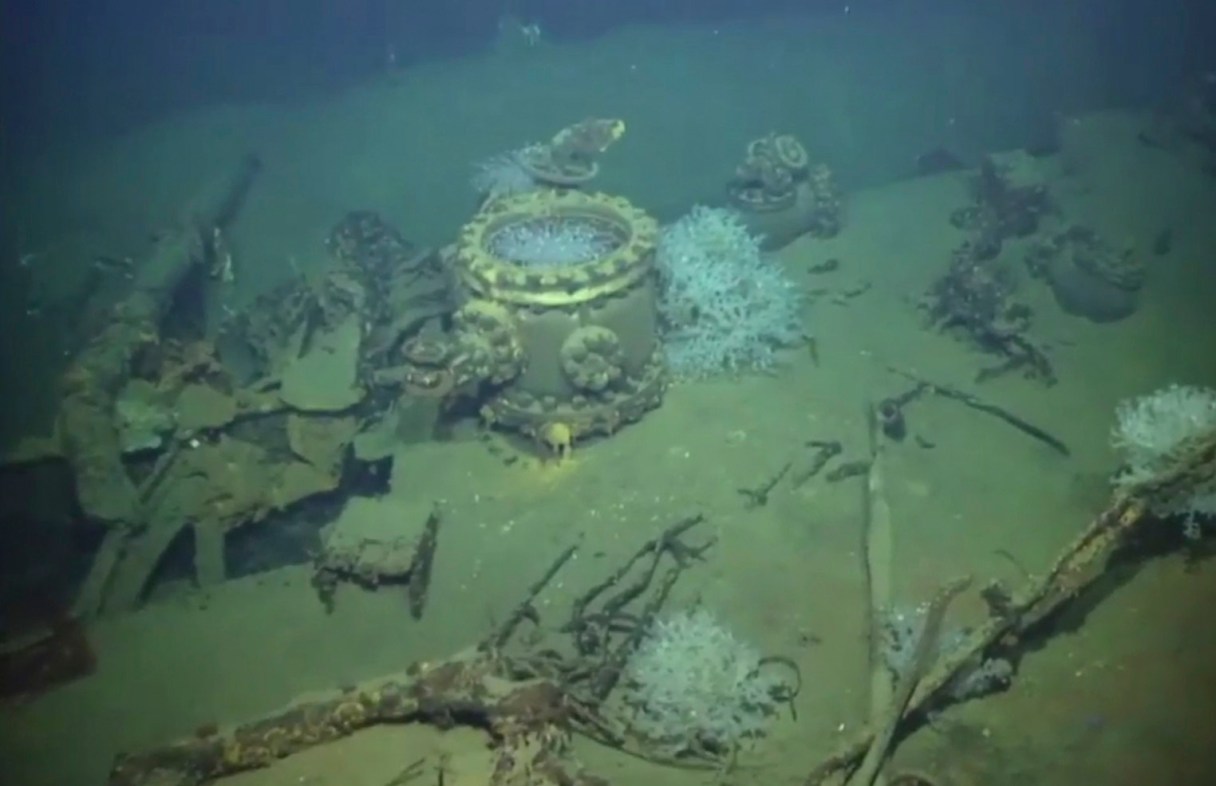
TOKYO (AP) – Debris scattered over a large area at the bottom of the sea near the Philippines indicate that the massive Japanese World War II battleship Musashi had blown up in an undersea explosion 70 years ago after it sank beneath the surface.
Experts from a research team analyzing a live feed from an unmanned submersible Friday said they believe the Musashi suffered at least one explosion while sinking to the 1,000-meter (3,280-foot) deep seafloor. The 2 ½ hour feed provided the first detailed images of the ship.
The research team, sponsored by Microsoft co-founder and entrepreneur Paul Allen, first found the remains of the ship in early March after searching for it for eight years.
The Musashi, one of Japan’s biggest and most famous battleships, sank in October 1944 in the Sibuyan Sea during the Battle of Leyte Gulf, losing half of its 2,400 crew. It was last seen disappearing into the water in one piece after being struck by torpedoes, but what happened subsequently was never known.
“The wreck is actually very damaged,” said David Mearns, a marine scientist on the team. “It appears she suffered at least one, if not two, magazine explosions which would have sheered off the bow and the stern, and its entire middle section of its super-structure.”