
Thursday, November 12, 2026Nov 12

Google’s driverless car drivers ride a career less traveled

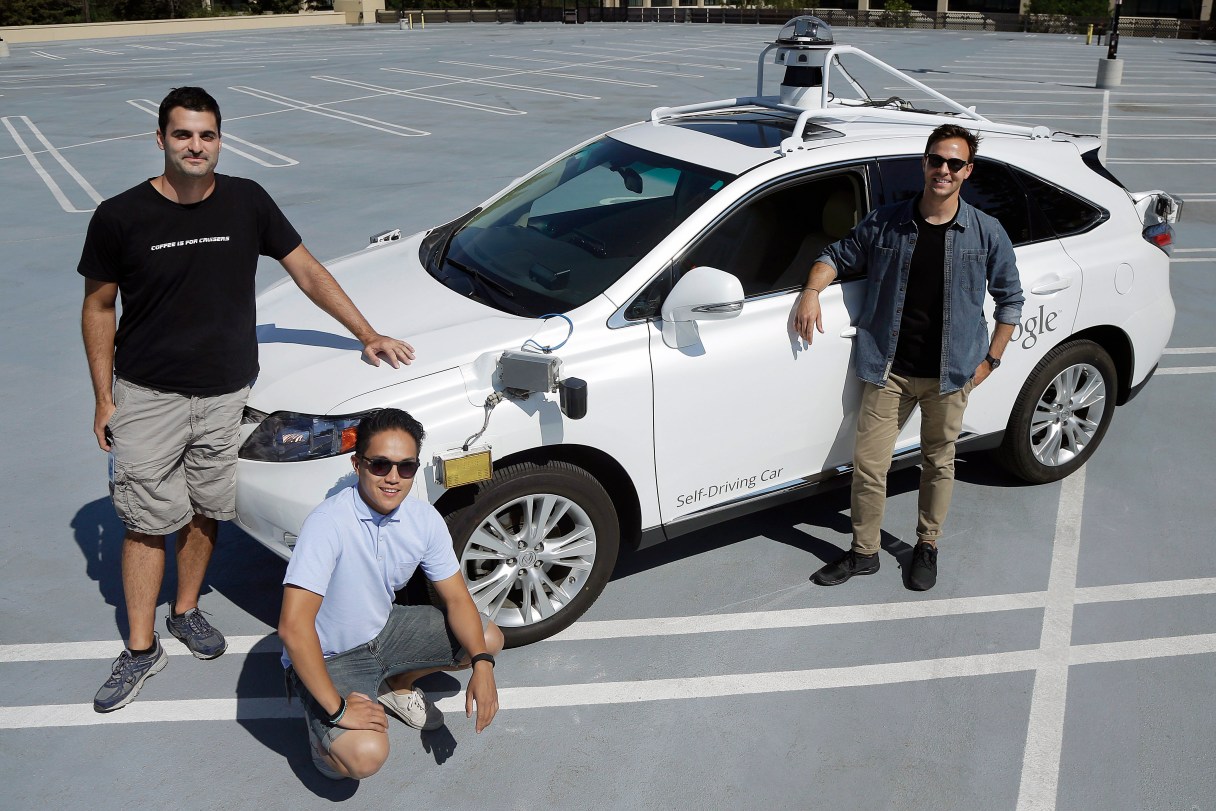
In this Monday, Aug. 24, 2015 photo, Brian Torcellini, Google team leader of driving operations, right, poses for photos with vehicle safety specialists Rob Miller, top left, and Ryan Espinosa, next to a vehicle at a Google office in Mountain View, Calif. Google employs a few dozen "safety drivers” that grab the steering wheel or hit the brakes on a fleet of robot cars that Google’s engineers are programming to navigate the roads without human assistance. (AP Photo/Jeff Chiu)
In this Monday, Aug. 24, 2015 photo, Brian Torcellini, Google team leader of driving operations, right, poses for photos with vehicle safety specialists Rob Miller, top left, and Ryan Espinosa, next to a vehicle at a Google office in Mountain View, Calif. Google employs a few dozen "safety drivers” that grab the steering wheel or hit the brakes on a fleet of robot cars that Google’s engineers are programming to navigate the roads without human assistance. (AP Photo/Jeff Chiu) In this Monday, Aug. 24, 2015 photo, Brian Torcellini, Google team leader of driving operations, right, poses for photos with vehicle safety specialists Rob Miller, top left, and Ryan Espinosa, next to a vehicle at a Google office in Mountain View, Calif. Google employs a few dozen "safety drivers” that grab the steering wheel or hit the brakes on a fleet of robot cars that Google’s engineers are programming to navigate the roads without human assistance. (AP Photo/Jeff Chiu)

MOUNTAIN VIEW, Calif. (AP) – Fresh out of college, Brian Torcellini dreamed about getting a job writing about surfing.

Instead, he wound up in a dusty, dimly lit garage near Google’s Silicon Valley headquarters six years ago, getting ready to ride a wave of technology that thrust him into an occupational oxymoron. He became a driver in a driverless car.

Torcellini, 31, now leads a crew of test, or “safety,” drivers who are legally required to ride in Google’s fleet of 48 robot cars that the Internet company’s engineers are programming to navigate the roads without human assistance.

“A lot of people go to work and sit in a cubicle,” Torcellini says. “Our cube just happens to move around the roads. And if we are successful, we are going to put ourselves out of a job.”

The driverless cars already have logged more than 2 million miles in six years of sometimes tedious testing on private tracks, highways and city streets located mostly near Google’s Mountain View, California, headquarters.