
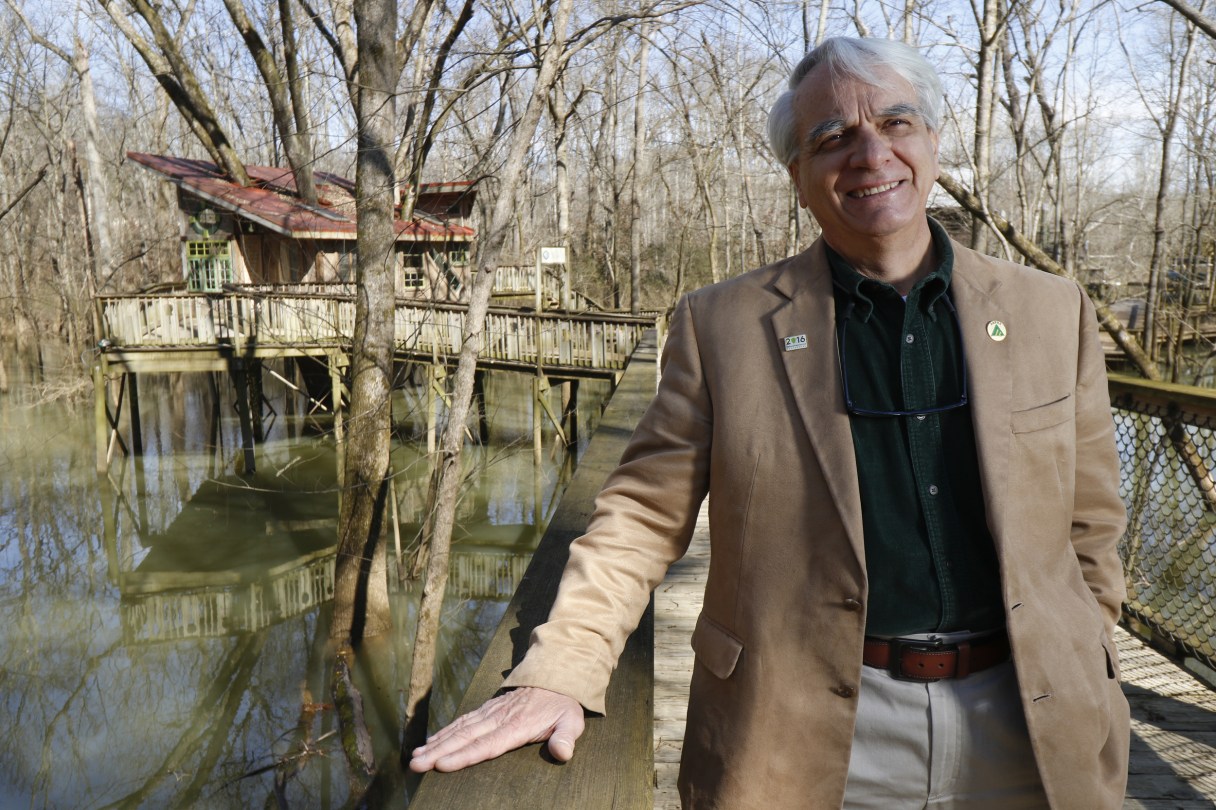
In 1972, 20-year-old Larry Zehnder landed a summer job with Cleveland, Ohio’s Metroparks District. He was a groundskeeper and it paid $2.15 an hour.
” All the grunt work went to the young people. I was on garbage can detail, picking up all the litter that people had left after a picnic,” says Zehnder.
He remembers one afternoon when his supervisor told him to empty a particular trash can at the park’s edge. Dutifully, Zehnder obliged. Inside, he found a snarling raccoon. From across the park, his supervisor chuckled.
Overall, the job had all the components to make it a terrible experience. Humidity clung to Zehnder’s brow. The sickly sweet smell of garbage hung in the air.
But, he says, “Being outside, being with wildlife it whetted my appetite for park work.”
Forty-three years later, Zehnder has crisscrossed the East Coast working for different parks departments. His experiences range from tending cemeteries to managing zoos.
In the 1990s, when he relocated to Chattanooga, he helped establish the Greenways Advisory Board, advocating for waterfront pathways to connect homes and attractions along North Chickamauga Creek, South Chickamauga Creek and Chattanooga Creek. His efforts would lead to the creation of the local branch of the Trust for Public Land, a national nonprofit which preserves land and creates parks for communities and those who will come after.
But before all that, Zehnder took a job in Athens, Tenn., as city director of recreation and park development. It was 1974 and Chattanooga was the nearest city. Sometimes on the weekend, he would make the hour-long drive.
“Chattanooga was a sleepy town back then,” he recalls. Still, he recognized the city’s outdoor potential. “[Chattanooga] just needed to be opened up to the public,” he says. And to do that, Zehnder believed the city needed to focus on three things: botanicals, wildlife and outdoor recreation.
After a prolific career – which include numerous national and regional awards and recognitions – Zehnder retired from the city of Chattanooga Parks Department in 2012. Last November, he became the executive director of Reflection Riding Arboretum and Nature Center, a nonprofit educational facility boasting 317 acres and 15 miles of trails near the base of Lookout Mountain.
Zehnder has big plans for the park. Like Chattanooga, he sees its potential – pending those same three important elements.
Botanicals
Zehnder says he has always had a penchant for gardening. While still in high school, he developed a landscaping business. In college, he studied horticulture. He still makes time to landscape his own yard, from his serpentine walkway to his vegetable garden. Now, he hopes to develop a botanical garden at Reflection Riding.
A botanical garden, Zehnder explains, is more than just beautiful flowers. It is a public garden rooted in science and education. For instance, a botanical garden might focus on species conservation or plant research.
In conjunction with Reflection Riding’s proposed gardens, Zehnder plans to host workshops and classes which might include lessons on how to sprout seeds, arrange flowers or attract important pollinators. The big picture, he says, is to connect people with their native environment. He wants to expand the arboretum’s rhododendron and Glenn Dale azalea collection, emphasize native wildflowers and plant more varieties of pines and conifers.
Wildlife
Currently, there are over 140 different tree species at Reflection Riding, helping attract local wildlife such as deer, turkey, eagles, etc. “We have 15,000 children come through every year for summer camps,” Zehnder says, which means many opportunities to teach about the important roles animals play. For example, Zehnder points to the tomato hornworm, a notorious plant-eating garden pest.
“Yes, they are creepy, and yes, I want to step on them too. But you have to understand they have a purpose,” he says. Eventually, those green caterpillars transform into the beautiful five-spotted hawk moth. Hawk moths are an important pollinator.
Moreover, those hornworms serve as a metaphor for the city itself, says Zehnder.
“Do you remember what Walter Cronkite said in 1969? He called Chattanooga the dirtiest city in America,” he says.
Outdoor Adventure
Zehnder relocated to Chattanooga 24 years after Cronkite’s decree. The city had made strides to clean itself up, but still had a long way to go. Zehnder remembers his first canoe trip down North Chickamauga Creek. It was 1993 and he and his buddy put their boat in the water at the old Hixson High School. Then, they paddled the 15 miles to Chickamauga Dam.
“It took us all day! There were so many barriers – downed trees and garbage,” Zehnder says. After that, he began to initiate creek cleanups. He asked his staff what sort of outdoor activities they enjoyed. “They couldn’t think of anything but football and softball,” he says.
When Chattanooga’s parks department began to provide resources for activities such as canoeing and climbing, Zehnder says, “It hit the mark and just exploded.”
He hopes Reflection Riding will help renew Chattanooga’s passion for adventure. Visitors can rent canoes and kayaks to paddle the bordering Lookout Creek, or stay overnight in the “Paddler’s Perch” treehouse. He’s also looking to it for a revitalization of his own. Zehnder began his career because he wanted to be outside. “Over the years, I became a bureaucrat. I wasn’t outside nearly as much. But I still like to watch other people enjoy the results of my work,” he says.
It is Zehnder’s belief that by building a healthy environment for oneself, inevitably, the community benefits too.