
Wednesday, November 11, 2026Nov 11

Ancient ice reveals vital clues about Earth’s past climate

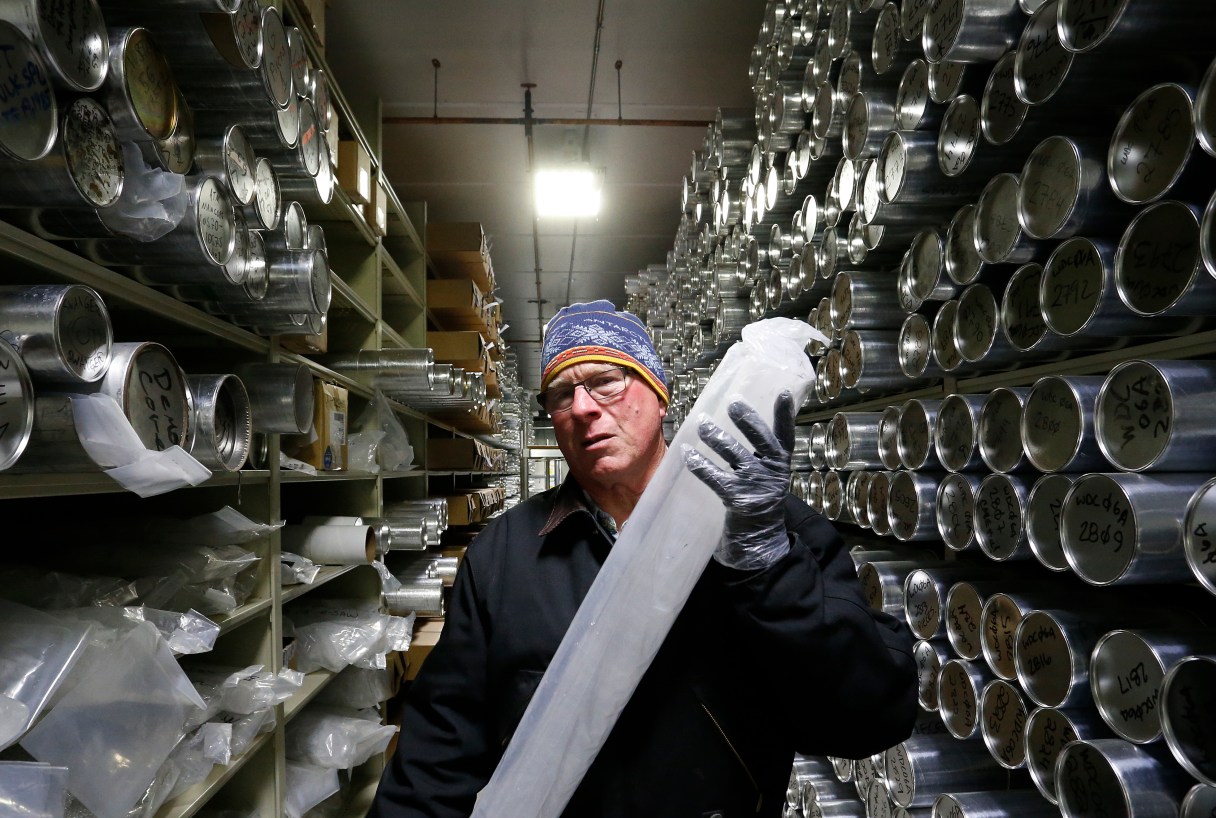
In this Aug. 8, 2016 photo, Geoffrey Hargreaves, curator of the National Ice Core Laboratory, carries an arctic ice core inside the minus-33 degree Fahrenheit environment of the lab's archive warehouse, in Lakewood, Colo. Using a wide range of data, from ice cores to trace gas analysis and other methods, scientists are attempting to measure the past and present so they can better model the near and distant future of our planet. (AP Photo/Brennan Linsley)
In this Aug. 8, 2016 photo, Geoffrey Hargreaves, curator of the National Ice Core Laboratory, carries an arctic ice core inside the minus-33 degree Fahrenheit environment of the lab's archive warehouse, in Lakewood, Colo. Using a wide range of data, from ice cores to trace gas analysis and other methods, scientists are attempting to measure the past and present so they can better model the near and distant future of our planet. (AP Photo/Brennan Linsley) In this Aug. 8, 2016 photo, Geoffrey Hargreaves, curator of the National Ice Core Laboratory, carries an arctic ice core inside the minus-33 degree Fahrenheit environment of the lab's archive warehouse, in Lakewood, Colo. Using a wide range of data, from ice cores to trace gas analysis and other methods, scientists are attempting to measure the past and present so they can better model the near and distant future of our planet. (AP Photo/Brennan Linsley)

LAKEWOOD, Colo. (AP) – Inside a huge walk-in freezer in suburban Denver, a college student in a thick parka shoots a jolt of electricity through a yard-long column of ice extracted from Antarctica.

Just outside the freezer, in a much warmer room, a computer wired to the ice registers a sudden spike in a jagged red line crawling across the screen.

“Hey, we got a volcano,” says T.J. Fudge, a University of Washington researcher. The electric current has detected a thin layer of volcanic residue in the ice, deposited by an eruption about 8,000 years ago.

This is the National Ice Core Laboratory in Lakewood, where ice pulled from the depths of Antarctica and Greenland is sliced up, photographed and tested. Most of it is shipped to other labs, where researchers do more experiments looking for clues about Earth’s past and future.

Smooth and milky white, the 4- to 5-inch-diameter pieces – called ice cores – provide scientists with a wealth of historical information, from air temperature to greenhouse gases to evidence of cosmic events. The record reaches as far back as 800,000 years.