

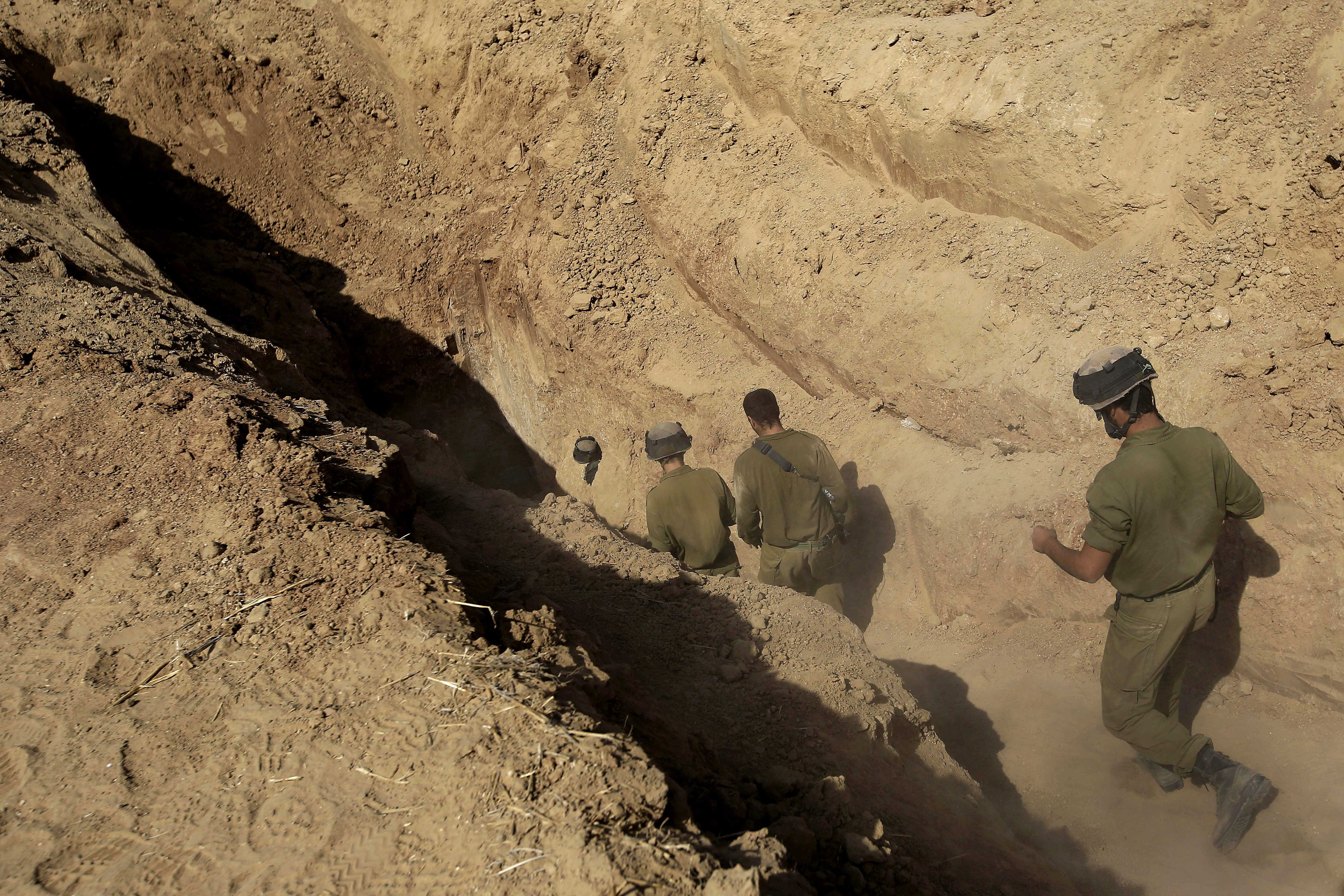
 FILE – In this Sunday, Oct. 13, 2013 file photo, Israeli soldiers enter a tunnel discovered near the Israel Gaza border. Israel’s military chief Lt. Gen. Gadi Eisenkot said Tuesday, Feb. 9, 2016, that Gaza’s Hamas rulers have been rebuilding the sophisticated network of underground tunnels that Israel damaged during the 2014 war. Eisenkot said destroying this network is the military’s top priority for 2016. (AP Photo/Tsafrir Abayov)
In December at the Brookings Saban Forum on the Middle East, Atlantic magazine reporter Jeff Goldberg asked right-wing former Israeli Foreign Minister Avigdor Lieberman this provocative question: “Things are shifting radically not only in non-Jewish America but in Jewish America as it concerns Israel and its reputation. My question is: (A) Do you care? (B) What are you going to do about it? And (C) how important is it to you?”
“To speak frankly, I don’t care,” Lieberman responded, adding that Israel lived in a dangerous neighborhood. Give Lieberman credit for honesty.
That conversation came back to me as I listened to the Democratic and Republican debates when they briefly veered into foreign policy, with candidates spouting the usual platitudes about standing with our Israeli and Sunni Arab allies. Here’s a news flash: You can retire those platitudes. Whoever becomes the next president will have to deal with a totally different Middle East.
It will be a Middle East shaped by struggle over a one-state solution, a no-state solution, a non-state solution and a rogue-state solution.
That is, a one-state solution in Israel, a no-state solution in Syria, Yemen and Libya, a non-state solution offered by the Islamic caliphate and a rogue-state solution offered by Iran.