
 Mark Wiedmer
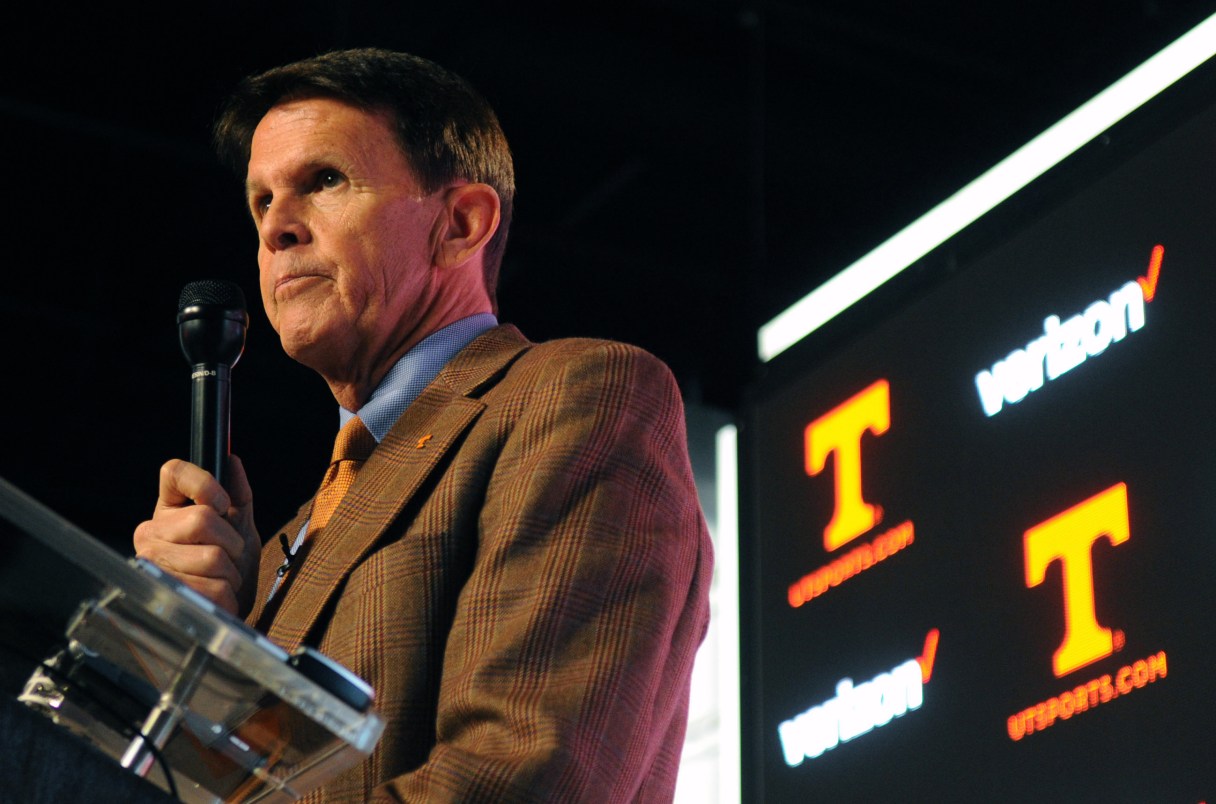
 Tennessee athletic director Dave Hart speaks during a press conference at University of Tennessee’s Ray & Lucy Hand Digital Studio in Knoxville, Tenn., on Thursday, Feb. 25, 2016. Hart stood by his embattled football coach during the news conference Thursday at the university, two weeks after a federal lawsuit was filed Feb. 9 in Nashville alleging that Tennessee mishandles assault complaints against athletes. (Adam Lau /Knoxville News Sentinel via AP) MANDATORY CREDIT
KNOXVILLE – Maybe it was the demonstrators shouting outside, the 20 or so University of Tennessee students, mostly young women, carrying signs that proclaimed “Stop UT Rape Culture.” And “End Violence On Our Campus.” And “No Means No.”
Maybe it was SEC Network pundit and UT grad Paul Finebaum’s sobering assessment of the federal lawsuit against UT involving the school’s “hostile sexual environment.”
Said Finebaum with brutal frankness Thursday morning’s “Mike & Mike” radio show: “The entire reputation of the university is at stake here. This is a federal lawsuit (and) it keeps getting bigger, it keeps getting worse. Even if it’s settled today, how are you going to scrape away these allegations?”
But whatever the reason or reasons, someone in Volsville finally seemed to get what this lawsuit is all about.
Finally.
And it wasn’t the grad assistant volleyball coach. Or the late-night custodian, though UT athletic director Dave Hart was quick to encourage folks to “talk to our custodians, talk to our clerical people,” about the culture inside the athletic department building.
But it was something else Hart said early Thursday afternoon as he dealt with a rather large and inquisitive media throng inside the athletic department’s Ray and Lucy Hand Digital Studio that offered at least a hint of humanity and hope for all past, present and future victims of sexual assault.
“I’m blessed to have a fantastic wife, two beautiful daughters and three adorable granddaughters,” he said. “I say that because I have tremendous empathy and sympathy for the alleged victims and all victims of sexual assault across the country. It is simply an unacceptable act. This has to gain the attention of everyone.”
Much to the chagrin of many in the Big Orange Nation, including the school’s 16 head coaches of varsity athletic teams, this lawsuit has gained the unwanted and unwelcome attention of rival recruiters, concerned parents of possible future students and a national media contingent who sees the world through decidedly un-Clorox Orange glasses.
Or as Finebaum added, “Right now, this university is in panic mode.”
With the rape cases of A.J. Johnson and Michael Williams scheduled for trial this summer, with new plaintiffs being added seemingly every day to the federal suit, with Wednesday night’s news that former Vol Drae Bowles is now accusing head football coach Butch Jones in the lawsuit of calling him a “traitor” for helping the alleged victim in the Johnson-Williams rape case, the UT brass might be right to panic.
But unlike the 16 coaches, including Jones, who took to a stage on Tuesday looking as if their chief aim was to model Nike garb rather than discuss their solidarity over a lawsuit that overwhelmingly targets the athletic department – Finebaum called this gathering “a SNL (Saturday Night Live) skit” – Hart spoke with reason, resolve and restraint.
“I care deeply about our student-athletes, but I also care deeply about our student body,” he said. “We encourage victims to come forward, and it is my hope that the amount of publicity that has been generated in recent days will not discourage victims from coming forward, because that’s a huge part of our collective effort. Guilty parties should be immediately dealt with and prosecuted.”
Nor did he shy away from the growing perception that football programs and the players within those programs are out of control, especially in the issue of sexual assault.
“Some of the speakers we have brought in have talked about that very thing, because some experts feel there’s maybe a link there to the very sport of football,” Hart noted. “I’m not saying that’s accurate, I’m just saying some speakers have talked candidly to our team about that. It’s a natural thing to look to.
“But it’s not about the squad size, it’s about making good choices and making good decisions and having respect for others. I think that’s a staple, that’s a common thread is teaching respect and what it really is and what it really means.”
What it really means for the UT program long-term is unknown. The Johnson and Williams trials should change the dialogue considerably, depending on how those cases turn out. Bowles’ role in the lawsuit now is certain to impact the athletic department, since Jones came forward late Wednesday to strongly deny the charge that he ever labeled the former player a traitor.
There also figures to be much focus on Bowles’ assertion that he was beaten up by teammate Curt Maggitt for having helped Johnson’s and Williams’ alleged victim.
But the far bigger, more important conclusion may become how the average female UT student feels about her safety and freedom moving forward. Does she feel threatened at every weekend party she attends, especially if football players are present? Does she worry that any misdeed by an athlete will be swept under the rug to preserve a special season?
As Finebaum noted, “I’ve seen universities sell their souls to try to win a championship,” and the football Vols will be the favorites to win the SEC East this season. And any team that wins the SEC East could conceivably be on the path to win a national championship, even if the West has been best every year since 2009.
Said protester Elizabeth Stanfield, a senior from Jackson, Tenn.: “We need a far greater commitment from the administration regarding sexual assault education. We need mandatory conferences for every student. Athletes, everyone.”
UT spokesman Karen Simsen says such a mandatory conference – in addition to a required online course in sexual assault – has been in place since 2014. But Stanfield wants something bigger and better, something capable of curbing a culture that seems out of control to too many on the outside looking in.
And while Hart readily admits that neither he nor the university is perfect in this area, he at least tried to sound like someone who understands the concerns of protesters such as Stanfield and all those alleged victims in the lawsuit labeled Jane Doe.
“Those people who make those choices (to commit sexual assault),” he said, “they need to pay the price of the disruption they’ve caused women and families who have been subjected to sexual assault.”
If Hart and the school he represents are sincere, there may still be a way to salvage the entire reputation of UT.
Contact Mark Wiedmer at mwiedmer@timesfreepress.com.