
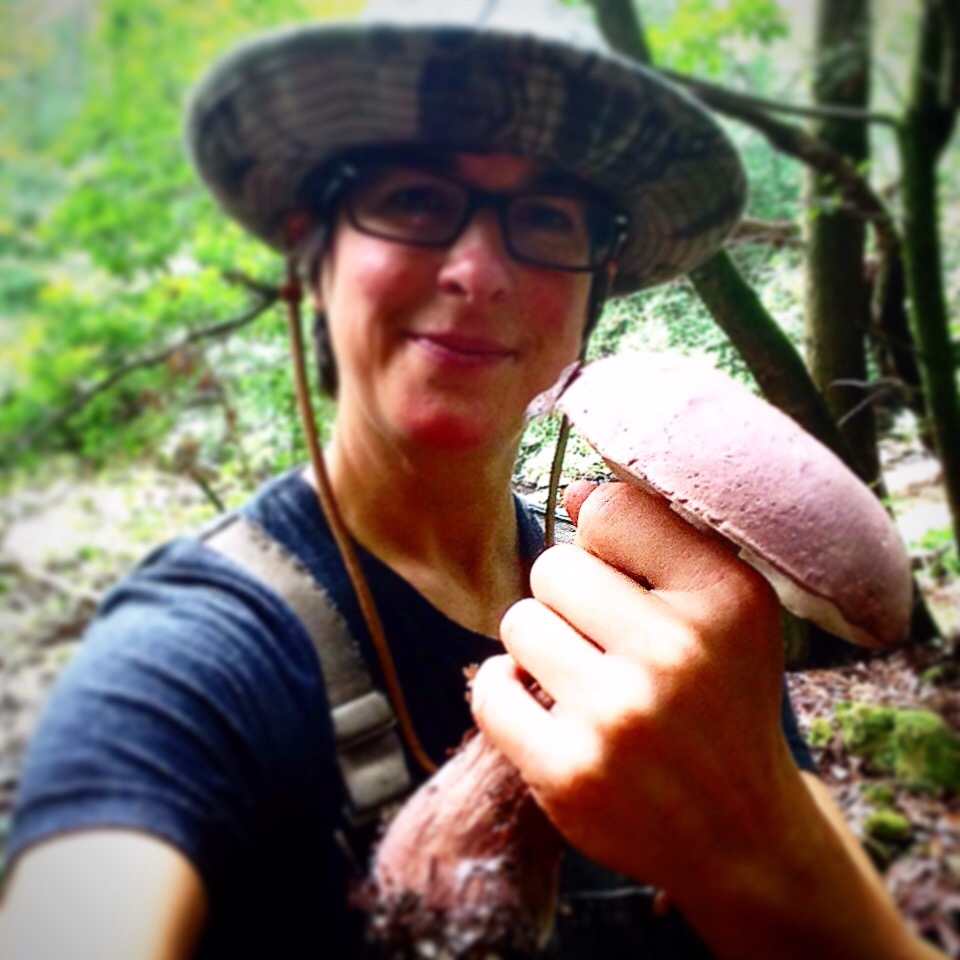
 Amy Foster poses with a massive bolete, which is common species of wild edible mushroom.
When oak leaves are the size of squirrel ears, morel season has begun.
“That’s what my dad taught me. He was a walking field guide,” says Amy Foster, who spent her childhood in forests, learning to identify species. Like her father, Foster has developed an inherent fondness for fungus.
Growing up, Foster’s family moved around a lot, living in Missouri, Nebraska, Pennsylvania and Oklahoma. Now, at age 43, Foster has settled on Signal Mountain. On a cloudy spring afternoon, she stands outside her cobblestone cabin, wearing khaki pants, a short-sleeved denim button-up and a tool belt stuffed with paper bags for mushroom collection.
“This is my poison pouch,” she says, pointing to the left side of her belt. “All questionable mushrooms go here.”
This time of year, nearly every day, Foster will scout her property for new growth. Some of the fruit she finds she sells to local restaurants like Cashew, Easy Bistro and St. John’s. Others, she keeps for herself. But her appreciation for mushrooms stems beyond simple utility.