
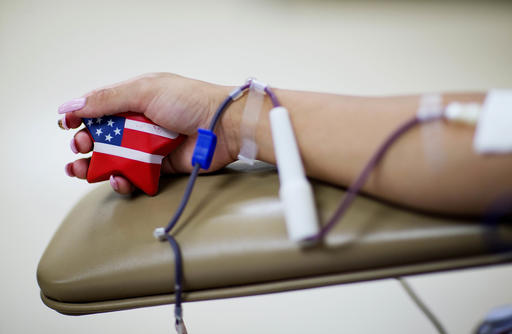
 Tatiana Osorio, of Orlando, squeezes an American-flagged themed stress ball while giving blood at the OneBlood blood center near the mass shooting at a nightclub Monday, June 13, 2016, in Orlando, Fla. Osorio lost three friends in the shooting. (AP Photo/David Goldman)
WASHINGTON – One of the manifold tragedies of the Orlando mass murder is how difficult it is for us to experience it and mourn together.
This killing lies at the intersection of so many deep emotions and personal equities: The war against terrorism. Resentment against Islam. Gay rights and pride. Gun control. Many Americans immediately claimed that the shooting justifies their pre-existing beliefs, not just about the threats to America, but about the nature of evil.
How can we possibly learn anything under these circumstances? But learning is needed. A friend refers to this type of attack as the price of living in a free society, comparing it to the situation in London during the years of IRA terror bombings. America – free and vast – is a massive soft target. But conceding that future attacks are likely is very different from viewing them as normal. In Orlando, we saw the horrifying failure of a valid expectation of security.
We should fight this. But everyone, it seems, has chosen different battlefields. It is as if, following Pearl Harbor, some had urged a campaign against Japan, others against Canada, still others against Paraguay. How can any society as polarized and politicized as our own diagnose and oppose a common threat?
This was once the role of political rhetoric – to find shared lessons and common purpose. But it is difficult, at least in this case, to imagine the unity of Dec. 8, 1941, or even Sept. 12, 2001. President Obama’s speech following the Orlando attack asserted a unity “in grief, in outrage and in resolve” but also touched on gun control themes that immediately angered many in the redder portion of his audience.