
Wednesday, November 11, 2026Nov 11

New mine brings big changes to town in Suriname rainforest

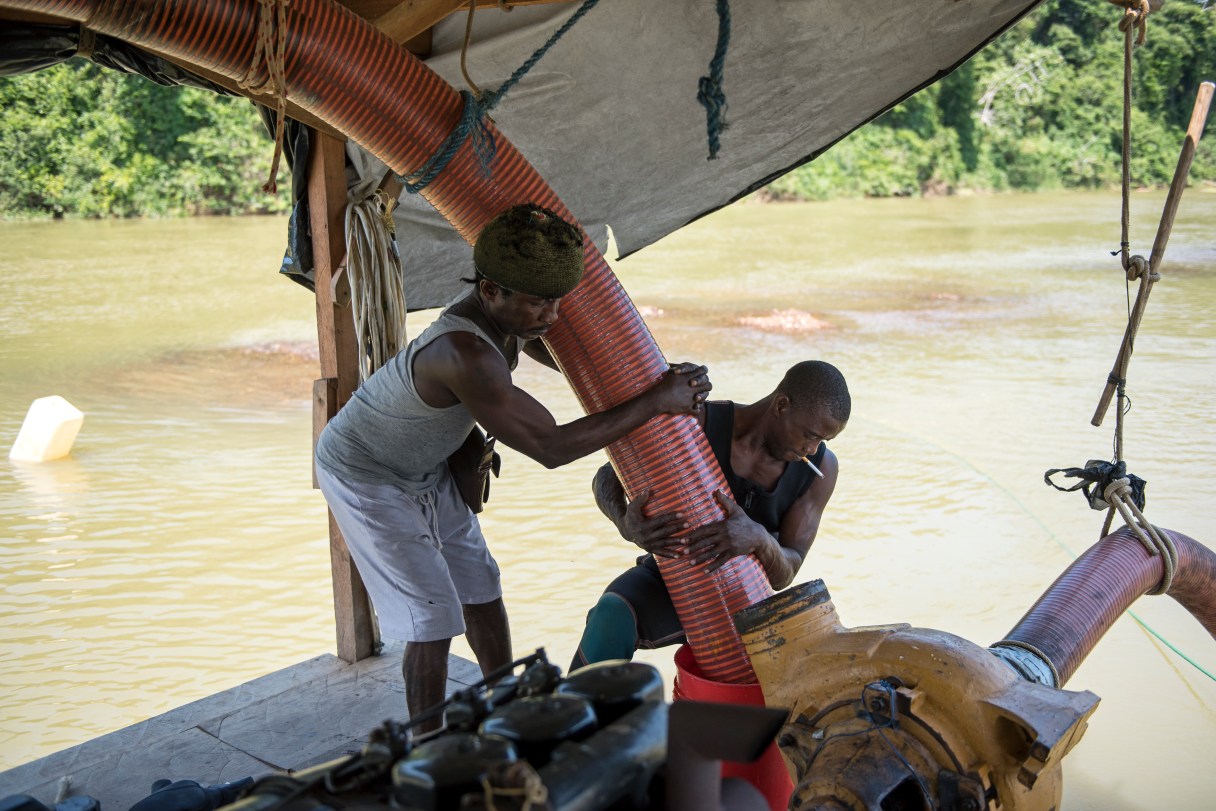
In this Oct. 30, 2016 photo, two men, both indigenous Paramaka, known as Rasta, left, and Luck, right, independent miners working on a gold pontoon on the Marowijne river near the town of Langa Tabiki set up a mining opetation. The hose they mounting is used to suck up mud from the river bottom. They say they are able to find much less gold in the river than on land. Many independent miners have left the area, leaving Langa Tabiki a ghost town. (AP Photo/Pieter Van Maele)
In this Oct. 30, 2016 photo, two men, both indigenous Paramaka, known as Rasta, left, and Luck, right, independent miners working on a gold pontoon on the Marowijne river near the town of Langa Tabiki set up a mining opetation. The hose they mounting is used to suck up mud from the river bottom. They say they are able to find much less gold in the river than on land. Many independent miners have left the area, leaving Langa Tabiki a ghost town. (AP Photo/Pieter Van Maele) In this Oct. 30, 2016 photo, two men, both indigenous Paramaka, known as Rasta, left, and Luck, right, independent miners working on a gold pontoon on the Marowijne river near the town of Langa Tabiki set up a mining opetation. The hose they mounting is used to suck up mud from the river bottom. They say they are able to find much less gold in the river than on land. Many independent miners have left the area, leaving Langa Tabiki a ghost town. (AP Photo/Pieter Van Maele)

LANGA TABIKI, Suriname (AP) – Muddy footpaths wind past empty homes, most collapsing into ruins. Dozens of stores and bars have closed. The most prominent citizen, the chief of a tribe descended from escaped African slaves, has decamped to the capital.

A gold mine operated by a U.S.-based company opened recently in the rainforest of southern Suriname, bringing hundreds of jobs and badly needed revenue to a government struggling with some of the highest inflation in the world.

But it has also emptied out the nearest community, Langa Tabiki, a small frontier town with an outsized role in the history and culture of this South American nation, one that has depended heavily on wildcat mining.

Thousands of independent miners have left the area, driven off by soldiers and private security keeping them away from the nearly 2,000 square miles (5,200 square kilometers) of forest in the “area of interest” allotted by the government to Newmont Mining Corp. Only a few stragglers remain.

“Most people have already left to other places in the country to try their luck,” said Tjamie Ceder, one of those who stayed. “Langa Tabiki, once again, has become a ghost town.”