
Wednesday, November 11, 2026Nov 11

Super big black hole from early universe farthest ever found

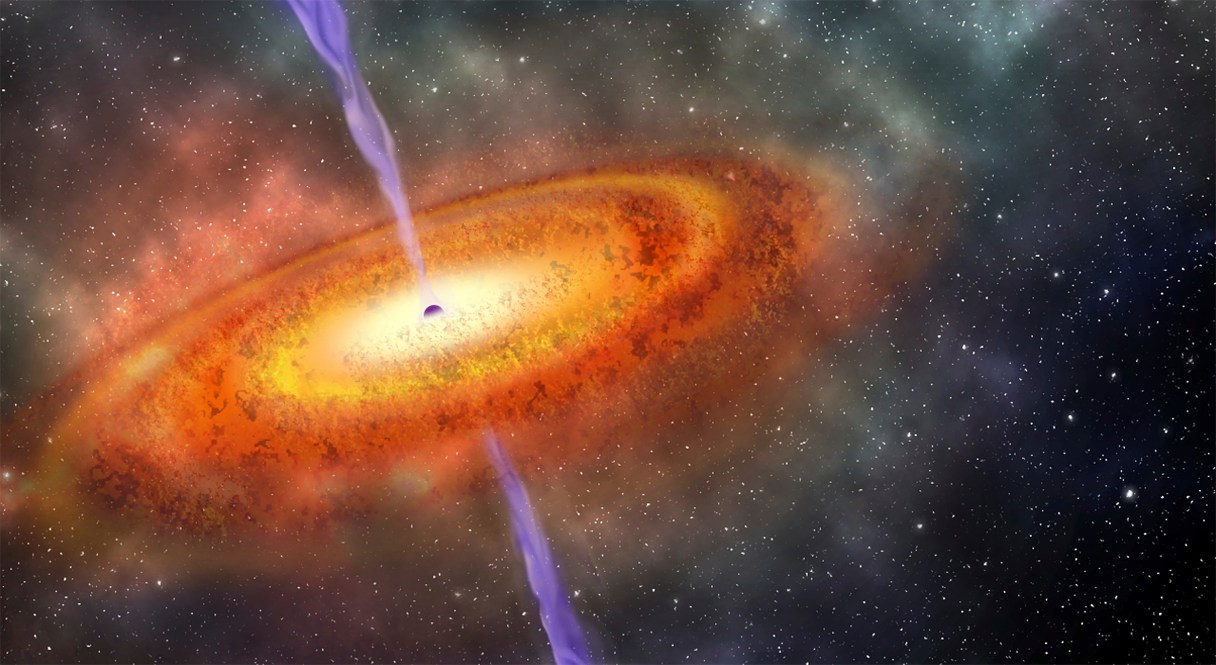
This illustration provided by the Carnegie Institution for Science shows the most-distant supermassive black hole ever discovered, which is part of a quasar from just 690 million years after the Big Bang. On Wednesday, Dec. 6, 2017, a team led by the Carnegie Observatories' Eduardo Banados reported the discovery in the journal Nature. (Robin Dienel/Carnegie Institution for Science via AP)
This illustration provided by the Carnegie Institution for Science shows the most-distant supermassive black hole ever discovered, which is part of a quasar from just 690 million years after the Big Bang. On Wednesday, Dec. 6, 2017, a team led by the Carnegie Observatories' Eduardo Banados reported the discovery in the journal Nature. (Robin Dienel/Carnegie Institution for Science via AP) This illustration provided by the Carnegie Institution for Science shows the most-distant supermassive black hole ever discovered, which is part of a quasar from just 690 million years after the Big Bang. On Wednesday, Dec. 6, 2017, a team led by the Carnegie Observatories' Eduardo Banados reported the discovery in the journal Nature. (Robin Dienel/Carnegie Institution for Science via AP)

CAPE CANAVERAL, Fla. (AP) – Astronomers have discovered a super-size black hole harkening back to almost the dawn of creation.

It’s the farthest black hole ever found.

A team led by the Carnegie Observatories’ Eduardo Banados reported in the journal Nature on Wednesday that the black hole lies in a quasar dating to 690 million years of the Big Bang. That means the light from this quasar has been traveling our way for more than 13 billion years.

Banados said the quasar provides a unique baby picture of the universe, when it was just 5 percent of its current age.

It would be like seeing photos of a 50-year-old man when he was 2 1/2 years old, according to Banados.