
Thursday, October 29, 2026Oct 29

This story is free to read.

Biggest explosion seen in universe came from black hole

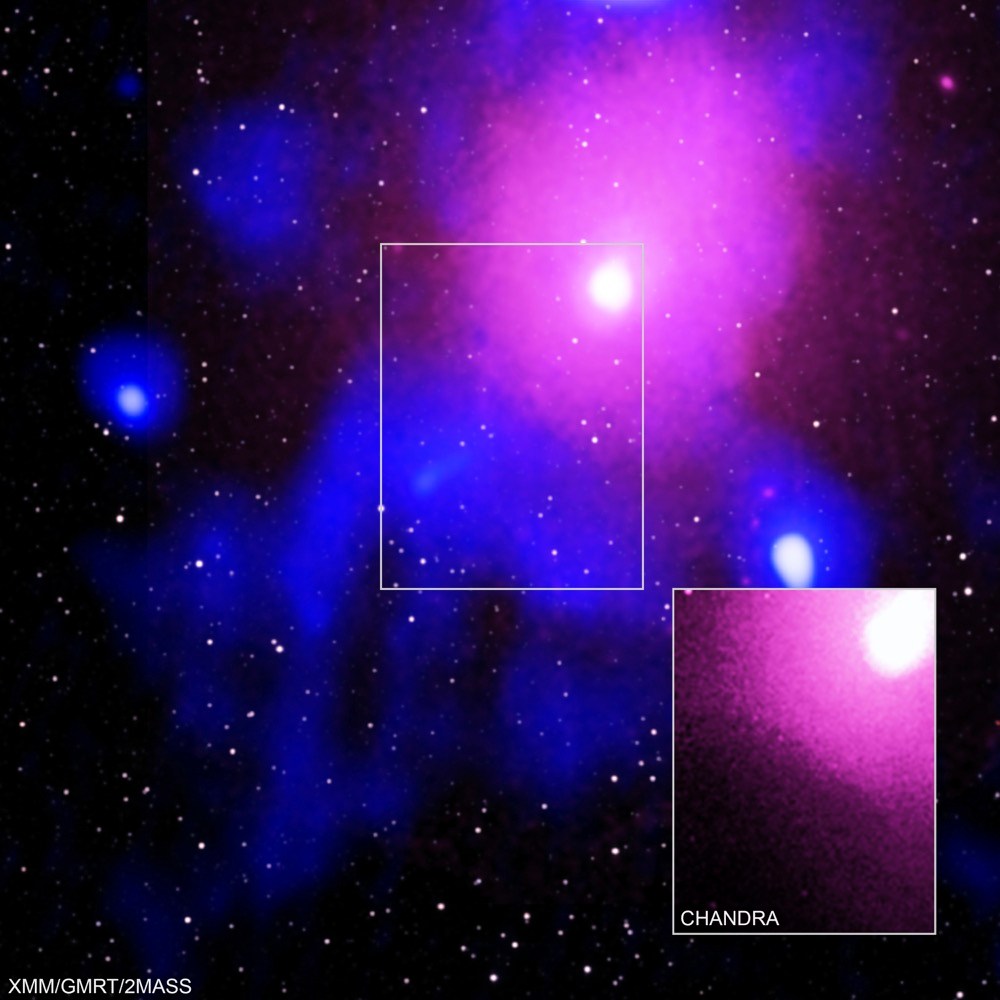
This image made available by NASA on Thursday, Feb. 27, 2020 shows the Ophiuchus galaxy cluster viewed in a composite of X-ray, radio and infrared data. The inset image at bottom right shows data from the Chandra X-ray Observatory which confirmed a cavity formed by a record-breaking explosion from a super-massive black hole. The explosion was so large it carved out a crater in the hot gas that could hold 15 Milky Ways, said lead author Simona Giacintucci of the Naval Research Laboratory in Washington. (Chandra: NASA/CXC/NRL/S. Giacintucci, et al., XMM: ESA/XMM; Radio: NCRA/TIFR/GMRT; Infrared: 2MASS/UMass/IPAC-Caltech/NASA/NSF via AP)
This image made available by NASA on Thursday, Feb. 27, 2020 shows the Ophiuchus galaxy cluster viewed in a composite of X-ray, radio and infrared data. The inset image at bottom right shows data from the Chandra X-ray Observatory which confirmed a cavity formed by a record-breaking explosion from a super-massive black hole. The explosion was so large it carved out a crater in the hot gas that could hold 15 Milky Ways, said lead author Simona Giacintucci of the Naval Research Laboratory in Washington. (Chandra: NASA/CXC/NRL/S. Giacintucci, et al., XMM: ESA/XMM; Radio: NCRA/TIFR/GMRT; Infrared: 2MASS/UMass/IPAC-Caltech/NASA/NSF via AP) This image made available by NASA on Thursday, Feb. 27, 2020 shows the Ophiuchus galaxy cluster viewed in a composite of X-ray, radio and infrared data. The inset image at bottom right shows data from the Chandra X-ray Observatory which confirmed a cavity formed by a record-breaking explosion from a super-massive black hole. The explosion was so large it carved out a crater in the hot gas that could hold 15 Milky Ways, said lead author Simona Giacintucci of the Naval Research Laboratory in Washington. (Chandra: NASA/CXC/NRL/S. Giacintucci, et al., XMM: ESA/XMM; Radio: NCRA/TIFR/GMRT; Infrared: 2MASS/UMass/IPAC-Caltech/NASA/NSF via AP)

CAPE CANAVERAL, Fla. (AP) – Astronomers have discovered the biggest explosion seen in the universe, originating from a super-massive black hole.

Scientists reported Thursday that the blast came from a black hole in a cluster of galaxies 390 million light-years away.

The explosion was so large it carved out a crater in the hot gas that could hold 15 Milky Ways, said lead author Simona Giacintucci of the Naval Research Laboratory in Washington.

It’s five times bigger than the previous record-holder.

Astronomers used NASA’s Chandra X-Ray Observatory to make the discovery, along with a European space observatory and ground telescopes. They believe the explosion came from the heart of the Ophiuchus cluster of thousands of galaxies: a large galaxy at the center contains a colossal black hole.