
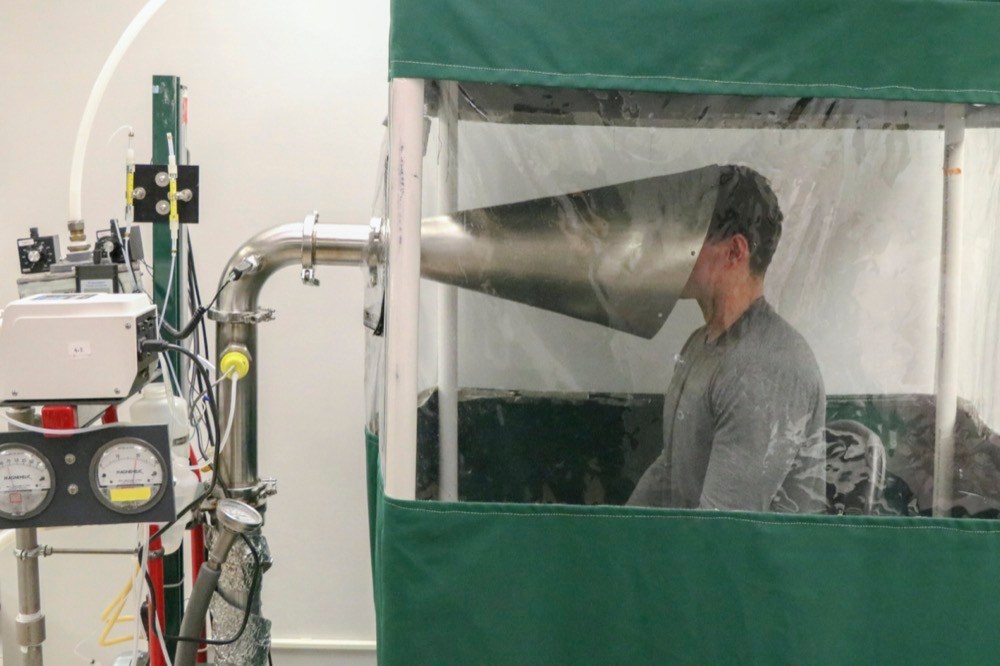
NEW YORK (AP) – At a University of Maryland lab, people infected with the new coronavirus take turns sitting in a chair and putting their faces into the big end of a large cone. They recite the alphabet and sing or just sit quietly for a half hour. Sometimes they cough.
The cone sucks up everything that comes out of their mouths and noses. It’s part of a device called “Gesundheit II” that is helping scientists study a big question: Just how does the virus that causes COVID-19 spread from one person to another?
It clearly hitchhikes on small liquid particles sprayed out by an infected person. People expel particles while coughing, sneezing, singing, shouting, talking and even breathing. But the drops come in a wide range of sizes, and scientists are trying to pin down how risky the various kinds are.
The answer affects what we should all be doing to avoid getting sick. That’s why it was thrust into headlines a few days ago when a U.S. health agency appeared to have shifted its position on the issue, but later said it had published new language in error.
The recommendation to stay at least 6 feet (2 meters) apart – some authorities cite about half that distance – is based on the idea that larger particles fall to the ground before they can travel very far. They are like the droplets in a spritz of a window cleaner, and they can infect somebody by landing on their nose, mouth or eyes, or maybe being inhaled.