
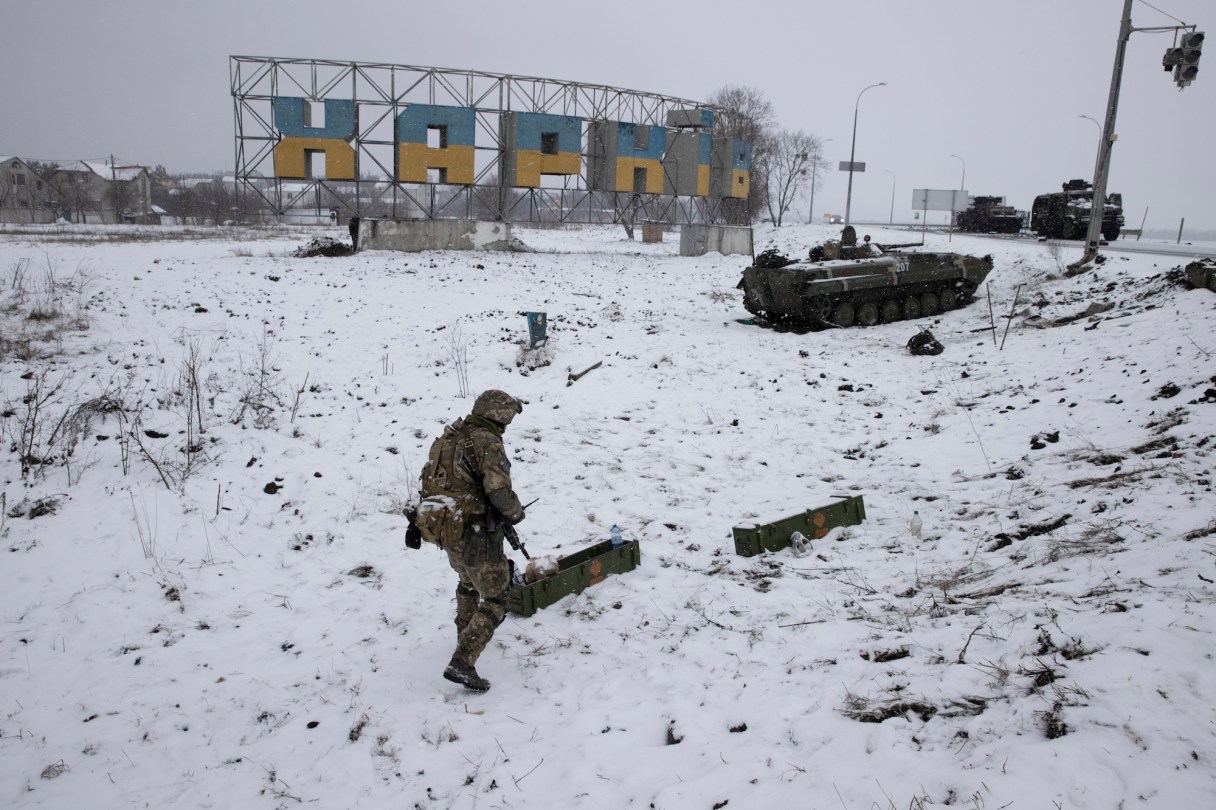
Vladimir Putin’s full-scale invasion of Ukraine is advancing from the east, the south and toward Kyiv in the north. As fighting raged on Thursday, President Joe Biden ordered a harsh round of sanctions, and a fateful new East-West struggle is underway with no indication of where it might lead or how long it might last.
It is imperative to state clearly that none of the pretext for war that Putin churned out in recent days and weeks contained much truth or any justification whatsoever for waging war on a weaker neighbor. This is a war of choice for all the wrong reasons, and Putin and his coterie are solely and fully responsible for every drop of Ukrainian – and Russian – blood, for every livelihood destroyed and for all the economic pain engendered by this conflict.
It is also important to acknowledge that no one, save possibly Putin, has any idea what will happen in coming days, weeks, months and possibly even years. The Russian president said he had no intention of occupying Ukraine, yet he intends to oust its leadership and round up his enemies. But what does that mean? How did he intend to plant a puppet regime without seizing Kyiv, or to kidnap people without taking the whole country? How long does he intend to occupy the country?
Does the United States or its allies and friends have the levers, and the will, to punish Russia sufficiently to stymie Putin’s ambitions? In announcing new sanctions, trade restrictions and measures against Russian oligarchs, Biden said they would impose “severe costs” on the Russian economy “both immediately and over time.” But while a serious fall in the Russian currency and stock market suggest this could be so, the sanctions also demonstrated the limitations of what the West has done so far.
Biden announced sanctions on several large Russian banks, major state-owned enterprises and Putin’s lieutenants, and restrictions on high-tech exports to Russia. Those had all been threatened over many weeks. That the threat failed to deter Putin indicates that he was prepared to absorb the costs, and to wait and see whether the West could do the same.