
Thursday, October 29, 2026Oct 29

This story is free to read.

Nobel Prize for 3 chemists who made molecules ‘click’

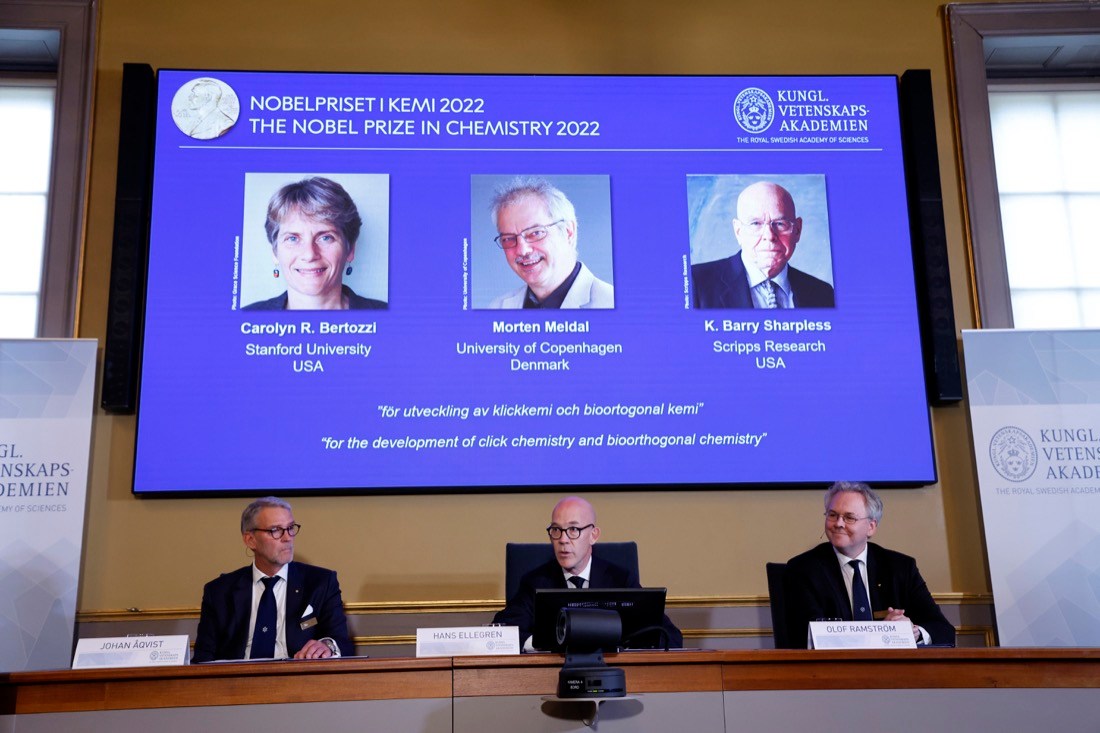
Secretary General of the Royal Swedish Academy of Sciences Hans Ellegren, centre, Jonas Aqvist, Chairman of the Nobel Committee for Chemistry, left, and Olof Ramstrom, member of the Nobel Committee for Chemistry announce the winners of the 2022 Nobel Prize in Chemistry during a press conference at the Royal Swedish Academy of Sciences in Stockholm, Sweden, Wednesday, Oct. 5, 2022. The winners of the 2022 Nobel Prize in chemistry are Caroline R. Bertozzi of the United States, Morten Meldal of Denmark and K. Barry Sharpless of the United States. (Christine Olsson /TT News Agency via AP)
Secretary General of the Royal Swedish Academy of Sciences Hans Ellegren, centre, Jonas Aqvist, Chairman of the Nobel Committee for Chemistry, left, and Olof Ramstrom, member of the Nobel Committee for Chemistry announce the winners of the 2022 Nobel Prize in Chemistry during a press conference at the Royal Swedish Academy of Sciences in Stockholm, Sweden, Wednesday, Oct. 5, 2022. The winners of the 2022 Nobel Prize in chemistry are Caroline R. Bertozzi of the United States, Morten Meldal of Denmark and K. Barry Sharpless of the United States. (Christine Olsson /TT News Agency via AP) Secretary General of the Royal Swedish Academy of Sciences Hans Ellegren, centre, Jonas Aqvist, Chairman of the Nobel Committee for Chemistry, left, and Olof Ramstrom, member of the Nobel Committee for Chemistry announce the winners of the 2022 Nobel Prize in Chemistry during a press conference at the Royal Swedish Academy of Sciences in Stockholm, Sweden, Wednesday, Oct. 5, 2022. The winners of the 2022 Nobel Prize in chemistry are Caroline R. Bertozzi of the United States, Morten Meldal of Denmark and K. Barry Sharpless of the United States. (Christine Olsson /TT News Agency via AP)

STOCKHOLM (AP) — Three scientists were jointly awarded this year’s Nobel Prize in chemistry on Wednesday for developing a way of “snapping molecules together” that can be used to design better medicines, including ones that target diseases such as cancer more precisely.

Americans Carolyn R. Bertozzi and K. Barry Sharpless, and Danish scientist Morten Meldal were cited for their work on click chemistry and bioorthogonal reactions, which are used to make cancer drugs, map DNA and create materials that are tailored to a specific purpose.

“It’s all about snapping molecules together,” said Johan Aqvist, a member of the Royal Swedish Academy of Sciences that announced the winners at the Karolinska Institute in Stockholm.

Sharpless, 81, who previously won a Nobel Prize in 2001 and is now the fifth person to receive the award twice, first proposed the idea of connecting molecules using chemical “buckles” around the turn of the millennium, Aqvist said.

“The problem was to find good chemical buckles,” he said. “They have to react with each other easily and specifically.”