

Three Hamilton County Schools received F’s and 14 earned A’s under a new formula Tennessee used to give its first-ever letter grades to every public school, according to data released Thursday.
When asked how the district would handle conversations with parents whose schools received a low score, Deputy Superintendent Sonia Stewart has said district officials need to go back to their values.
District officials have frequently expressed their support for evaluating schools through a balance between proficiency and growth. Proficiency looks at the number of students who met state standards, while growth examines how much students learned compared to where they started.
“We have to talk about the (letter grade) D because the state is going to tell us about the D,” Stewart said during an interviewing advance of the release of the grades. “What our community expects from us right now is that our kids would be growing in achievement, that they would be growing in growth, that there would be these other indicators that we’re measuring and that those things would give a comprehensive understanding of how they’re being educated.
“We are going to continue to push a conversation that says, ‘Hey everybody, we’re not looking at just this one thing, right. We’re looking at these things collectively, and this is how we can assess a school and how we want you to be able to assess a school.'”
(READ MORE: Tennessee outlines new school letter grading system, district officials respond)
The 20 schools in Hamilton County that received D’s or F’s tended to have both low growth and low achievement scores. The lowest performing students at these schools also consistently showed the same or more academic growth than the school as a whole.
Background
The letter grades were first supposed to be assigned in 2018, but online testing problems followed by pandemic-related disruptions caused the state to repeatedly push back its rollout date. This fall, Education Commissioner Lizzette Reynolds launched a process to revamp the grading formula.
As required by law, the newly released letter grade model considers academic proficiency and student growth. It also weighs the growth of the lowest performing quartile of students. For high schools, the model also considers college and career readiness, which is calculated through the percentage of graduates who meet one of several achievements based on ACT scores, postsecondary credits or industry credentials.
School letter grade weights and indicators
Elementary and middle school
— Achievement: 50%.
— Growth: 40%.
— Growth of lowest-performing students: 10%.
High school
— Achievement: 50%.
— Growth: 30%..
— Growth of lowest-performing students: 10%.
— College and career readiness: 10%.
Source: Tennessee Department of Education
Proponents of the system say letter grades provide families with a clear rating to see how their school is performing.
In the lead-up to the letter grades’ release, Hamilton County Schools officials have criticized the state’s new formula and expressed support for the previous accountability model that was never used to issue letter grades, which also offered a growth pathway for demonstrating achievement.
Superintendent Justin Robertson has told school board members the grades will likely arouse a lot of emotions for families, which may then be used to try to say public schools are not serving students well.
“I don’t think it’s a coincidence that the year we finally decide to publish letter grades for public schools is the same year that we’re going to push through a school voucher program statewide when we have zero evidence to support its effectiveness,” he said.
In a statement Thursday, the district reiterated its concerns with the formula.
“Hamilton County Schools appreciates the state’s commitment to transparency and accountability for the work taking place in our public schools. However, we have concerns with the recently crafted way these grades were calculated,” district spokesperson Steve Doremus said by email. “It is our belief that these grades do not accurately reflect the progress being made in our classrooms and schools.”
The district touted the academic growth score of five, the highest possible score from the Tennessee Value-Added Assessment System, it received earlier this year, as well as its increased academic proficiency rates.
“Our focus as a school district will remain on helping all students thrive and experience a future without limits by providing opportunities that meet their needs and help them progress along their educational journeys,” Doremus said.
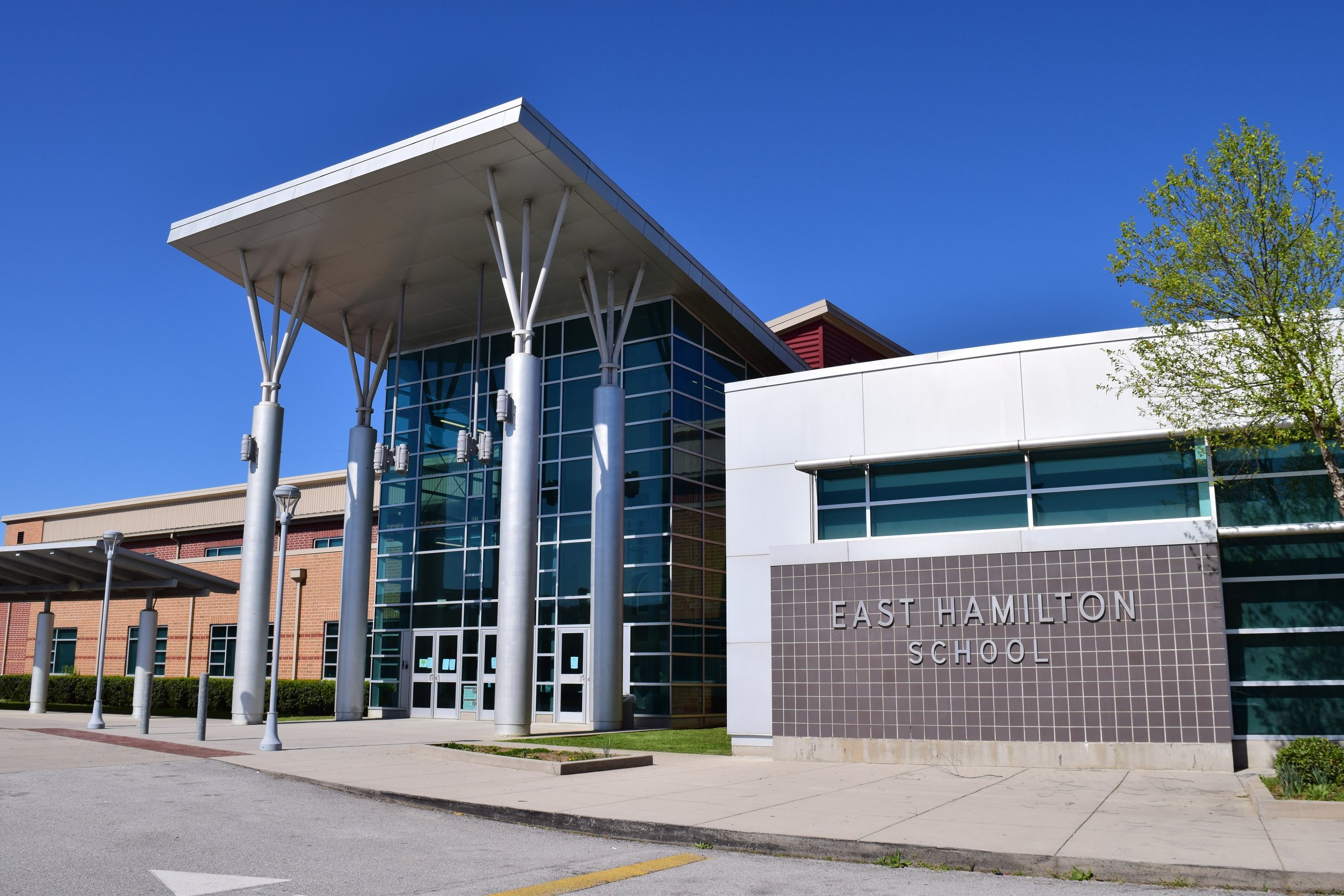 Staff Photo by Robin Rudd / East Hamilton High School, as photographed in 2020, was one of 14 district schools to receive an A letter grade.
Examining the data
Of the 78 Hamilton County schools ― including charter schools ― that received letter grades, 14 received A’s, 23 received B’s, 21 received C’s, 17 received D’s and three received F’s.
These grades roughly mirror the distribution of letter grades across the state.
In Hamilton County, schools that earned an A had top growth and achievement scores. Many of the schools that received a C had either a high growth and low achievement score or the opposite, while others met state targets for both.
Ahead of the release, critics of the new formula said its emphasis on absolute achievement could produce grades that are correlated with each school’s income level, rather than demonstrate what is happening within individual schools. Achievement is correlated with the percent of a school’s students who are economically disadvantaged, state data shows.
In Hamilton County, the 15 district schools with the lowest percentage of economically disadvantaged students during the 2021-22 school year all received A’s or B’s. On the flip side, one of the 15 schools with the highest percentage of low-income students received a score above a C.
Chattanooga Charter School of Excellence High, Ivy Academy’s Skillern Elementary and Montessori Elementary at Highland Park were ineligible for letter grades because of their size.
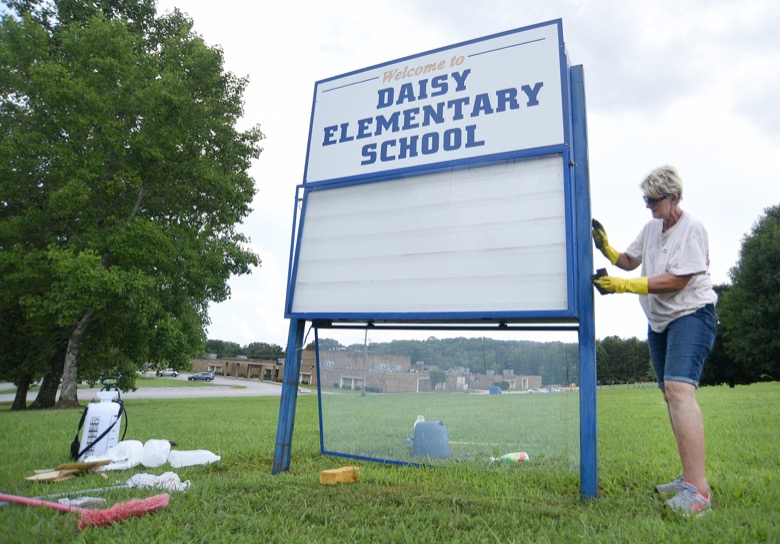 Staff photo by Matt Hamilton / School Board Member Rhonda Thurman, R-Hixson, cleans the sign outside Daisy Elementary School before adding a fresh layer of paint Aug. 2. Daisy Elementary was one of 14 district schools to receive an A letter grade.
Southeast Tennessee
Of the 110 other schools in Southeast Tennessee that received letter grades, few got an A, most earned a B or C and one, in Coffee County, received an F.
In several of these districts — including Bledsoe County Schools, Rhea County Schools and Sequatchie County Schools — no school earned a score below a C.
In others — such as Cleveland City Schools, Franklin County Schools and McMinn County Schools — at least a third of the district’s schools received a D.
More information about each school’s letter grade can be found on the Tennessee Department of Education’s website.
Contact Shannon Coan at scoan@timesfreepress.com or 423-757-6396.